Persimmon Tree: How To Grow American And Asian Persimmons
On this page
- Persimmon Tree Growing Guide For Home Gardens
- American Vs Asian Persimmons
- Persimmon Climate And Cold Hardiness
- Which Persimmon Fits Your Zone?
- Astringent Vs Non-Astringent Persimmons
- Best Persimmon Varieties For Home Growers
- Persimmon Pollination And Seedless Fruit
- How To Plant A Persimmon Tree
- Watering And Fertilizing Persimmons
- Pruning And Training A Persimmon Tree
- Why Persimmon Trees Drop Their Fruit
- Persimmon Pests And Diseases
- Harvesting, Ripening And Removing Astringency
- Persimmon Tree FAQs
Persimmon Tree Growing Guide For Home Gardens
Two persimmon species are grown for fruit in American yards. The American persimmon (Diospyros virginiana) is a tall native tree that survives deep winter cold and bears small, intensely sweet fruit. The Asian persimmon (Diospyros kaki), also called Japanese or Oriental persimmon, is a smaller tree with fruit the size of a peach or larger, and it needs milder winters.
Both are deciduous, both color brilliantly in fall and both hold their orange fruit on bare branches after the leaves drop. They are also easy keepers, with few serious pests and little pruning. The hard parts are choosing the right species for your winters and knowing when the fruit is ready to eat.
The guidance below draws on University of Georgia, NC State, University of Tennessee, University of Florida IFAS, University of Wisconsin, Virginia Tech and Florida Department of Agriculture sources.
American Vs Asian Persimmons
The two species look alike in leaf, but they behave very differently in the garden.
| Trait | American persimmon | Asian persimmon |
|---|---|---|
| Botanical name | Diospyros virginiana | Diospyros kaki |
| Origin | Native from Connecticut to Florida and west to Iowa and Texas | East Asia; long cultivated in China, Japan and Korea |
| Winter cold | Survives about 20 to 25°F below zero | Injured or killed below about 10°F |
| Tree size | 30 to 50 feet or more, spread 20 to 35 feet | 20 to 30 feet; some stay near 10 feet |
| Fruit size | 1 to 2 inches across | 2 to 4 inches across |
| Astringency | Astringent until fully soft | Astringent or non-astringent, by variety |
| Pollination | Usually separate male and female trees | Many varieties set seedless fruit without pollen |
| Main use | Pulp for puddings, breads and preserves | Fresh eating, drying and baking |
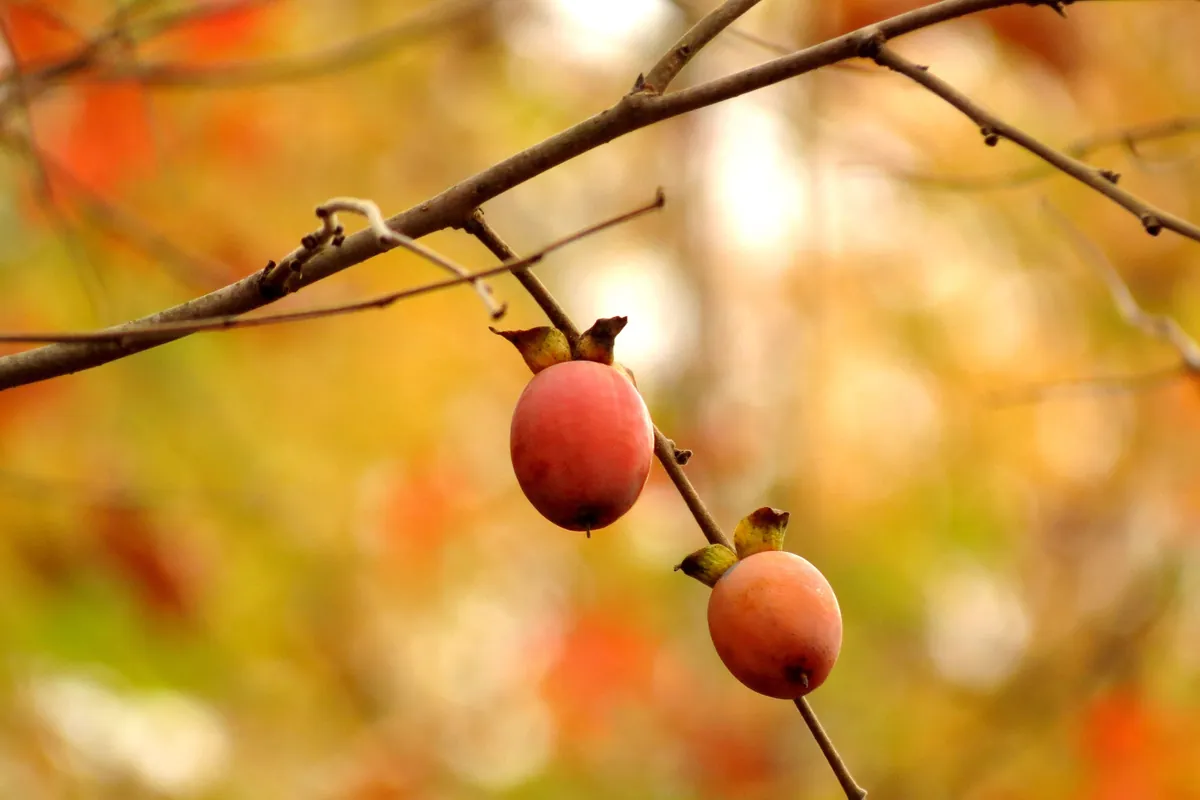
American fruit is mostly processed into pulp, because the skin of wild fruit stays tannic. Improved American varieties have larger fruit, fewer seeds and milder skins.
A small group of hybrids crosses the two species. Native and Asian persimmons do not pollinate each other, so you cannot get hybrid fruit just by planting both.
Persimmon Climate And Cold Hardiness
Your winter low decides which persimmon you can grow. The NC State Extension plant profile for American persimmon lists it for USDA zones 4 to 9, and both the University of Georgia and NC State report that native trees survive 20 to 25°F below zero without obvious injury. Asian persimmons are mostly rated for zones 7 to 10, with a few varieties listed for zone 6, according to the University of Tennessee.
How Much Cold An Asian Persimmon Can Take
NC State and the University of Georgia both warn that Asian persimmons may be injured or killed below about 10°F. The University of Georgia notes that a few Chinese types grafted on native rootstock, such as Great Wall, Peping and Sheng, have been hardy to 0°F.
Summer Heat And Spring Frost
Persimmons need a long, warm season to ripen. The University of Wisconsin notes that American persimmons can survive zone 4 winters, but fruit may fail to ripen there before winter returns. Bloom comes late, around mid-April in North Carolina, so flowers usually escape the worst spring frosts. A slightly raised planting site, rather than a low hollow, helps the tree dodge late cold air that settles in low ground.
Which Persimmon Fits Your Zone?
Use your coldest winter temperature, then your summer length, to choose a species.
| Your zone | Best choice | Varieties to try | Main risk |
|---|---|---|---|
| 4 to 5 | American persimmon | Meader, local improved selections | Short season; fruit may not ripen |
| 6 | American or hybrid; Asian only in a sheltered spot | Meader, John Rick, Nikita’s Gift, Saijo | Winter dieback on Asian trees, frosted hybrid blooms |
| 7 | Asian on American rootstock, or American | Fuyu, Jiro, Saijo, Hachiya | Cold snaps below 10°F |
| 8 to 9 | Asian persimmon | Fuyu, Jiro, Hachiya, Izu | Fruit drop in drought, leaf spot in humid areas |
| 10 | Asian persimmon; test locally | Fuyu, Hachiya | Fungal leaf spots in humid areas |
Astringent Vs Non-Astringent Persimmons
Unripe persimmons are loaded with soluble tannins that make the mouth feel dry and furry. How the fruit loses those tannins splits every variety into two groups.
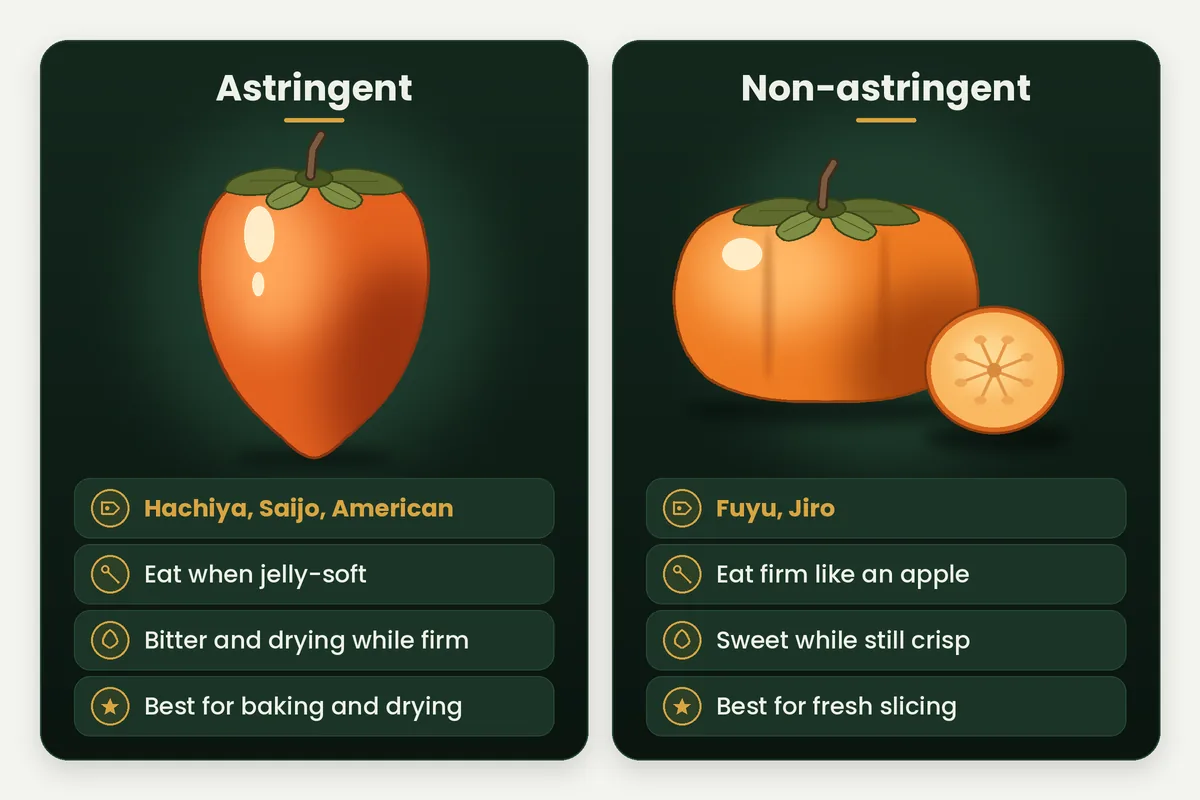
Astringent persimmons must be completely soft before you eat them. Hachiya, Saijo and every American persimmon fall in this group. Ripened until the flesh feels like a water balloon, they turn sweet and custardy.
Non-astringent persimmons, led by Fuyu and Jiro, lose their tannins on the tree. You can eat them crisp, sliced like an apple, or let them soften further. The University of Georgia notes that Fuyu and Jiro can be eaten firm with little astringency.
Pollination-Constant And Pollination-Variant Types
Nurseries sometimes split these groups again. In pollination-constant varieties, such as Fuyu and Jiro, the flesh stays the same whether or not the fruit has seeds. In pollination-variant varieties, seeded fruit develops dark, streaked flesh around the seeds, and University of Florida IFAS notes that some of these types must be fully seeded to lose their astringency. If a label simply says “non-astringent,” it usually means a pollination-constant type that is safe to eat firm every year.
Best Persimmon Varieties For Home Growers
Pick a species for your winters first, then choose between astringent and non-astringent fruit.
| Variety | Type | Fruit | Eat when | Notes |
|---|---|---|---|---|
| Fuyu | Asian | Medium to large, flat, red-orange | Firm or soft | Popular non-astringent type; ripens October to November |
| Jiro | Asian | Medium to large, flat, red-orange | Firm or soft | Non-astringent; Ichikikei Jiro is compact and can set seedless crops |
| Hachiya | Asian | Medium to large, oblong, pointed | Jelly-soft | Astringent; sets seedless fruit; preferred for baking |
| Saijo | Asian | Medium, egg-shaped | Jelly-soft | Astringent and very sweet; one of the hardier Asian types |
| Meader | American | Small, orange | Fully soft | Reliably self-fertile; survives at least 25°F below zero |
| Prok | American | Small, orange | Fully soft | Sold as a self-pollinating native variety |
| John Rick | American | Medium, firm | Fully soft | Productive, with excellent flavor and firm fruit |
| Nikita’s Gift | Hybrid | Reddish-orange | Soft | American and Asian cross from Ukraine; rated to about 10°F below zero |
Fuyu is the safest first tree for zones 7 to 9 because you can eat it firm, and University of Florida IFAS calls it the most widely grown variety in that state. Hachiya is the classic astringent persimmon for baking and drying. Saijo is often listed by nurseries for zone 6, which makes it a common pick for growers on the edge of the Asian persimmon range.
For colder gardens, Meader is the standout. The University of Wisconsin describes it as the only American selection that is reliably self-fertile, and one test tree came through 31.6°F below zero without visible injury. The University of Tennessee lists Prok and Yates as self-pollinating native varieties as well. Nikita’s Gift is a newer hybrid rated by nurseries to about 10°F below zero, though a University of Illinois Extension writer notes that its flowers may be damaged by frost, so crops can be uneven.
Persimmon Pollination And Seedless Fruit
American Persimmons Usually Need A Partner
American persimmons are usually dioecious: each tree carries either male or female flowers. Only female trees bear fruit, and a male tree nearby is generally needed for a full crop. If you have room for only one native tree, plant a self-fruitful variety such as Meader or Prok. Otherwise, plant several trees or rely on wild males in the neighborhood.
Asian Persimmons Often Fruit Alone
Asian trees can carry male, female or perfect flowers, and many popular varieties bear mostly female flowers. They are often parthenocarpic, which means they set seedless fruit without any pollen. Hachiya, Tamopan, Tanenashi and Ichikikei Jiro all produce good fruit this way, so a single tree can crop well.
Pollination still helps. The University of Georgia home garden persimmon guide notes that pollinated trees usually give heavier, more consistent crops, while seedless fruit is more likely to drop during the season. Fuyu and Gailey are the standard pollinators for Asian varieties. Native and Asian persimmons will not cross-pollinate, so an American male tree does nothing for a Fuyu.
How To Plant A Persimmon Tree
Plant bare-root persimmons in late winter or early spring while they are dormant.
Site And Soil
Choose full sun. Persimmons tolerate shade and many soil types, but yields fall in shade, and NC State Extension reports the best growth in loamy, well-drained soil with a pH of 6.0 to 6.5. Avoid low frost pockets. NC State spaces Asian trees 15 to 16 feet apart; give American persimmons more room, around 20 feet or more, unless you plan to keep them pruned.
Respect The Taproot
Persimmons grow a deep, brittle taproot. That makes established trees, including wild native seedlings, very hard to move. Buy a young grafted tree, plant it once in its permanent spot and never let the roots freeze or dry out while you work; NC State stresses that persimmon roots are fragile.
Planting Steps
- Dig a hole as deep as the root system and two to three times as wide.
- For a container tree, gently tease out circling roots and straighten the taproot rather than coiling it.
- Set the tree at the depth it grew in the nursery, or no more than 1 inch deeper.
- Backfill with native soil, firm it lightly and water deeply to settle it.
- Mulch 2 to 3 inches deep over the root zone, kept a few inches from the trunk. Skip fresh sawdust mulch, which the University of Georgia links to termite attack on young trees.
Watering And Fertilizing Persimmons
Water a new tree right after planting, then about once a week whenever there is no rain, as NC State recommends. Once established, persimmons handle dry spells better than most fruit trees, but drought still costs you. It shrinks fruit size and yield, and the University of Georgia lists drought and poor drainage among the causes of serious fruit drop.
Feed lightly. The University of Georgia suggests 10-10-10 for young trees in early spring and again in midsummer, at about 2 ounces per year of tree age. Bearing trees need little more than a lawn-level feeding.
Too much nitrogen makes persimmons drop their fruit. NC State and the University of Georgia both warn about this, so if a vigorous tree keeps shedding young fruit, cut back on fertilizer before anything else. A soil test shows whether other nutrients are needed.
Pruning And Training A Persimmon Tree
Persimmons need far less pruning than apples or peaches.
- Young trees: NC State trains persimmons to a modified central leader with 3 to 5 well-spaced scaffold branches, about 8 to 12 inches apart.
- Scaffold height: start the first limb 3 to 4 feet above the ground, then leave roughly 2 feet without branches above it.
- Mature trees: remove dead, broken, crowded and weak limbs, plus watersprouts.
- Every year: cut out root suckers, which American rootstock sends up freely under grafted Asian trees.
- Timing: prune in late winter while the tree is dormant and easy to read.
Persimmons flower on the current season’s growth, so moderate cuts every 1 to 2 years keep new fruiting wood coming. For general cuts and tools, see our tree care guides.
Persimmon wood is brittle and breaks easily under a heavy crop. In a heavy year, the University of Georgia suggests thinning Asian fruit to about 6 inches apart within a month after bloom.
Why Persimmon Trees Drop Their Fruit
Some fruit drop is normal, but heavy drop usually traces back to one of these causes.
- Excess nitrogen: heavy feeding pushes leafy growth and triggers premature fruit drop.
- Drought or soggy soil: both stress the tree during fruit growth. Water weekly in dry spells and plant in well-drained ground.
- Seedless fruit: parthenocarpic fruit falls more readily than pollinated fruit. A pollinator nearby can steady the crop.
- Overloaded branches: a very heavy set leads to drop and broken limbs; thin early in big years.
- Early leaf loss: University of Florida IFAS notes that early fall defoliation can delay or stop ripening.
Pick up dropped fruit promptly, because it attracts wasps, raccoons and other wildlife.
Persimmon Pests And Diseases
Asian persimmons are relatively free of serious insect and disease problems. Native trees are attacked more often, according to the University of Georgia, but damage rarely calls for spraying in a home yard.
Persimmon Psylla
The persimmon psylla is a tiny, aphid-like insect that feeds on new leaves and makes them roll and curl. Natural parasites often keep it in check, and the University of Georgia advises waiting until real damage appears before you consider treating.
Twig Girdlers
The twig girdler is a reddish-brown longhorned beetle about 5/8 inch long, with very long antennae. In late summer the female chews a neat ring around a twig and lays eggs beyond the cut. The girdled twig wilts, browns and drops, and you find cleanly cut twigs scattered under the tree. Larvae overwinter inside those fallen twigs. Virginia Tech recommends raking up and destroying fallen twigs, by burning or chipping them, in fall and winter. Insecticide sprays have shown little benefit.
Borers, Scale And Other Insects
The persimmon borer is a serious pest of both species. Its larvae tunnel into the lower trunk and taproot, and the University of Georgia advises preventive treatment similar to that used for peachtree borer where it is present. Persimmon and tuliptree scale can be controlled with a dormant oil spray shortly before bud swell. Ambrosia beetles attack sunscalded bark, so painting young trunks with white latex paint helps.
Diseases And Wildlife
Anthracnose and leaf spots can appear, especially in humid climates, and University of Florida IFAS names Cercospora leaf spot and Botryosphaeria as major limits on persimmon in Florida. Rake up fallen leaves and prune for airflow. In parts of the South, American persimmons can also be killed by persimmon wilt, a fungal disease that causes sudden wilting from the top down and rapid leaf drop. The Florida Department of Agriculture reports that Asian persimmons are nearly immune unless grafted on American rootstock. Remove infected trees and avoid wounding healthy ones. Expect deer, raccoons, opossums and birds to compete for ripe fruit.
Harvesting, Ripening And Removing Astringency
Persimmons ripen from September into December, depending on species and variety. Frost is not needed to make them edible. Both the University of Georgia and NC State note that frost actually ruins immature fruit on the tree, and good persimmons lose their astringency before frost arrives.
When To Pick Each Type
- Non-astringent Asian (Fuyu, Jiro): pick when the skin has turned fully orange or red-orange with no green, and eat firm or slightly soft.
- Astringent Asian (Hachiya, Saijo): pick once fully colored but still firm, then ripen indoors until the fruit is jelly-soft.
- American: harvest soft, fully ripe fruit as it falls or shakes loose, often after early frosts. Some varieties, such as Meader, hang on even when dead ripe, so check by touch.
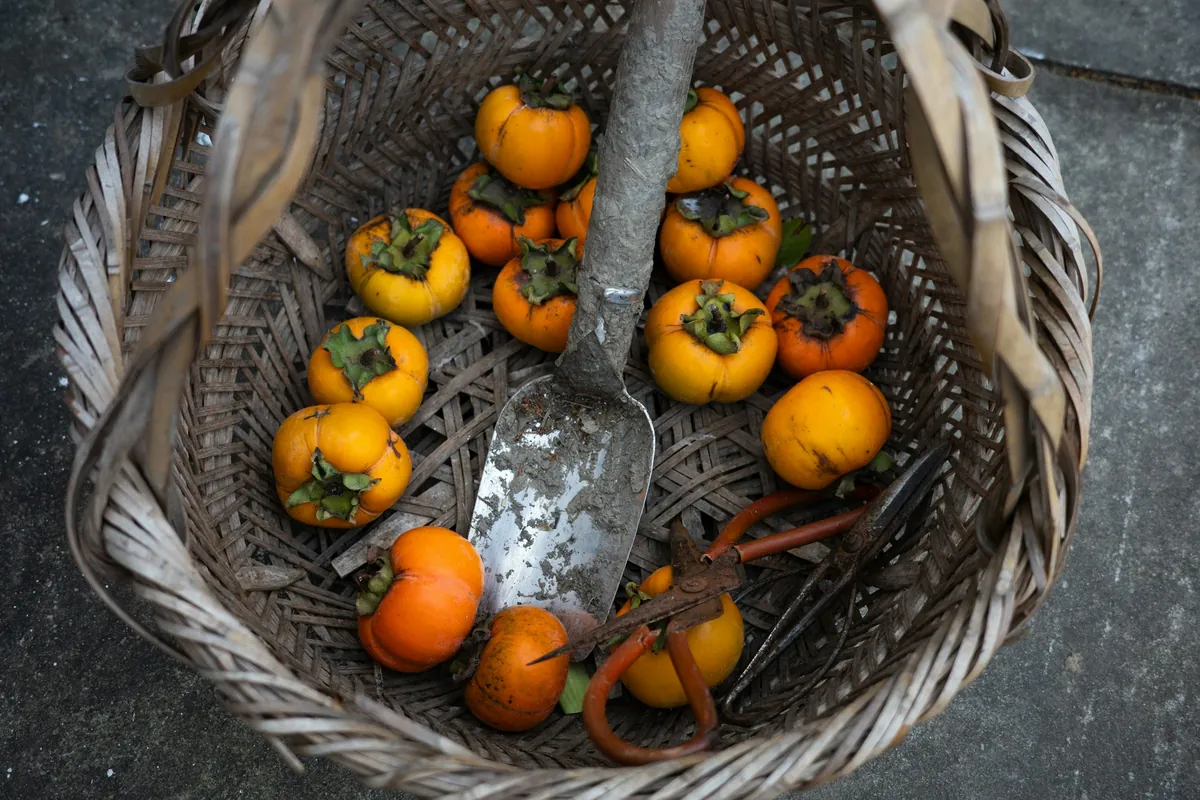
Cut Asian fruit from the branch with hand pruners, leaving the green cap attached. The fruit bruises easily.
How To Ripen And Remove Astringency
Astringent persimmons keep ripening after picking. Leave them at room temperature until soft, or speed things up as NC State suggests by sealing fully colored fruit loosely in a plastic bag with an apple or banana, which give off ethylene gas. Freezing whole fruit, then thawing it, removes some astringency; University of Florida IFAS describes a 24-hour freeze. Drying also works. Peeled, dried astringent persimmons lose their tannins completely, and University of Florida IFAS puts sun or dehydrator drying at about 3 to 7 days.
Storing Persimmons
Firm non-astringent fruit keeps several weeks in the refrigerator, according to NC State, and University of Florida IFAS reports up to 30 days at room temperature. Soft, ripe fruit does not keep long, so scoop the pulp and freeze it for baking. For American persimmons, remove the caps and press the fruit through a food mill or sieve to separate the pulp from the skins and seeds.
Looking for another fall fruit tree? A pomegranate tree ripens in the same season and loves summer heat, and a fig tree suits the same warm, sunny yards. In colder gardens, an apple tree pairs well with a hardy American persimmon, and our apricot tree guide explains how to steer clear of frost pockets. Or browse all our fruit trees.
Persimmon Tree FAQs
How Long Does A Persimmon Tree Take To Bear Fruit?
Grafted persimmon trees usually begin bearing about 3 to 6 years after planting. American persimmons on grafted stock often fruit in 3 to 5 years, and Asian trees typically take 4 to 6. Trees grown from seed take longer and may produce fruit of unpredictable quality.
Do You Need Two Persimmon Trees To Get Fruit?
For American persimmons, usually yes, since most trees are either male or female. Self-fruitful varieties such as Meader and Prok are the exception. Most Asian persimmons, including Fuyu and Hachiya, can set seedless fruit on a single tree, though a pollinator can raise yields.
What Is The Difference Between Fuyu And Hachiya Persimmons?
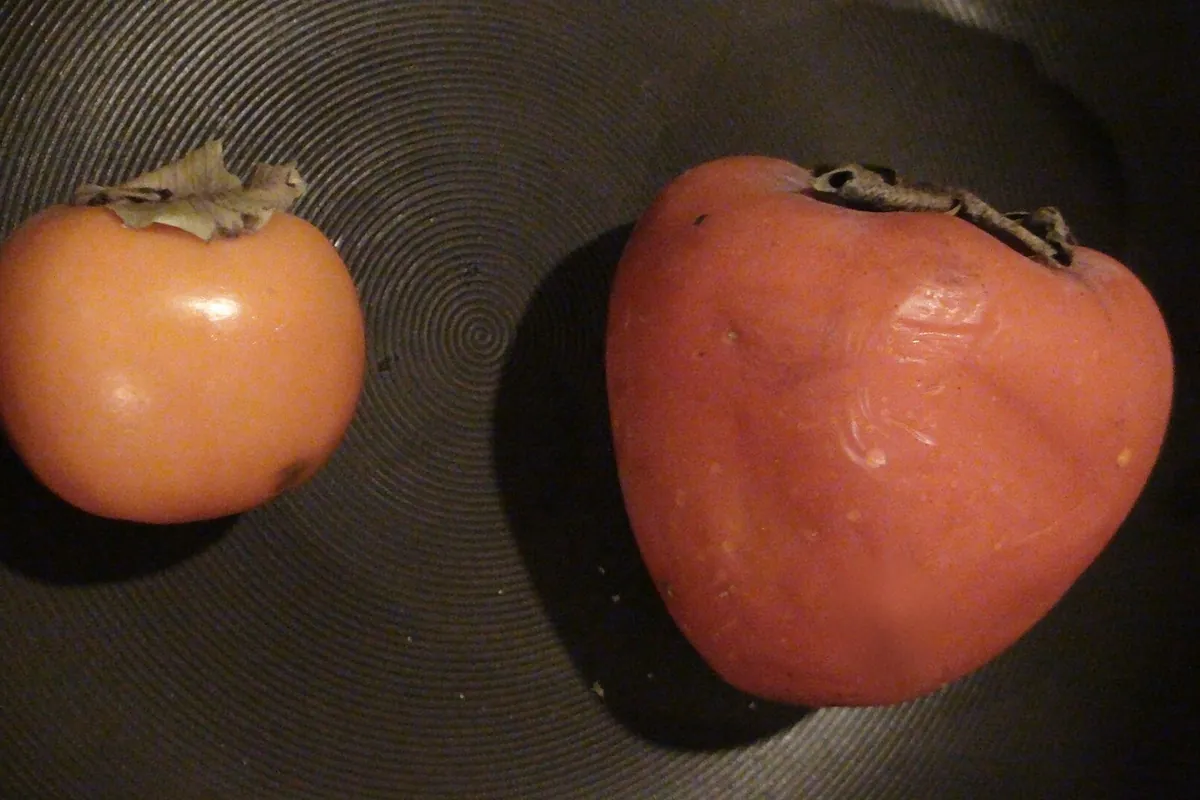
Fuyu is non-astringent, flat and squat, and can be eaten firm like an apple. Hachiya is astringent, taller and acorn-shaped, and must be completely soft and jelly-like before eating. Hachiya is often preferred for baking, while Fuyu is the better choice for fresh slicing.
How Cold Can A Persimmon Tree Survive?
American persimmons survive about 20 to 25°F below zero and grow in USDA zones 4 to 9. Asian persimmons may be injured or killed below about 10°F and are mostly grown in zones 7 to 10. Hybrids such as Nikita’s Gift fall between the two.
Why Is My Persimmon Tree Dropping Its Fruit?
The most common causes are too much nitrogen fertilizer, drought or poorly drained soil, an overloaded crop and seedless fruit that sets without pollination. Feed lightly, water weekly during dry spells, thin heavy crops early and consider a pollinator for Asian varieties.
Do Persimmons Need Frost To Ripen?
No, persimmons do not need frost to become sweet. Frost can actually damage immature fruit on the tree. Fruit loses its astringency as it ripens fully, and astringent types can be softened indoors at room temperature or in a bag with an apple or banana.