Oak Tree: Types, Growth Rate And How To Plant And Care For Oaks
On this page
- What Is An Oak Tree?
- Types Of Oak Trees: The Ten Most Planted US Species
- Oak Tree Growth Rate And Lifespan
- How To Plant An Oak Tree
- Watering, Mulching And Fertilizing Young Oaks
- Pruning Oak Trees Safely
- Common Oak Tree Problems
- Oaks, Acorns And Wildlife Value
- Oaks For Small Yards, Fall Color And The Maple Question
- Frequently Asked Questions
- Final Thoughts
An oak tree is the backbone of America’s forests and front yards. The genus Quercus includes roughly 90 native species in the United States, and at least one oak grows wild in every state except Alaska. Oaks feed more wildlife than any other tree on the continent, and the right oak tree becomes a 200 year investment that cools the house every summer.
This guide explains how to tell the red oak group from the white oak group, which ten oaks are planted most, how fast each one grows, and how to plant an oak tree so that it settles in quickly. It also covers watering, pruning timing in oak wilt regions, common problems, and narrow cultivars for small yards. The advice draws on university extension services, the USDA Forest Service, the Arbor Day Foundation, and the Morton Arboretum.
What Is An Oak Tree?
Oaks belong to the beech family, Fagaceae, and the genus Quercus. Botanists recognize about 435 oak species worldwide. Most are deciduous, although live oaks keep their leaves through winter. All oaks produce acorns, and the acorn is the one feature that confirms you are looking at an oak.
The Genus Quercus In The United States
The USDA Forest Service lists oaks as the most widespread hardwood group in the country, dominating eastern forests from Maine to Texas and the savanna foothills of California. With so many species, the easiest way to sort them is by group.
Red Oak Group Vs White Oak Group
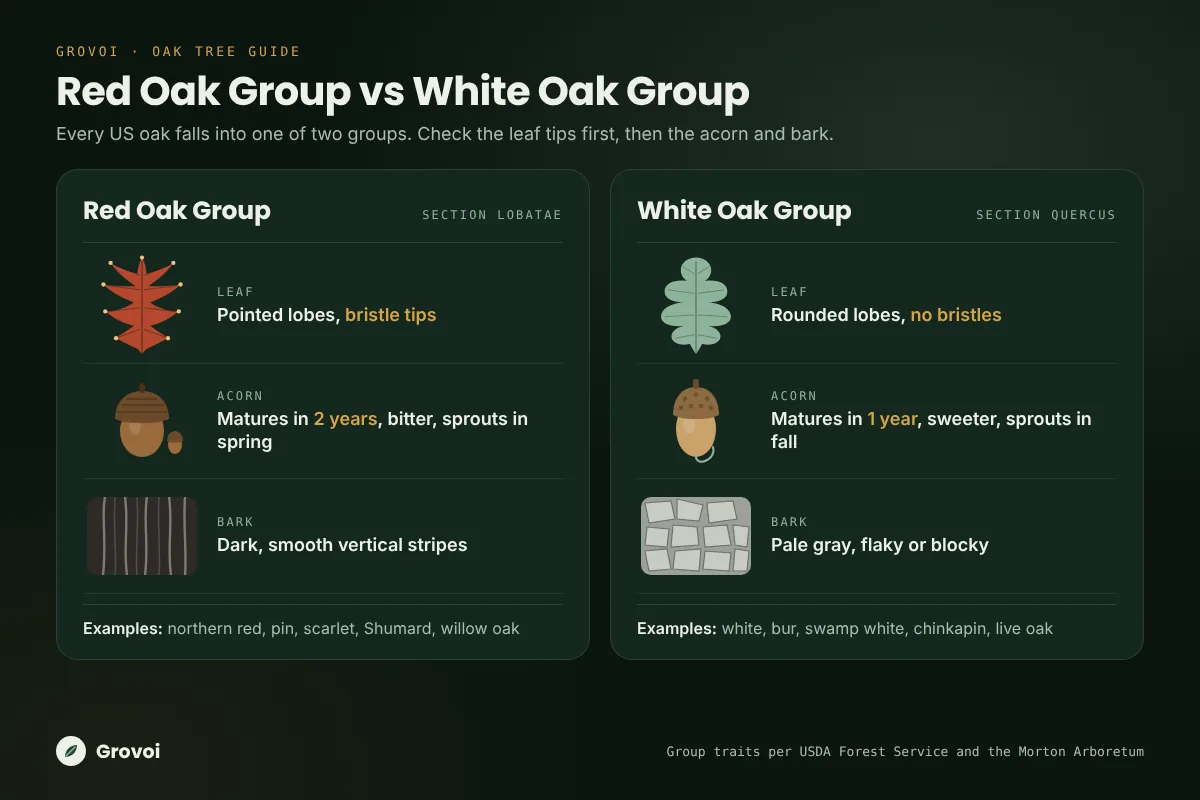
Every US oak falls into either the red oak group (section Lobatae) or the white oak group (section Quercus). The differences matter for identification and for disease risk.
- Leaf lobes: red oaks have pointed lobes that end in a fine bristle tip. White oaks have rounded lobes with no bristle.
- Acorn maturation: red oak acorns take two growing seasons, so tiny and full size acorns hang on the same branch. White oak acorns mature in one season and sprout the autumn they fall.
- Bark: white oaks usually show pale gray, flaky or blocky bark. Red oaks tend toward darker bark with smooth vertical stripes.
- Disease: red oaks die within weeks from oak wilt. White oaks resist it and often survive for years.
Types Of Oak Trees: The Ten Most Planted US Species
Ten species account for most of the oak trees planted in American yards, parks, and streets. The table pulls together zones, size, growth rate, fall color, and soil pH tolerance from extension and arboretum data.
Oak Tree Comparison Table
| Species | Group | USDA zones | Mature height | Growth rate | Fall color | Soil pH | Best use |
|---|---|---|---|---|---|---|---|
| White oak (Q. alba) | White | 3 to 9 | 50 to 80 ft | 1 to 1.5 ft/yr | Red to burgundy | Acidic to neutral | Legacy shade tree |
| Northern red oak (Q. rubra) | Red | 3 to 8 | 60 to 75 ft | 2 ft/yr | Russet red | Acidic to neutral | Fast lawn shade |
| Pin oak (Q. palustris) | Red | 4 to 8 | 60 to 70 ft | 2 to 2.5 ft/yr | Bronze red | Acidic only | Wet lawns, parks |
| Live oak (Q. virginiana) | White | 8 to 10 | 40 to 80 ft | 2 to 3 ft/yr early | Evergreen | Wide tolerance | Southern estates |
| Bur oak (Q. macrocarpa) | White | 3 to 8 | 70 to 80 ft | 1 ft/yr | Yellow brown | Acidic to alkaline | Prairie, tough sites |
| Willow oak (Q. phellos) | Red | 5 to 9 | 40 to 75 ft | 2 ft/yr | Yellow bronze | Acidic to neutral | Street tree |
| Shumard oak (Q. shumardii) | Red | 5 to 9 | 40 to 60 ft | 2 ft/yr | Red to scarlet | Acidic to alkaline | Southern lawns |
| Swamp white oak (Q. bicolor) | White | 4 to 8 | 50 to 60 ft | 1.5 to 2 ft/yr | Yellow to copper | Acidic to neutral | Damp soil, rain gardens |
| Scarlet oak (Q. coccinea) | Red | 4 to 9 | 60 to 80 ft | 1.5 to 2 ft/yr | Brilliant scarlet | Acidic, dry | Fall color on sandy soil |
| Chinkapin oak (Q. muehlenbergii) | White | 4 to 7 | 40 to 60 ft | 1 to 1.5 ft/yr | Yellow to orange brown | Alkaline tolerant | Limestone soils |
Which Oak Suits Your Region
In the Midwest and Northeast, bur, white, swamp white, and northern red oak handle cold winters and heavy clay. In the Southeast, live, willow, and Shumard oak tolerate heat and humidity. On limestone soils, choose chinkapin or bur oak, since both shrug off high pH. Use the tree encyclopedia to compare oaks with other native shade trees before you buy.
Oak Tree Growth Rate And Lifespan
The old saying that oaks grow slowly is only half true. Most oaks grow fastest between year five and year thirty, then slow as the crown fills out.
Slow Growers Vs Fast Growers
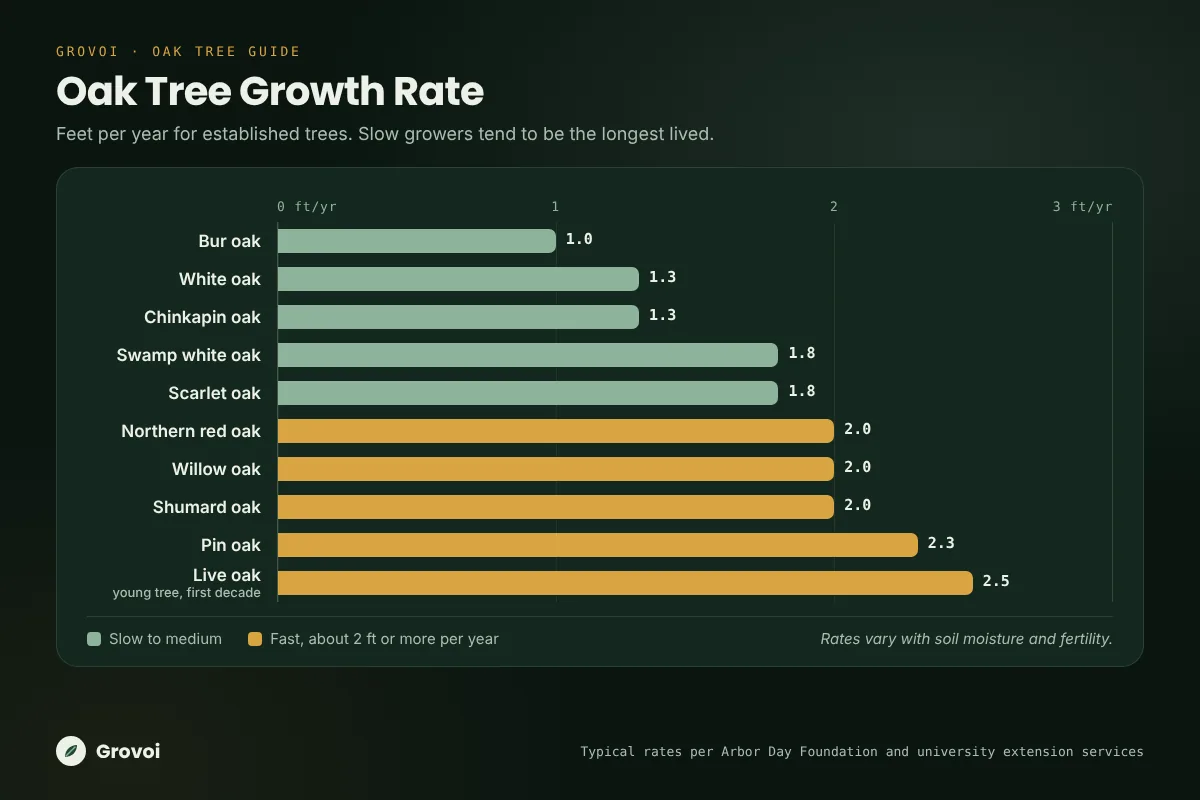
The Arbor Day Foundation rates white oak and bur oak as slow to medium, roughly 12 to 18 inches per year once established. Northern red oak, pin oak, willow oak, and Shumard oak sit at the fast end and often add 2 feet a year, sometimes 3 feet on moist, fertile soil. Live oak grows 2 to 3 feet per year for its first decade before slowing. Consequently, a northern red oak planted as a 6 foot sapling can cast real shade within 12 to 15 years.
How Long Do Oak Trees Live?
Lifespan follows the opposite pattern. Fast oaks such as pin oak and scarlet oak typically live 100 to 150 years. White oak, bur oak, and live oak routinely pass 300 years. Therefore, plant a fast species for shade in your lifetime and a slow species as a gift to the future, or one of each.
How To Plant An Oak Tree
Planting an oak tree correctly matters more than any later care. Oaks develop a strong taproot early and resent transplanting once large, so start small and get the depth right.
Acorn, Container Or Bare Root
- Acorn: free, and the seedling keeps its natural taproot. Expect 10 to 15 years before meaningful shade.
- Container tree (3 to 15 gallon): the most common nursery option. Check for circling roots and cut them before planting.
- Bare root: cheap and quick to establish, but sold dormant for only a few weeks in late winter.
- Balled and burlapped: large instant trees that lose most of their roots at digging and need years of careful watering.
Extension trials show that a 1 inch caliper oak often overtakes a 3 inch caliper oak within seven years, because it suffers less transplant shock.
Site Selection And Spacing
Choose full sun. Plant a full size oak at least 20 feet from the house foundation, and 30 feet for white, bur, and live oak because their crowns spread 60 to 100 feet. Keep oaks 15 feet from driveways and clear of septic fields. Test your soil pH first. Pin oak develops severe iron chlorosis, with yellow leaves and green veins, whenever soil pH rises above 7.5, according to Iowa State University Extension. On alkaline ground, choose chinkapin, bur, or Shumard oak instead.
Planting Depth And The Root Flare
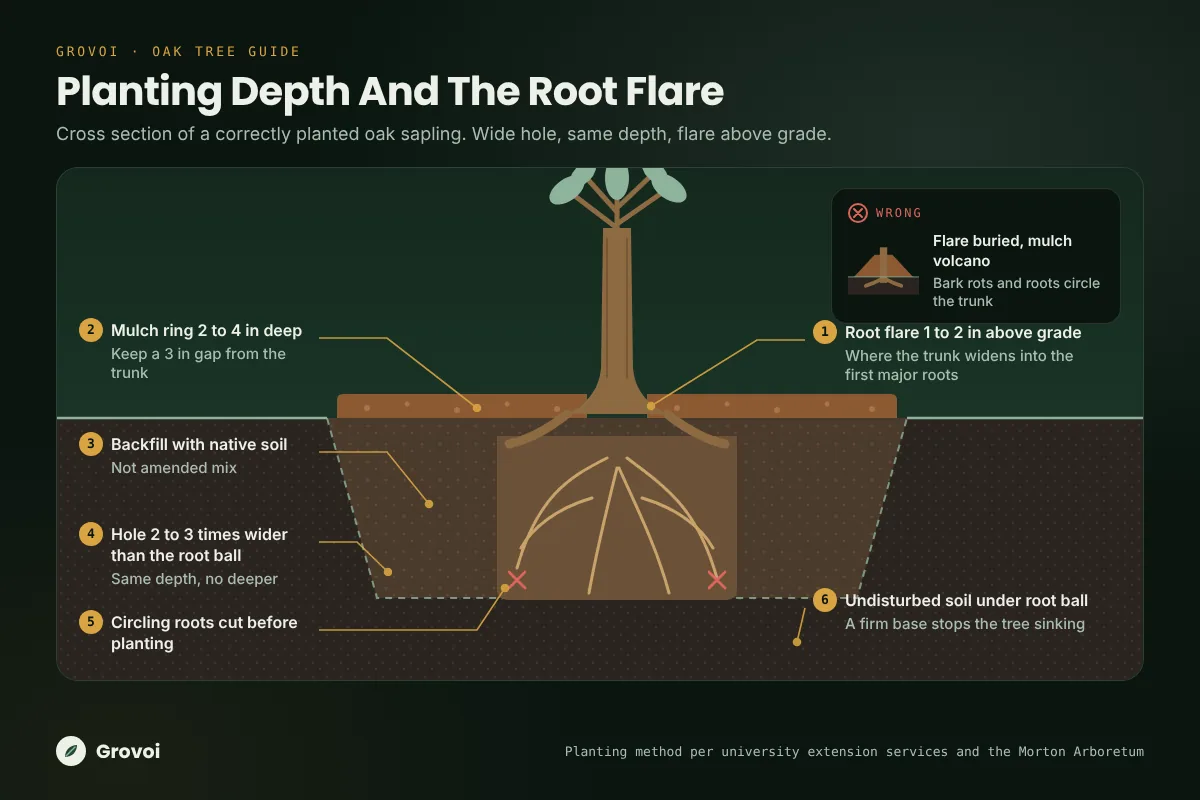
The most common oak planting mistake is planting too deep. Find the root flare, the point where the trunk widens into the first major roots, and set the tree so the flare sits 1 to 2 inches above grade. Dig the hole two to three times wider than the root ball but no deeper. Backfill with native soil, not amended mix, and water slowly to settle it. Then spread 2 to 4 inches of wood chip mulch in a wide ring, 3 inches clear of the trunk. Stake only on windy sites, and remove stakes after one season.
Watering, Mulching And Fertilizing Young Oaks
A newly planted oak tree needs consistent moisture for two to three years. After that, most native oaks survive on rainfall alone in their home range.
Watering Schedule
Give a new oak about 10 gallons of water per inch of trunk diameter each week in the growing season, applied slowly so it soaks 12 inches deep. In hot, dry weeks, water twice. Established oaks should not get frequent lawn irrigation at the trunk, because constant wet soil around the root collar invites root rot. The tree care section covers deep watering tools and schedules.
Mulch And Fertilizer
Mulch does more for an oak than fertilizer ever will. A wide ring of wood chips keeps the soil cool, holds moisture, and keeps string trimmers away from the bark. Fertilizer is rarely needed. Extension services advise against feeding oaks unless a soil test shows a deficiency, since excess nitrogen produces weak, pest prone growth. The same soil test logic applies when choosing the best fertilizer for fruit trees. For oaks, leave fallen leaves under the canopy; they are the fertilizer the tree evolved with.
Pruning Oak Trees Safely
Oaks need less pruning than most trees, and bad timing can kill them, especially in the red oak group.
Timing And Oak Wilt
Never prune an oak tree between April and July in any state where oak wilt occurs. Sap feeding beetles carry the fungus to fresh wounds within minutes, and the Wisconsin Department of Natural Resources reports that red, black, and pin oaks can die within a few weeks of infection. Prune in the dormant season, from late November through February, when the beetles are inactive. If a storm breaks a branch in summer, cut it cleanly and paint the wound at once.
What To Cut
On a young oak, remove crossing branches, double leaders, and limbs with a tight angle to the trunk. Never remove more than a quarter of the live crown in one season. Mature oaks should only be pruned for deadwood or safety, ideally by a certified arborist. The technique mirrors the three cut method in how to prune fruit trees, although oaks need far fewer cuts.
Common Oak Tree Problems
Oaks host a long list of pests and diseases. Most are cosmetic, but a few are fatal.
Diseases
- Oak wilt: leaves bronze and drop from the top down in midsummer, fatal to red oaks. Spreads by beetles and root grafts. Remove infected red oaks promptly.
- Sudden oak death: bleeding trunk cankers on coast live oak and black oak in coastal California and Oregon. Report suspected cases to your state agriculture department.
- Anthracnose: brown blotches along leaf veins in cool wet springs. Ugly but rarely harmful.
- Bacterial leaf scorch: leaf edges brown in late summer and worsen each year on pin, red, and scarlet oak. No cure, but deep watering slows decline.
- Oak galls: round or woolly growths caused by tiny wasps. Harmless in nearly every case.
Pests
- Spongy moth (formerly gypsy moth): caterpillars strip oaks in May and June. Healthy trees refoliate, but repeated defoliation can kill. Use burlap trunk bands and Bt sprays on young trees.
- Oak lace bugs: tiny insects that stipple leaves pale yellow by August. Insecticidal soap controls them.
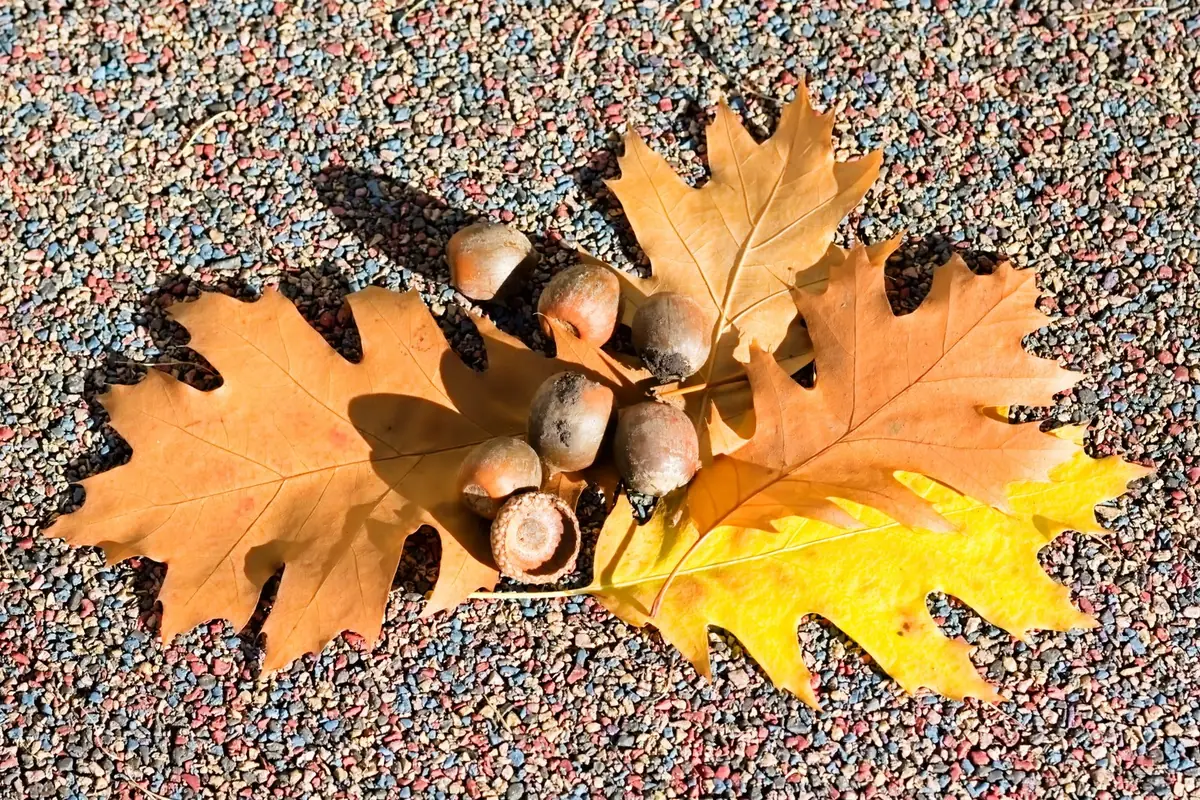
Oaks, Acorns And Wildlife Value
No other native tree feeds as many animals as an oak tree. Entomologist Doug Tallamy of the University of Delaware found that oaks support more than 500 species of caterpillars in the Mid-Atlantic alone, more than any other plant genus. Those caterpillars feed songbird chicks, which is why Tallamy calls oaks a keystone species. A mature oak also drops thousands of acorns in a mast year, feeding deer, turkeys, blue jays, and squirrels.
How To Grow An Oak From An Acorn, Step By Step
- Collect acorns in early fall from a healthy local oak. Discard any with weevil holes.
- Float test them in water for ten minutes. Sinkers are sound; floaters are empty.
- Plant white oak acorns right away. Store red oak acorns in damp peat in the refrigerator for 30 to 60 days to break dormancy.
- Plant each acorn on its side, 1 to 2 inches deep, in a deep pot or in the ground.
- Cover the spot with hardware cloth or a tree tube to stop squirrels, mice, and deer.
- Water weekly when dry. Transplant pot grown seedlings after the first true leaves appear, before the taproot circles.
Oaks For Small Yards, Fall Color And The Maple Question
A full size oak overwhelms a city lot, but narrow cultivars keep the wildlife value in a fraction of the space.
Columnar Oak Cultivars
‘Regal Prince’ (Quercus x warei) grows 40 to 60 feet tall but only 15 to 20 feet wide, with mildew resistant foliage. ‘Kindred Spirit’, from the same cross, stays about 6 to 10 feet wide and suits a side yard or driveway line. Both fit a yard that already holds a fig tree or a potted olive tree, and they host the same caterpillars as a wild oak.
Oak Fall Color
Oaks color later than maples and hold their leaves longer. Scarlet oak turns true red in late October, white oak deep burgundy, northern red oak russet, and pin oak bronze red. Many red oaks keep dead brown leaves all winter, a harmless trait called marcescence.
Oak Vs Maple: Which Shade Tree Should You Plant?
Maples grow faster at first and deliver more reliable fall color. Oaks win on everything else. An oak tree lives two to three times longer, resists storm damage better because of its stronger wood, supports roughly five times as many caterpillar species, and casts lighter shade that lets grass grow underneath. Red and silver maples also have shallow roots that heave sidewalks. If you have room for one large tree and you plan to stay, plant the oak. In warm climates where you want fruit instead of shade, a date palm tree or another species from our fruit tree guides may suit better.
Frequently Asked Questions
How fast does an oak tree grow?
Oak tree growth rate ranges from about 1 foot per year for white oak and bur oak to 2 to 3 feet per year for northern red oak, pin oak, willow oak, and young live oak. Growth is fastest between years five and thirty on moist, well drained, slightly acidic soil. Drought, compacted soil, and deep planting all slow an oak down.
How far from a house should I plant an oak tree?
Plant a full size oak at least 20 feet from the foundation, and 30 feet or more for wide spreading species such as white oak, bur oak, and live oak. Keep oaks 15 feet from driveways and sidewalks. Columnar cultivars such as ‘Kindred Spirit’ can go as close as 10 feet because their crowns stay under 10 feet wide.
When is the best time to plant an oak tree?
Fall is the best season across most of the United States. Soil stays warm after air temperatures drop, so roots grow for weeks before winter. Early spring, after the ground thaws and before buds open, is the second choice. Avoid summer planting, since heat stress and transplant shock combine to kill many new oaks.
What is the difference between red oak and white oak?
Red oaks have pointed leaf lobes with bristle tips, acorns that take two years to mature, and darker bark with smooth stripes. White oaks have rounded lobes, acorns that ripen in one season, and pale flaky bark. Red oaks grow faster but die quickly from oak wilt. White oaks grow slower, live longer, and resist the disease.
Why are my pin oak leaves turning yellow?
Yellow leaves with green veins on pin oak almost always mean iron chlorosis caused by alkaline soil. Pin oak needs a pH between 5.0 and 6.5 and struggles above 7.5. Chelated iron sprays give quick but temporary relief. Soil sulfur applied in spring and fall helps over several years. On alkaline sites, chinkapin or bur oak is a better long term choice.
Do oak trees need fertilizer?
Established oaks almost never need fertilizer. Native oaks are adapted to lean soils, and extra nitrogen encourages soft growth that attracts aphids and scale. Keep a wide mulch ring, let fallen leaves decompose under the canopy, and water deeply during drought. Feed only if a soil test from your county extension office identifies a specific nutrient shortage.
Can I grow an oak tree from an acorn?
Yes, and it is the cheapest way to start one. Collect sound acorns in fall, float test them, and plant them 1 to 2 inches deep. White oak acorns sprout the same autumn, while red oak acorns need a cold period and sprout in spring. Protect seedlings from squirrels and deer with a tree tube, and expect 10 to 15 years before useful shade.
Final Thoughts
An oak tree asks for a few simple things: the right species for your soil, a wide shallow hole with the root flare showing, deep watering for three years, and no pruning between April and July. Give it those, and it will outlive your house.
Which Oak To Plant
Choose northern red or Shumard oak for fast shade, white or bur oak for a tree your grandchildren will climb, swamp white oak for damp ground, chinkapin oak for limestone, live oak in the Deep South, and ‘Kindred Spirit’ for a narrow lot. Whichever Quercus you pick, you are planting the most valuable wildlife tree in North America.
Pingback: Japanese Maple: How To Choose, Plant And Care For Stunning Fall Color - Grovoi
Pingback: Weeping Willow Tree: Growth Rate, Root Warnings And Care Guide - Grovoi