Best Fertilizer For Fruit Trees: What, When And How Much To Feed
On this page
- Best Fertilizer For Fruit Trees: The Short Answer
- Start With A Soil Test
- N-P-K Basics: Reading A Fertilizer Label
- How Much Fertilizer Does A Fruit Tree Need?
- Use Terminal Shoot Growth As Your Guide
- Types Of Fruit Tree Fertilizer Compared
- When To Fertilize Fruit Trees
- How To Apply Fertilizer Around A Fruit Tree
- Signs Of Overfeeding And Underfeeding
- Micronutrients: Iron, Zinc And Boron
- Feeding Notes By Fruit Type
- Fertilizing Fruit Trees In Containers
- Fruit Tree Fertilizer FAQs
Best Fertilizer For Fruit Trees: The Short Answer
The best fertilizer for fruit trees is the one that supplies what your soil lacks, in the right amount and at the right time. For most home orchards, that means a modest dose of nitrogen in early spring. A balanced product such as 10-10-10 only makes sense when a soil test shows that phosphorus or potassium is low.
Here is the short version. Test your soil first. Feed about 0.1 pound of actual nitrogen per year of tree age, up to 1 pound for a mature tree. Spread it in a wide band from a couple of feet off the trunk to just past the drip line. Apply it between bud break and petal fall, then water it in. Finally, check last year’s shoot growth and adjust the rate up or down.
Citrus is the big exception. It needs more nitrogen, more frequent feeding and a fertilizer with magnesium and micronutrients. The guidance below draws on extension advice from Iowa State, the University of Arizona, Penn State, Utah State, Oregon State, the University of Kentucky, UC ANR and UF/IFAS.
Start With A Soil Test
A soil test is the cheapest way to avoid wasting fertilizer. It reports your soil pH and whether phosphorus, potassium and other nutrients are already in good supply. Penn State Extension advises testing before an orchard is planted. In established plantings, the test is mainly used to monitor pH.
pH matters because it controls how easily roots can take up nutrients. The University of Kentucky gives a target of pH 6 to 6.5 for most tree fruits, and UNH Extension uses the same range. In alkaline soil, iron and zinc become much harder for roots to absorb. Utah State links iron chlorosis to soils above pH 7.0.
How To Get A Soil Test
Your county extension office can point you to a state soil lab and explain how to collect the sample. Tell the lab you are growing fruit trees, so the report includes tree fruit recommendations. If the report calls for lime, apply it well ahead of planting. UNH notes that lime works slowly, so fall application before spring planting is ideal.
Leaf Analysis For Established Trees
Penn State points out that a leaf analysis shows what the tree has actually absorbed, which a soil test cannot do. Oregon State also suggests leaf and petiole analysis to find nutrients that are deficient or excessive. It is a useful next step when a tree looks unhealthy but the soil test seems fine.
Rule out the obvious problems first, too. Oregon State advises suspecting a nutrient shortage only when poor performance cannot be explained by pruning, pollination, disease, winter injury, insects, drought, rodents or poor drainage.
N-P-K Basics: Reading A Fertilizer Label
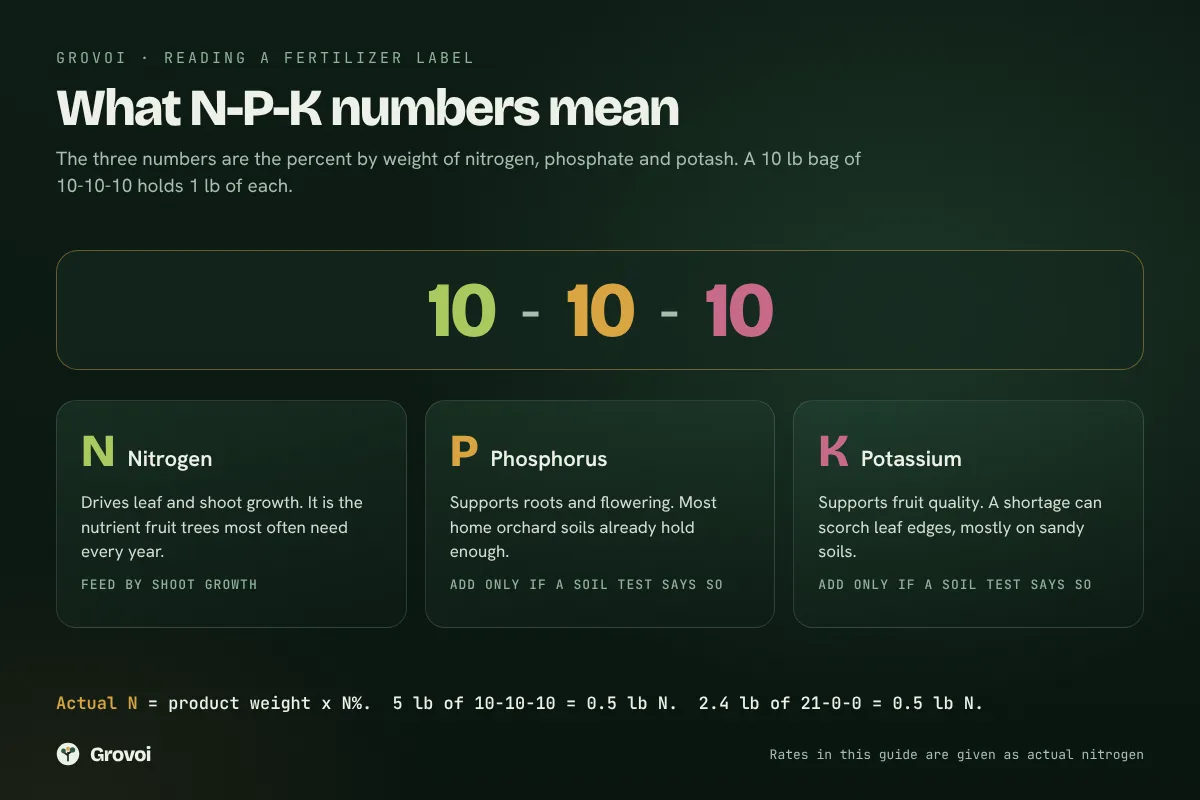
Every fertilizer bag carries three numbers, such as 10-10-10 or 21-0-0. They show the percentage by weight of nitrogen (N), phosphate (P) and potash (K), always in that order. The University of Arizona puts it simply: a 10 pound bag of 10-10-10 holds 1 pound each of nitrogen, phosphate and potash.
Nitrogen Is Usually The Only Nutrient Needed
Nitrogen drives leaf and shoot growth, and fruit trees use more of it than any other nutrient. Oregon State says nitrogen is probably the only nutrient needed in most home orchards. Utah State agrees that trees generally need only nitrogen, with iron as the main exception among the micronutrients.
Phosphorus and potassium still matter, but many soils already hold enough. Add them only when a soil test shows a shortage. Extra phosphorus is not harmless, either. Utah State notes that high soil phosphorus can make iron chlorosis worse.
Think In Pounds Of Actual Nitrogen
Extension rates are given as actual nitrogen, not product weight. To convert, divide the nitrogen you need by the first number on the bag, written as a decimal. For example, a tree that needs 0.5 pound of nitrogen gets 5 pounds of 10-10-10 (0.5 divided by 0.10). The same tree needs about 2.4 pounds of ammonium sulfate (0.5 divided by 0.21).
Weigh the product rather than guessing. UF/IFAS warns against scooping with a 1-pound coffee can, because it may hold nearly 3 pounds of mixed fertilizer. As a rough guide, one pint of mixed fertilizer weighs about a pound.
How Much Fertilizer Does A Fruit Tree Need?
Most extension services set nitrogen rates by tree age or trunk size. For a typical backyard tree, both methods land on similar numbers.
The Age Formula
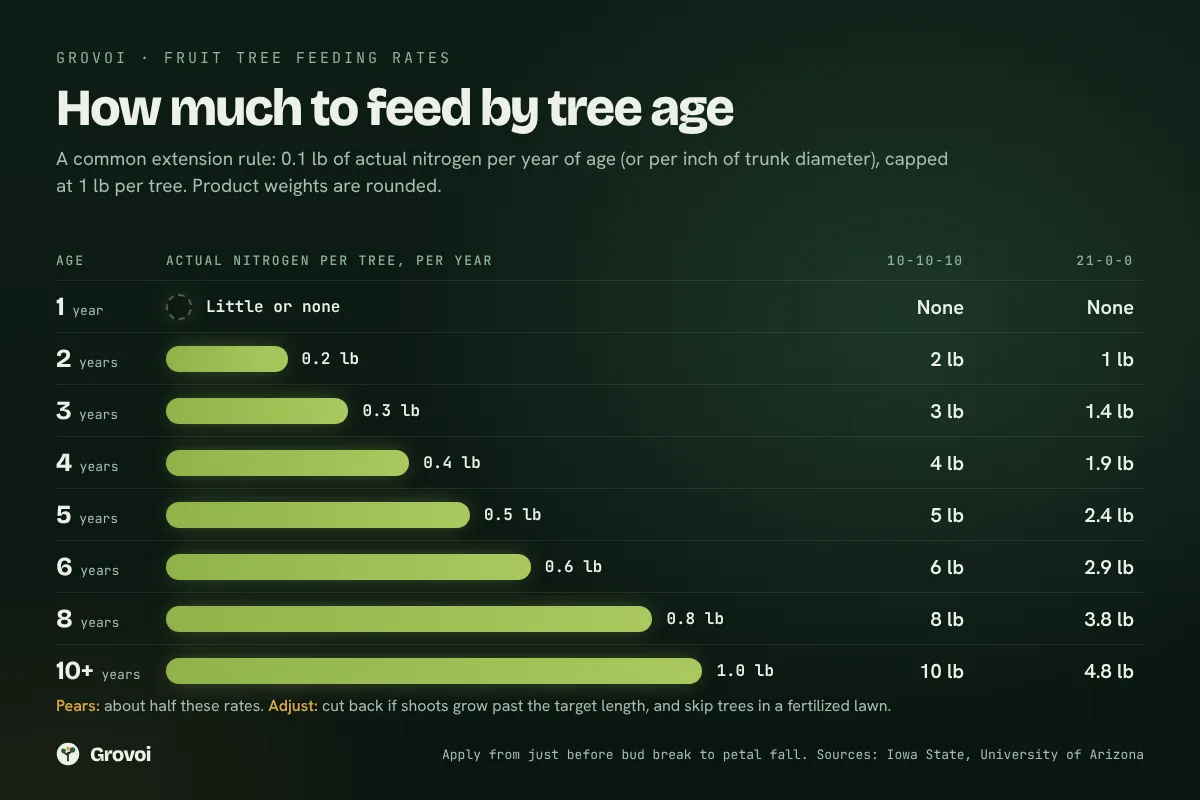
Iowa State Extension recommends 0.1 pound of actual nitrogen per year of tree age, counted from planting. A 5-year-old tree gets 0.5 pound. Trees 10 years and older should get no more than 1 pound a year. The Iowa State guide to fertilizing tree fruits also gives soil-test-based rates for phosphorus and potash.
The Trunk Diameter Formula
The University of Arizona uses the same 0.1 pound rate per inch of trunk diameter, up to 1 pound per tree. That rate covers apples, peaches, nectarines, plums, cherries and apricots. Pears get half: 0.05 pound per inch, up to 0.5 pound. UNH Extension measures trunk diameter 1 foot above the ground.
| Tree age | Actual nitrogen | 10-10-10 | Ammonium sulfate (21-0-0) | Calcium nitrate (15.5-0-0) |
|---|---|---|---|---|
| Planting year | None to very little | Wait for new growth | Wait for new growth | Wait for new growth |
| 2 years | 0.2 lb | 2 lb | 1 lb | 1.3 lb |
| 3 years | 0.3 lb | 3 lb | 1.4 lb | 1.9 lb |
| 4 years | 0.4 lb | 4 lb | 1.9 lb | 2.6 lb |
| 5 years | 0.5 lb | 5 lb | 2.4 lb | 3.2 lb |
| 6 years | 0.6 lb | 6 lb | 2.9 lb | 3.9 lb |
| 8 years | 0.8 lb | 8 lb | 3.8 lb | 5.2 lb |
| 10 years and older | 1 lb (maximum) | 10 lb | 4.8 lb | 6.5 lb |
Other Extension Rates You May See
Rates vary by region. Utah State suggests 1 ounce of actual nitrogen per year of age, up to 8 ounces per tree, and Oregon State gives cherries and peaches about double the apple and pear rate. The lesson is the same everywhere: start modestly, then let the tree’s growth guide you.
When To Cut Back Or Skip A Year
- The tree grows in a fed lawn: Iowa State notes that trees near a regularly fertilized lawn usually need no extra.
- Shoots grew well past the target: the tree already has plenty of nitrogen.
- You pruned hard over winter: heavy dormant pruning already triggers strong regrowth, as our guide on how to prune fruit trees explains.
- A stone fruit set no crop: UNH Extension advises not fertilizing peaches, plums, cherries and apricots that did not set a crop the previous year.
- A pear is growing vigorously: UNH warns that too much growth increases fire blight risk.
Use Terminal Shoot Growth As Your Guide
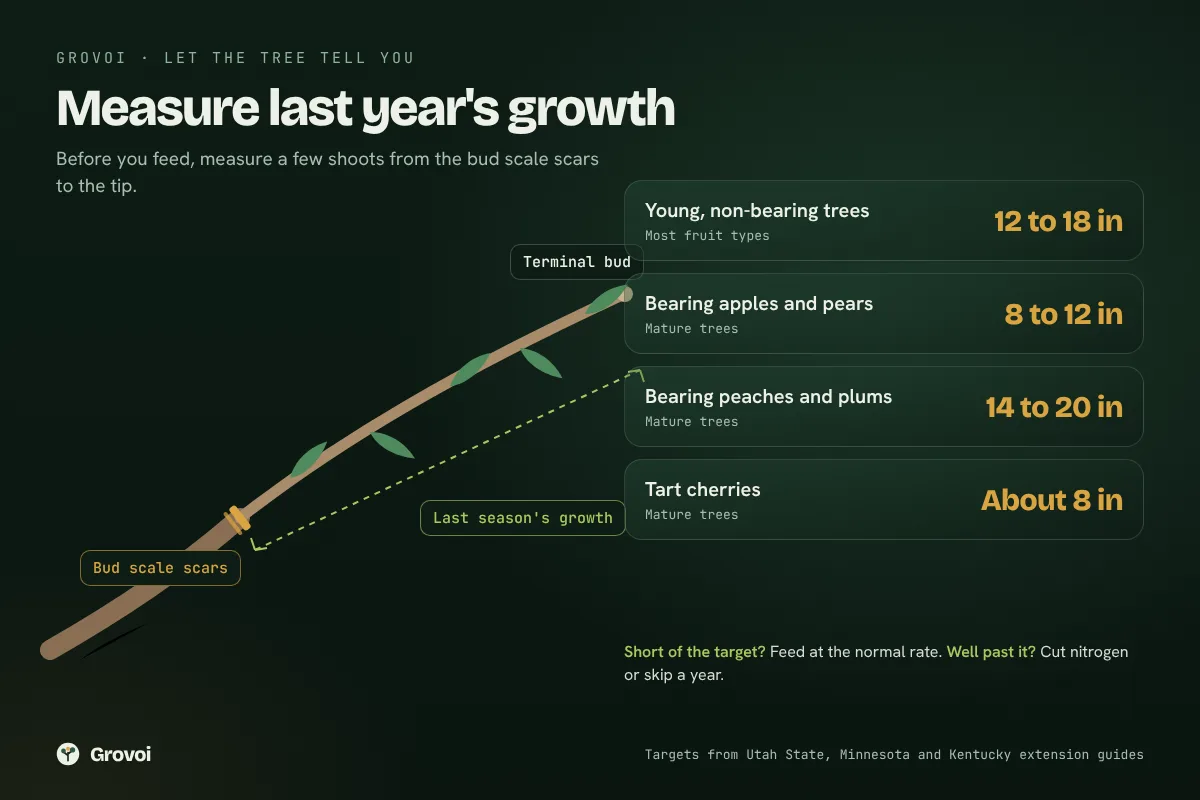
Formulas give you a starting point. The tree gives you the answer. In late winter or early spring, measure last season’s growth on several shoots around the canopy. Measure from the bud scale scars, a ring of tight lines on the bark, out to the tip of the shoot.
| Source | Fruit | Young trees | Bearing trees |
|---|---|---|---|
| Utah State | Most fruit trees | 12 to 18 in | 8 to 12 in |
| Virginia Tech | Apple, pear, plum, sour cherry | 15 to 20 in | 8 to 10 in |
| Virginia Tech | Peach, nectarine, sweet cherry | 20 to 30 in | 10 to 15 in |
| Kentucky | Peach, plum | Up to double | 14 to 20 in |
| Kentucky | Tart cherry | Up to double | About 8 in |
Kentucky’s rule is simple. If terminal growth falls short of the target, increase nitrogen. If it runs over, reduce it. Virginia Tech suggests a third spring application when growth was short, and only one application when growth was excessive.
Drought, heavy crops, shade and pests can also shorten shoots. If growth stays short despite feeding, check for those problems before adding more.
Types Of Fruit Tree Fertilizer Compared
As UC ANR points out, a tree cannot tell whether a nutrient came from an organic or synthetic source. What differs is how much nitrogen each product delivers, how fast it is released and what else comes with it.
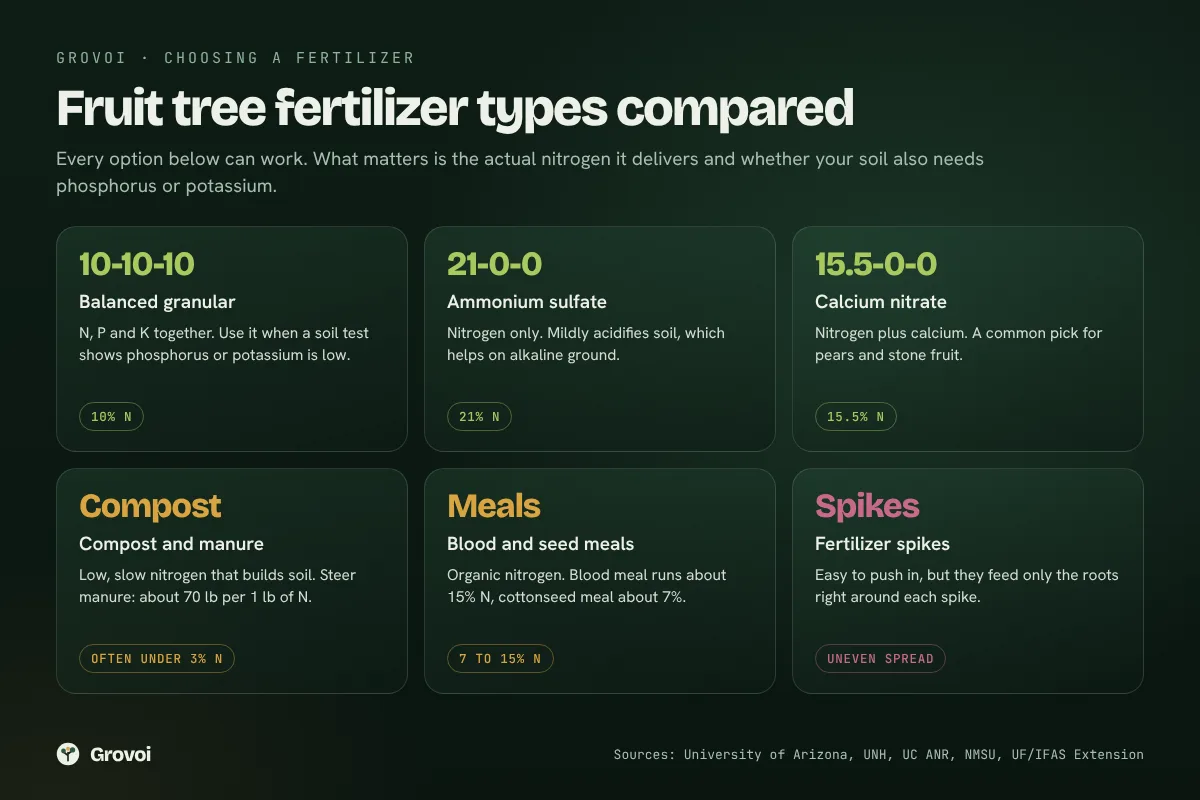
| Fertilizer | Nitrogen | Best use | Watch out for |
|---|---|---|---|
| Balanced granular (10-10-10) | 10% | Soils that also need phosphorus and potassium | Adds P and K you may not need |
| Ammonium sulfate (21-0-0) | 21% | Nitrogen only, especially on alkaline soil | Acidifies soil; weigh carefully |
| Calcium nitrate (15.5-0-0) | 15.5% | Pears and stone fruits | Nitrogen and calcium only |
| Blood meal | About 15% | Organic nitrogen boost | Release depends on soil warmth |
| Compost and manure | Low and variable | Building soil over time | Large volumes needed; often high in potassium |
| Fertilizer spikes | Varies by brand | Convenience | Feeds only roots near each spike |
Balanced Granular Fertilizer
Balanced granular blends supply nitrogen, phosphorus and potassium in one product. They are easy to find and simple to spread. UNH Extension suggests 1 pound of 10-10-10 per inch of trunk diameter for fruit trees, up to 2 1/2 pounds a year. The catch is that you may be adding phosphorus and potassium your soil does not need. Use a balanced blend when the soil test calls for all three.
Ammonium Sulfate (21-0-0)
Ammonium sulfate is a straight nitrogen source. Its high analysis means you spread less product. New Mexico State University recommends it for orchards there because it acidifies the soil somewhat. In alkaline soil, that can make some minor elements more available. On soil that is already acidic, check your soil test before relying on it.
Calcium Nitrate (15.5-0-0)
Calcium nitrate supplies nitrogen plus calcium. UNH Extension uses it for pears and stone fruits. A peach, plum, cherry or apricot that carried a good crop last year gets about 1 pound of calcium nitrate, or 1 1/2 pounds of 10-10-10.
Organic Options: Compost, Manure And Blood Meal
Organic fertilizers work, but their nitrogen is low and variable. The University of Arizona lists average values of about 15% nitrogen for blood meal, 7% for cottonseed meal, 2.4% for rabbit manure and 0.55% for sheep manure. UC ANR estimates that about 70 pounds of steer or cow manure supplies 1 pound of nitrogen. Organic nitrogen also relies on soil organisms to release it, so it is slower in cold soil.
Compost is still well worth using. UC ANR recommends composts for tree nutrition and soil health. University of Minnesota Extension suggests compost around the base of the tree when last year’s growth was under 12 inches, and none at all when growth exceeds the target. University of Maine Extension adds that compost and manure-based fertilizers are typically high in potassium, so skip extra potash if you use them.
Slow-Release Fertilizers
Slow-release products release nitrogen gradually rather than all at once. UC Master Gardeners use a slow-release citrus fertilizer for container trees, for example. Follow the label rate, and count the nitrogen they supply toward your annual total.
Fertilizer Spikes: Pros And Cons
Spikes are popular because there is no measuring or spreading. The downside is coverage. UF/IFAS Extension notes that spikes feed only the roots immediately around each spike, while broadcast fertilizer feeds the whole root area.
- Pros: quick to use, tidy and pre-measured for the package directions.
- Cons: uneven feeding and only a small treated area around each spike.
- Better use: UF/IFAS suggests crumbling spikes you already own and spreading them evenly under the canopy.
When To Fertilize Fruit Trees
Timing matters as much as the amount. Nitrogen applied in spring fuels the flush of leaves and shoots. Nitrogen applied late keeps trees growing into fall, when soft shoots are easily damaged by cold.
Early Spring, Before Bud Break
Iowa State recommends starting just before bud break and finishing by petal drop. University of Maine Extension says to apply nitrogen before June so trees harden off before winter. Oregon State times its application around the end of bloom, and Kentucky applies at bloom. In practice, that gives you a window of a few weeks in early spring. Some guides split the dose, such as Virginia Tech’s half in March and half in April.
Avoid Late Summer And Fall Feeding
Iowa State warns that late spring and summer applications can promote growth that is vulnerable to winter injury. NMSU adds that excess nitrogen can push late-season growth and raise the risk of freeze injury, especially in young trees.
Mild-winter California is the main exception. UC advisors there use split spring and fall feedings, and the UC home orchard guide notes that late-summer applications can be more efficient in that climate. If you garden where winters are mild, follow your local extension timing.
Newly Planted Trees
Never put fertilizer in the planting hole. Virginia Tech recommends no fertilizer at planting, and University of Minnesota Extension says there is no need to add it to the hole. Fertilizer in contact with roots can injure them. UC advisors suggest a very light first-year feeding of 1/2 to 1 ounce of actual nitrogen once the tree has made 6 to 8 inches of new growth. Oregon State similarly advises waiting several months after planting before applying nitrogen.
How To Apply Fertilizer Around A Fruit Tree
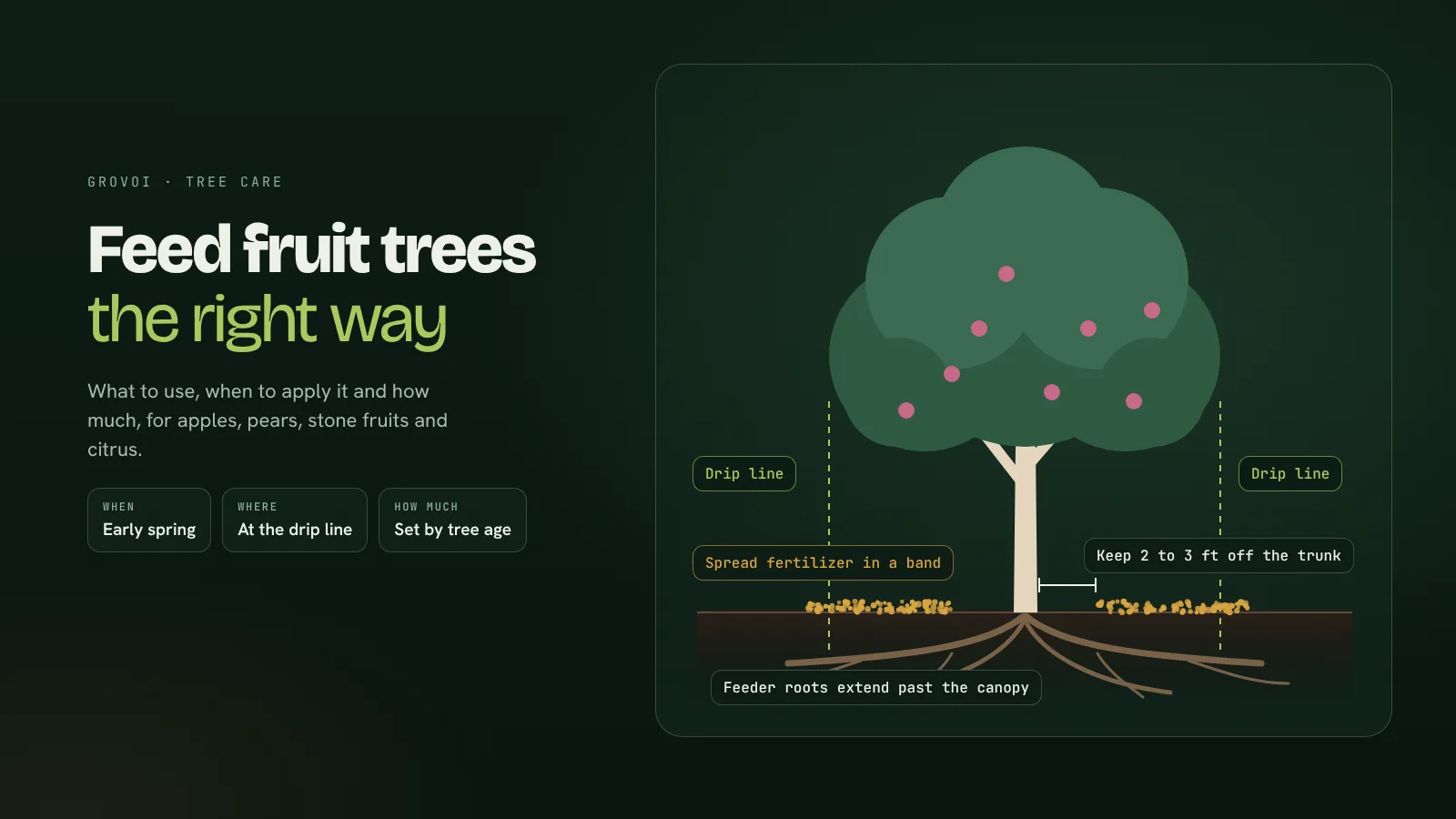
A fruit tree’s feeding roots spread wide. UC advisors note that roots often extend beyond the drip line, the outer edge of the canopy. Fertilizer piled against the trunk reaches few of them. Oregon State warns that fertilizing too close to the trunk can damage the tree.
- Work out the dose: use the age or trunk formula, then convert actual nitrogen to product weight.
- Weigh it: a kitchen scale is fine. The University of Arizona suggests weighing one cup of your fertilizer so you can measure by volume afterward.
- Clear the ground: Utah State suggests keeping a 3-foot radius around the trunk free of grass and weeds, so they don’t compete for the fertilizer.
- Spread it in a band: Iowa State recommends a circular band starting about 2 to 3 feet from the trunk and running slightly past the drip line. UNH keeps all fertilizer at least 18 inches from the trunk.
- Rake it in lightly: on bare soil, work the granules into the top inch or two.
- Water it in: Utah State notes that granular fertilizer needs rain or irrigation within a day or two to dissolve and reach the roots.
Young trees: Oregon State cautions that 1- and 2-year-old trees can be injured if nitrogen is banded around them. Broadcast it evenly under the canopy instead, starting about halfway between the trunk and the drip line.
Trees in a lawn: UC Cooperative Extension in Ventura County notes that grass absorbs most broadcast fertilizer. Its alternative is a ring of feeding holes. Drill 1-inch holes, 6 to 8 inches deep and about 3 feet apart, in a circle 3 feet from the trunk. Repeat with circles every 3 feet out to the drip line, and add 1/4 to 1/2 cup of fertilizer to each hole.
Signs Of Overfeeding And Underfeeding
Leaves, shoots and fruit all show how well a tree is fed. Learn the main patterns, then confirm with a soil or leaf test.
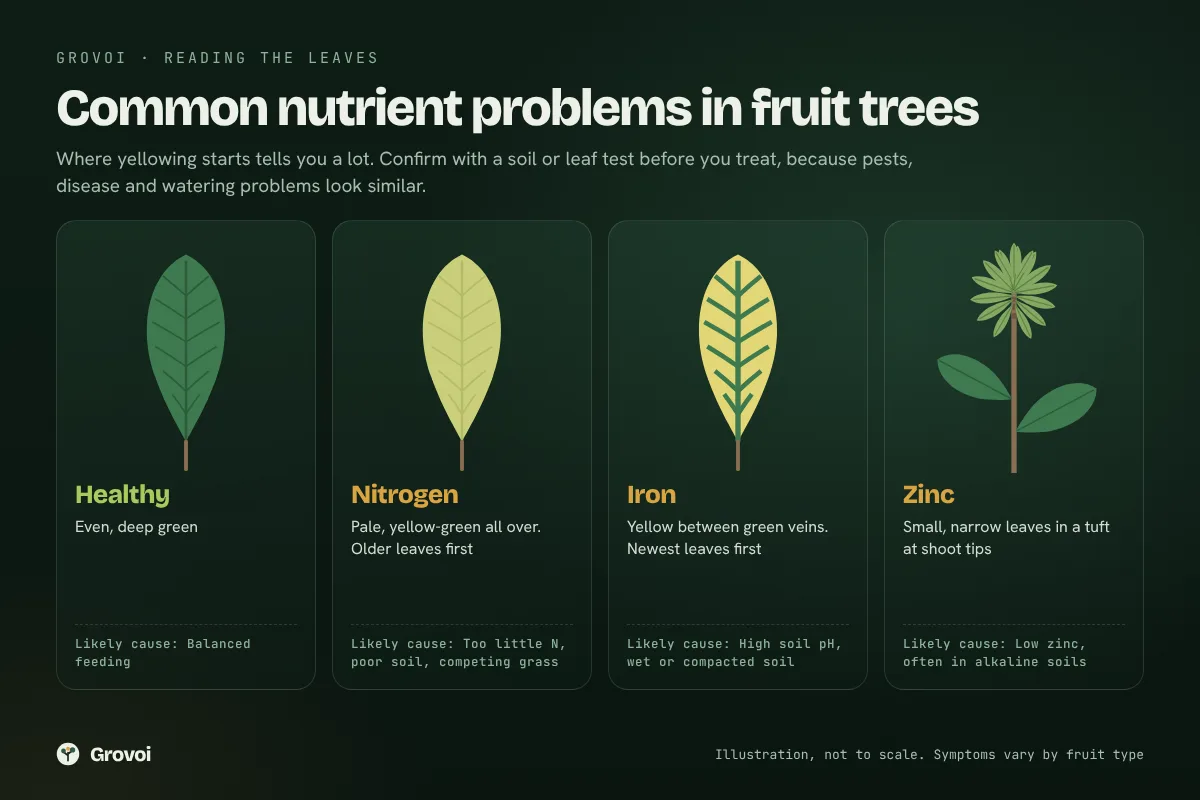
Signs Of Too Little Nitrogen
- Pale leaves: NMSU notes that older, lower leaves turn light green first, then the whole canopy pales.
- Small leaves and weak growth: UC advisors list lighter foliage, smaller leaves and poor growth as typical signs.
- Short shoots: terminal growth well below the targets above.
- Small fruit: NMSU notes that nitrogen shortage can reduce fruiting and leave fruit small.
Signs Of Too Much Nitrogen
- Lots of leaves, little fruit: Iowa State notes that excess fertilizer promotes vegetative growth and reduces fruiting.
- Late, soft growth: shoots that keep growing into fall are prone to freeze injury.
- Poor fruit quality: NMSU says excess nitrogen delays maturity and reduces red color on apples. UC advisors link it to bitter pit in apples.
- More disease: Virginia Tech notes that too much fertilizer can increase disease susceptibility, and lush pear growth invites fire blight.
- Root injury: Kentucky warns that roots in contact with undissolved fertilizer can burn.
Yellow leaves are not always a feeding problem. Utah State lists insects, disease, herbicide damage and overwatering as other common causes of yellowing.
Micronutrients: Iron, Zinc And Boron
Trace elements are needed in tiny amounts, and most soils supply them. Penn State still lists boron among the five minerals orchards should monitor, alongside nitrogen, phosphorus, potassium and calcium. Iron and zinc problems show up mainly in alkaline soils.
Iron Chlorosis
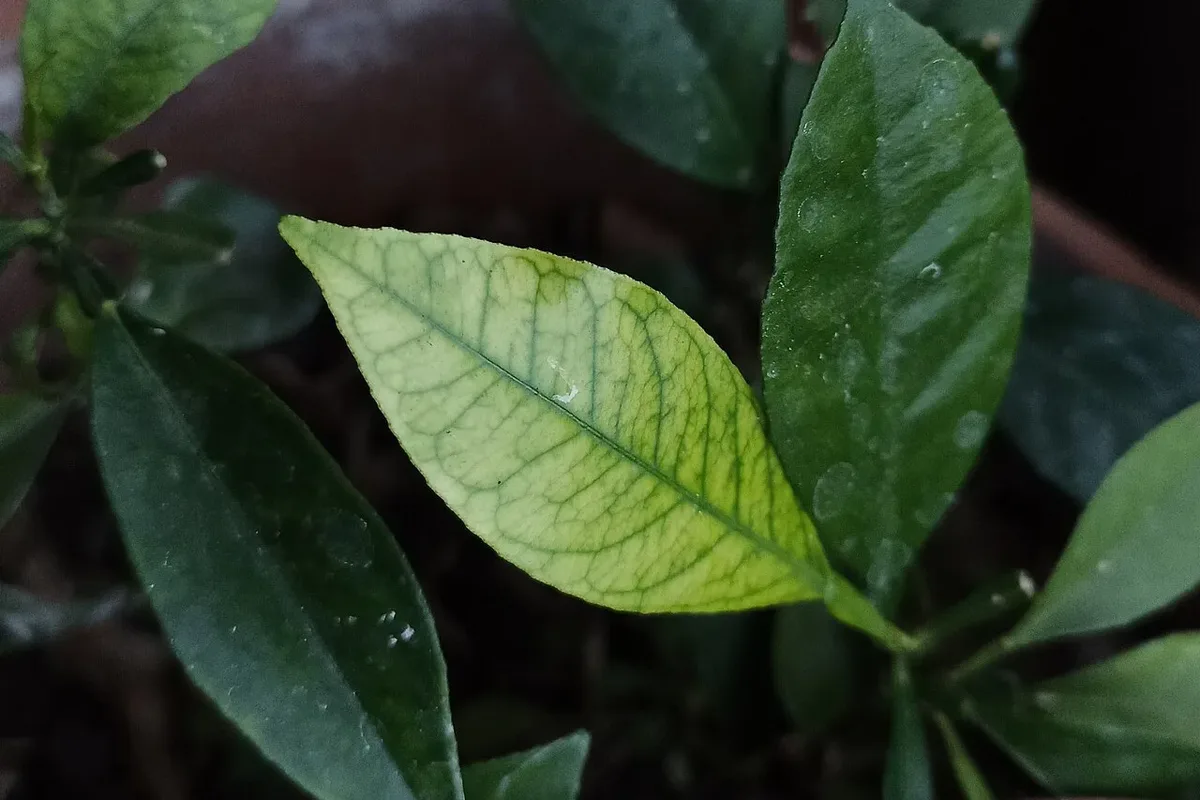
Utah State describes iron chlorosis as yellow leaves with a network of dark green veins, usually in soil above pH 7.0. NMSU notes that symptoms usually appear on flushes of new growth. In severe cases, even the veins turn yellow and leaf edges scorch.
The fix depends on soil pH. Utah State says the only iron chelate that works well in high-pH soil is one containing FeEDDHA. Other chelates are ineffective above about pH 7.2. Apply chelates in spring before growth begins. Foliar iron sprays act within days, but the response is often spotty and temporary. Utah State also recommends avoiding saturated soil and aerating compacted ground around affected trees.
Zinc Deficiency
Zinc-deficient shoots grow small leaves with short internodes, so the foliage clumps into a rosette at the shoot tip. NMSU notes that zinc symptoms usually appear by midseason and are most common in calcareous soils. Chelated zinc or zinc sulfate sprays correct the problem. NMSU finds spring, at or before green tip, the most effective time to spray.
Boron
Most boron advice for home orchards centers on apples. University of Maine Extension recommends borax (11% boron) on the soil once every 3 years: 1/2 ounce for young and dwarf apple trees, 1 ounce for semidwarf trees and 3 1/2 ounces for full-size trees. Stone fruits get half the apple rate. Weigh it carefully, since UNH warns that excess boron can be toxic to trees.
Feeding Notes By Fruit Type
Apples, pears, stone fruits and citrus share the same basics, but each has its quirks.
| Fruit tree | Nitrogen needs | Key note |
|---|---|---|
| Apple | Full rate: 0.1 lb N per year of age or trunk inch, up to 1 lb | Boron every 3 years where needed; excess N hurts color and quality |
| Pear | About half the apple rate | Vigorous growth raises fire blight risk |
| Peach and nectarine | Full rate; higher shoot growth targets | Fruit only on 1-year-old shoots, so steady new growth matters |
| Plum, cherry, apricot | Full rate in most guides | UNH feeds only after a good crop |
| Citrus | Rises to 1.1 to 1.4 lb N per year from year five | 3 to 6 feedings a year with magnesium and micronutrients |
Apples
Apples take the full rate and respond well to shoot-growth adjustments. UNH increases the rate by 50% for young apple trees growing less than 12 inches a year. For apples 4 years and older growing more than 12 inches, it skips nitrogen and applies only potassium, magnesium and boron as needed. Our apple tree guide covers the rest of apple care.
Pears
Pears need far less nitrogen. Arizona and Kentucky both put them at about half the apple rate. UNH does not apply nitrogen to pears older than 3 years that grow more than 12 inches a year, because lush growth invites fire blight. See our pear tree guide for more on fire blight.
Peaches, Plums, Cherries And Apricots
Peaches and nectarines fruit only on shoots that grew the previous season, so they need steady new growth each year. Kentucky’s target for bearing peaches is 14 to 20 inches of new growth, higher than for apples. Our peach tree guide explains how pruning and feeding work together.
For plums, cherries and apricots, feed according to crop load. UNH skips fertilizer after a year with no crop. Kentucky’s growth target for bearing tart cherries is only about 8 inches. Learn more in our guides to the cherry tree and the plum tree.
Citrus
Citrus feeds very differently. The UF/IFAS home citrus guide recommends an 8-8-8 fertilizer with other macro and micronutrients. In the first year, it suggests feeding about every 6 weeks from February through October. Applications then drop to 5 a year in year two, 4 in year three and 3 from year four onward.
| Year since planting | Feedings per year | Lb nitrogen per tree per year | Lb of 8-8-8 per feeding |
|---|---|---|---|
| First | 6 | 0.15 to 0.30 | 0.3 to 0.6 |
| Second | 5 | 0.30 to 0.60 | 0.8 to 1.5 |
| Third | 4 | 0.45 to 0.90 | 1.4 to 2.8 |
| Fourth | 3 | 0.80 to 1.0 | 3.3 to 4.2 |
| Fifth and later | 3 | 1.1 to 1.4 | 4.6 to 5.8 |
Placement also differs. During the first year, spread fertilizer over the watering basin. After that, UF/IFAS suggests spreading it as many feet beyond the drip line as the tree is old in years, up to 10. Keep it away from the trunk. On alkaline soil, an annual zinc and manganese foliar spray may help, and iron deficiency should be treated with soil-applied iron chelates. Our citrus tree care guide and lemon tree guide cover watering and other care.
Fertilizing Fruit Trees In Containers
Potted fruit trees depend on you for almost all their nutrients. UC Master Gardeners in Contra Costa County put it plainly: any plant confined to a pot needs an outside source of nutrients. For a potted Meyer lemon, they use a slow-release citrus fertilizer once a month from March to September, at the label rate.
Watering is the other half of the job. The same UC Master Gardeners warn that overwatering washes nutrients out of the root zone. Yellow-green leaves from iron deficiency can be a sign of that leaching. Water when the top inch or two of potting mix has dried out.
Fruit Tree Fertilizer FAQs
What Is The Best Fertilizer For Fruit Trees?
For most backyard fruit trees, the best fertilizer is a simple nitrogen source, such as ammonium sulfate or calcium nitrate, applied at about 0.1 pound of actual nitrogen per year of tree age. Use a balanced fertilizer like 10-10-10 only when a soil test shows phosphorus or potassium is low. Citrus does better with a citrus blend that includes magnesium and micronutrients.
Is 10-10-10 Good For Fruit Trees?
Yes, 10-10-10 works well when your soil needs all three nutrients. It is 10% nitrogen, so a tree that needs 0.5 pound of nitrogen gets about 5 pounds of product. If a soil test shows plenty of phosphorus and potassium, a nitrogen-only fertilizer avoids adding nutrients the tree does not need.
When Should You Fertilize Fruit Trees?
Fertilize in early spring, starting just before bud break and finishing by petal fall. Avoid feeding in late summer or fall in cold-winter areas, because late nitrogen keeps trees growing and leaves soft shoots open to freeze injury.
How Much Fertilizer Does A Fruit Tree Need?
A common extension rule is 0.1 pound of actual nitrogen per year of tree age, or per inch of trunk diameter, up to 1 pound for a mature tree. Pears get about half that. Divide the nitrogen amount by the first number on the bag, as a decimal, to find the product weight.
Should You Fertilize A Newly Planted Fruit Tree?
Do not put fertilizer in the planting hole, because it can injure the roots. Let the tree settle in and start growing first. UC advisors suggest a very light feeding of 1/2 to 1 ounce of actual nitrogen once the tree has made 6 to 8 inches of new growth.
Are Fertilizer Spikes Good For Fruit Trees?
Spikes are convenient, but they feed only the roots right around each spike. Broadcasting granular fertilizer under the canopy reaches far more of the root system. If you already have spikes, you can crumble them and spread them evenly instead.
Can You Use Compost Or Manure Instead Of Fertilizer?
Yes, but you need a lot of it. Manures and compost are low in nitrogen and release it slowly. UC advisors estimate it takes about 70 pounds of steer or cow manure to supply 1 pound of nitrogen. Compost is excellent for soil health, so many growers use it alongside a measured nitrogen source.
Why Are My Fruit Tree Leaves Turning Yellow?
Pale, evenly yellow-green leaves, starting with older leaves, usually point to too little nitrogen. Yellow leaves with green veins on new growth suggest iron chlorosis, which is common in alkaline soil. Overwatering, poor drainage, pests and disease can look similar, so check those and test your soil before adding more fertilizer.
Pingback: Date Palm Tree: How To Grow, Pollinate And Harvest Dates - Grovoi
Pingback: Oak Tree: Types, Growth Rate And How To Plant And Care For Oaks - Grovoi
Pingback: How To Plant A Tree Step By Step: Hole Size, Depth And Watering - Grovoi
Pingback: Crepe Myrtle: How To Plant, Prune And Get Bigger Blooms - Grovoi
Pingback: Weeping Willow Tree: Growth Rate, Root Warnings And Care Guide - Grovoi