Weeping Willow Tree: Growth Rate, Root Warnings And Care Guide

On this page
- What Is A Weeping Willow Tree?
- Weeping Willow Growth Rate Year By Year
- Weeping Willow Root Warnings
- Where To Plant A Weeping Willow Tree
- How To Plant A Weeping Willow
- Watering, Soil, And Fertilizer
- Pruning A Weeping Willow
- Pests, Diseases, And Weak Wood
- Alternatives For Small Yards
- Frequently Asked Questions
- Final Thoughts
A weeping willow tree is the fastest way to turn a bare, wet corner of a property into a landmark. Few trees grow as quickly, and none drape over a pond with the same grace. The same traits that make it beautiful also make it the most complained about tree in the suburbs, because its roots travel far and its wood breaks easily.
This guide covers how fast a weeping willow grows, how far its roots reach, how much space it needs from a house or septic system, and how to plant, water, and prune one so it stays healthy. The advice follows the North Carolina State Extension, the Arbor Day Foundation, and other university extension services. If you have the room and the water, the weeping willow is a joy. If you do not, read the root section before you buy one.
What Is A Weeping Willow Tree?
The weeping willow sold in American nurseries is usually Salix babylonica or, more often, a hybrid of it called Salix x sepulcralis. The species came from northern China along the old trade routes, and Linnaeus named it after Babylon by mistake. Its long, pendulous branches sweep down to the ground, carrying narrow leaves that are among the first to open in spring and the last to drop in fall.
Species And Hybrids You Will See For Sale
Pure Salix babylonica is tender and short lived, so most trees labeled “weeping willow” are golden weeping willow, Salix x sepulcralis ‘Chrysocoma’, a cross with white willow that is hardier and holds yellow twigs all winter. ‘Tristis’ is another common name for the same group. The Niobe willow and the Wisconsin weeping willow are also hybrids sold for colder states. All of them behave the same way in a yard, so the care below applies to each.
Size, Shape, And Lifespan
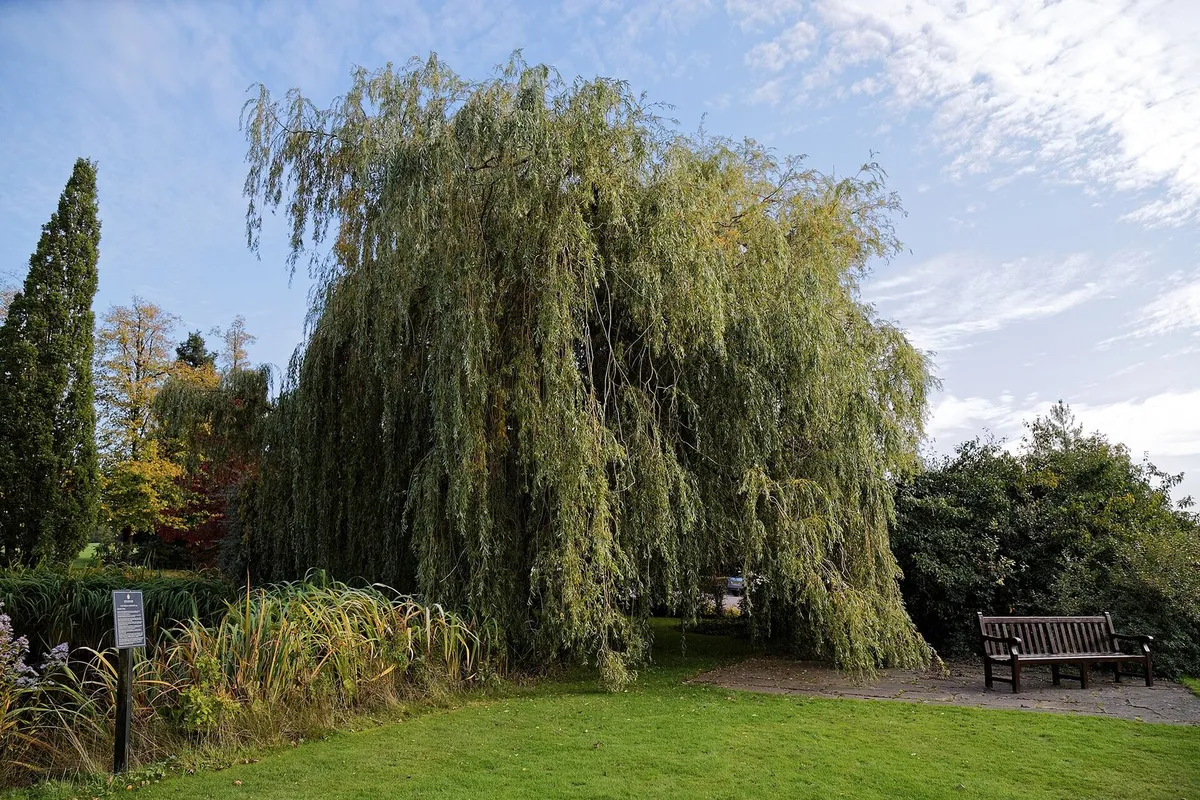
A mature weeping willow reaches 30 to 50 feet tall with a canopy just as wide, and it forms a broad, rounded dome of trailing branches. The trunk is short and thick, with furrowed gray brown bark that often splits with age. Lifespan is the catch: most weeping willows live about 30 years, and many begin to lose large limbs after 20. According to the North Carolina State Extension, rapid growth comes with weak wood that cracks under snow and ice.
Weeping Willow Growth Rate Year By Year
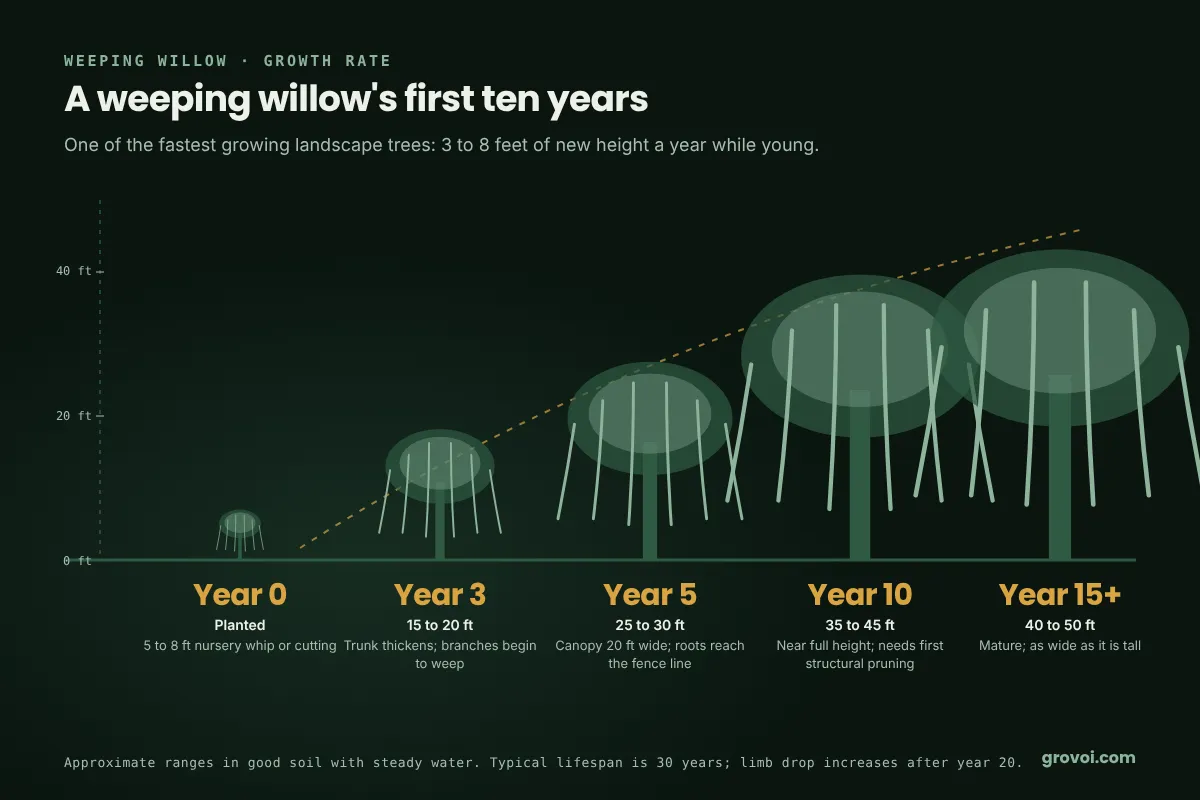
Speed is the weeping willow’s defining trait. The Arbor Day Foundation classes it as a fast grower, which means more than 24 inches of new height a year, and in a wet site the real figure is far higher.
How Fast Does A Weeping Willow Grow?
A young weeping willow in moist soil and full sun adds 3 to 8 feet of height a year. A 6 foot nursery whip planted this spring can stand 15 to 20 feet tall in three years and 25 to 30 feet in five. By year ten the tree is close to its full height of 35 to 45 feet, after which growth slows and the canopy fills out sideways. The tree reaches its mature width of 40 to 50 feet around year 15.
What Slows A Weeping Willow Down
Dry soil is the main brake. A willow on a dry, sandy slope may manage only 1 to 2 feet a year and will look thin and yellow by August. Heavy shade, root competition from established trees, and repeated storm damage also slow it. Fertilizer does not speed up a willow that is short of water, so fix the water first.
Weeping Willow Root Warnings
Weeping willow roots are shallow, fibrous, and relentless in their search for water. They do not crush pipes or foundations by force. Instead, they find the moisture leaking from any crack or joint and grow into it, until a hairline gap becomes a blocked drain or a lifted slab.
How Far The Roots Spread
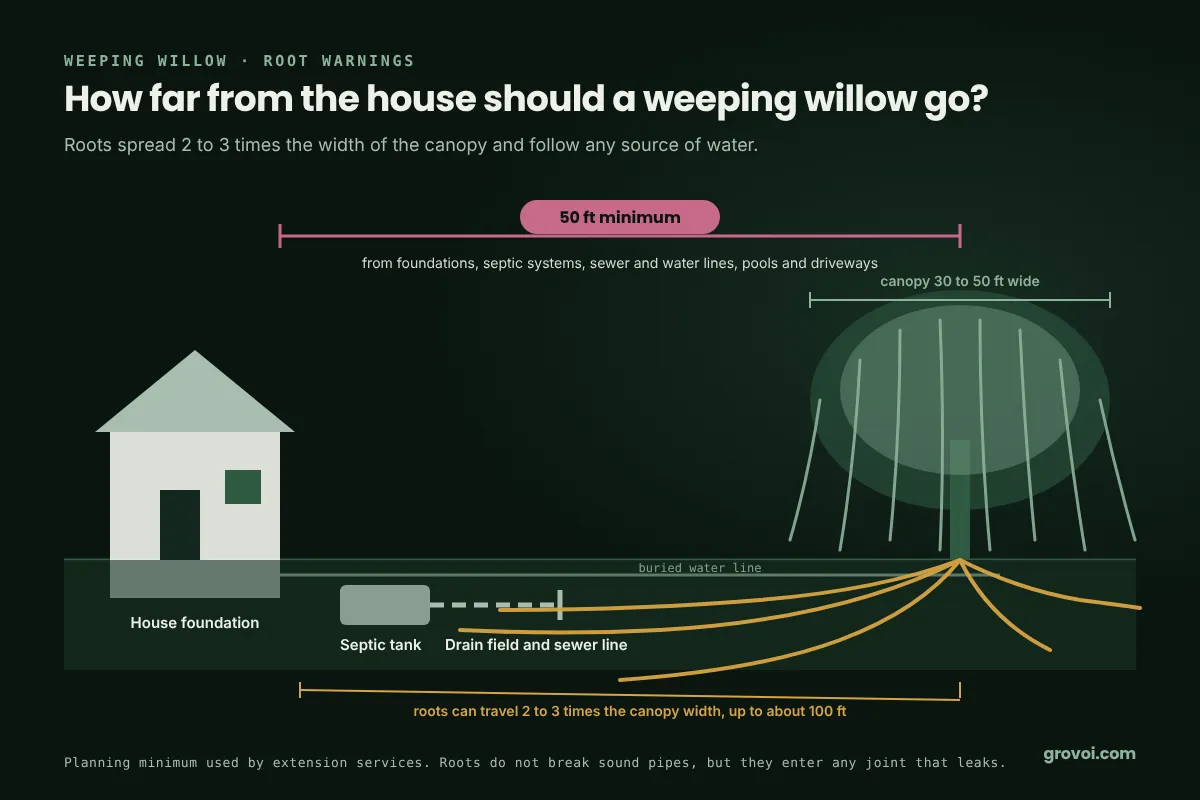
The root system of a weeping willow commonly reaches two to three times the width of the canopy. For a 40 foot wide tree, that means roots 80 to 120 feet from the trunk, and they run fastest toward lawns, drain fields, and leaking pipes. Most of the roots sit in the top 24 inches of soil, which is why they heave sidewalks and surface in lawns as the tree ages.
Safe Planting Distances
| Feature | Minimum distance | Why it matters |
|---|---|---|
| House foundation and basement | 50 feet | Roots enter cracks and drain moisture from clay soil, which can cause settling |
| Septic tank and drain field | 50 feet or more | Roots clog perforated drain lines and tank joints within a few years |
| Sewer, water, and irrigation lines | 50 feet | Any leaking joint becomes a root entry point |
| Driveway, patio, and sidewalk | 20 to 30 feet | Shallow roots lift slabs and pavers |
| Swimming pool | 50 feet | Roots seek the pool’s water; leaf and twig litter fouls filters |
| Neighboring property line | 25 feet | A 50 foot canopy and root run will cross the line |
| Other trees and vegetable beds | 30 feet | Willow roots outcompete almost everything for water |
Septic Systems, Pipes, And Foundations
Drain fields are the worst match for a weeping willow, because they release a steady supply of nutrient rich water into the soil, which is exactly what the roots hunt for. Older clay or cast iron sewer lines with loose joints are the next most common victims. Modern PVC lines with glued joints resist roots well, but only while the joints hold. If the only space you have is within 50 feet of a septic field or an old sewer line, choose a different tree. Root barriers help for the first few years but rarely stop a mature willow.

Where To Plant A Weeping Willow Tree
The right site solves most weeping willow problems before they start. The tree wants three things: water, sun, and room.
The Ideal Site
Plant beside a pond, lake, stream, or a low spot that stays damp after rain. Full sun produces the densest canopy, although the tree tolerates part shade. Allow a clear circle at least 50 feet across for the canopy, and keep the trunk 50 feet from any structure or buried utility, as the table above shows. A weeping willow on a slope above a wet area also controls erosion, and the North Carolina State Extension recommends it for rain gardens and water gardens.
Hardiness Zones And Climate
Weeping willows thrive in USDA zones 6 through 8. In zone 5 and colder, choose a hardy hybrid such as the Wisconsin weeping willow or Niobe willow, and expect some twig dieback after harsh winters. In zone 9, the tree survives with constant water but struggles in long dry heat. Willows handle wind poorly, so avoid exposed ridge tops where limbs snap.
How To Plant A Weeping Willow
Planting is simple, because a willow roots from almost anything. The planting rules that apply to an oak tree apply here too, but a willow forgives mistakes that would kill an oak.
Step By Step Planting
- Plant in early spring or fall when the soil is moist and temperatures are mild.
- Dig a hole two to three times as wide as the root ball and no deeper, so the root flare sits level with the ground.
- Loosen circling roots on a container tree, then set it in the hole and backfill with the soil you removed. Do not add fertilizer to the hole.
- Water slowly until the soil is saturated, and keep it moist for the entire first growing season.
- Spread 3 inches of mulch in a wide ring, leaving 4 inches clear around the trunk.
- Stake only in windy sites, and remove the stake after one year.
Growing A Weeping Willow From A Cutting
You do not need to buy a tree. Cut a pencil thick, 12 to 18 inch length of dormant branch in late winter, push two thirds of it into moist soil or stand it in a bucket of water, and it will root within weeks. Cuttings planted directly in a wet spot often outgrow nursery trees within three years, since there is no transplant shock.
Watering, Soil, And Fertilizer
Water is the whole story with a weeping willow. Soil and fertilizer matter far less.
Watering
A newly planted weeping willow needs deep watering two or three times a week through its first summer, and weekly in the second year. After that, a tree beside water looks after itself. A tree on ordinary lawn soil needs a deep soak every week in dry weather for life, or the leaves yellow, the canopy thins, and the roots head for your pipes.
Soil And pH
Weeping willows accept clay, loam, or sand and a pH anywhere from acidic to mildly alkaline. They tolerate periodic flooding and poorly drained ground that would rot most other trees. The one thing they dislike is dry, compacted fill.
Fertilizer
In most soils a willow needs no fertilizer. Rapid growth is already its weakness, and nitrogen makes the wood even softer. If a soil test shows a real shortage, use a slow release balanced product at half rate in early spring. Our guide to the best fertilizer for fruit trees explains how to read those labels.
Pruning A Weeping Willow
Pruning is the one task that reduces limb breakage, so it is worth doing from the first year.
When To Prune
Prune in late winter while the tree is dormant, before the sap rises in early spring. Willows bleed sap from cuts made in spring, and summer cuts invite borers and canker. Remove storm damaged limbs at any time.
What To Remove
- In the first three years, pick one central leader and remove competing upright shoots so the trunk is strong.
- Cut out branches with narrow, V shaped crotches, which split under weight.
- Remove dead, rubbing, and diseased wood back to healthy tissue.
- Thin the crown lightly every three to five years so wind passes through rather than tearing limbs off.
- Trim the trailing branch tips to the height you want, which is the only way to keep the curtain off a path or the water.
Use the three cut method described in how to prune fruit trees for any limb thicker than your wrist, and never top a willow, because the regrowth is weakly attached and breaks sooner.
Pests, Diseases, And Weak Wood
A weeping willow collects pests the way it collects water, although a well watered tree shrugs most of them off.
Common Problems
- Aphids: sticky honeydew on leaves and cars parked below. Wash off with a hose or let lady beetles handle them.
- Willow borers: sawdust at the base of limbs and sudden branch death. Keep the tree vigorous; prune out infested wood.
- Scale and lace bugs: stippled, yellowing leaves. Horticultural oil in late winter controls both.
- Crown gall and cankers: swollen or sunken bark areas. Prune out cankers; there is no cure for crown gall.
- Willow scab and black canker: blackened new shoots in wet springs. Rake fallen leaves and thin the crown for airflow.
- Powdery mildew and leaf spots: cosmetic in most years.
Limb Drop And Litter
The real maintenance cost is cleanup. Weeping willows shed twigs year round, drop branches in every ice storm, and release cottony seed in late spring. Keep cars, play equipment, and seating out from under the canopy, and budget for a professional inspection once the tree passes 20 years.
Alternatives For Small Yards
If the root warnings rule out a weeping willow, you can still have the weeping shape.
Smaller Trees With The Same Look
A weeping cherry, weeping European beech, or a laceleaf Japanese maple gives the cascading silhouette at a fraction of the size and with well behaved roots. River birch tolerates wet ground without the aggressive root run. Browse the tree finder for more options sized to a typical lot, and see the tree care section for help with whichever you choose.
Frequently Asked Questions
How fast does a weeping willow tree grow?
A weeping willow grows 3 to 8 feet a year when young in moist soil and full sun. A nursery whip can reach 20 feet in three years and close to its full height of 35 to 45 feet in about ten. Growth slows sharply in dry soil, where the tree may add only a foot or two a year.
How far should a weeping willow be from a house?
Plant a weeping willow at least 50 feet from a house foundation, septic system, sewer line, water line, or pool. The roots spread two to three times the canopy width and enter any crack or joint that leaks water. Keep it 20 to 30 feet from driveways and sidewalks to prevent lifted slabs.
Do weeping willow roots damage pipes and foundations?
Yes, but not by force. Willow roots do not break sound pipes or concrete; they grow into existing cracks and leaking joints in search of water and then expand until the pipe blocks or the slab lifts. Old clay sewer lines, septic drain fields, and leaking foundations are the most common casualties.
How long does a weeping willow live?
Most weeping willows live about 30 years, and 50 is possible beside a lake with good care. The fast, soft wood is prone to decay, so large limbs start to fail after year 20. Regular thinning, steady water, and early removal of narrow crotches extend the useful life of the tree.
Can you grow a weeping willow in a small yard?
A weeping willow is a poor choice for a small yard. It needs a clear 50 foot circle for the canopy, a 50 foot buffer from structures and pipes, and a wet site. In a small space, a weeping cherry, weeping beech, or laceleaf Japanese maple gives the same shape without the root problems.
Why are my weeping willow leaves turning yellow?
Yellow leaves in summer usually mean the tree is short of water, which is the most common weeping willow problem away from open water. Deep soak the root zone weekly. Yellowing with sticky residue points to aphids, and yellow stippled leaves suggest lace bugs or scale. Yellow leaves in October are normal fall color.
Final Thoughts
A weeping willow tree gives faster shade and more drama than almost anything else you can plant, and beside water it is close to carefree. The price is space: 50 feet from anything you value, and a lifetime of twig cleanup.
Should You Plant One?
Plant a weeping willow if you have a pond, a wet low spot, or a large rural lot with nothing underground nearby. Skip it on a suburban lot with a septic field or an old sewer line, and choose a smaller weeping tree instead. Either way, water deeply, prune for strong structure early, and enjoy the first tree to leaf out each spring.
Pingback: Fastest Growing Shade Trees: 15 Picks And How Fast They Really Grow - Grovoi