Fiddle Leaf Fig Care: Light, Water And Fixes For Brown Or Dropping Leaves

On this page
- Fiddle Leaf Fig Care: The Short Answer
- What Is A Fiddle Leaf Fig?
- Light: Bright, Indirect And Some Direct Sun
- How To Water A Fiddle Leaf Fig
- Humidity, Temperature And Drafts
- Soil, Pot And Drainage
- Feeding A Fiddle Leaf Fig
- When And How To Repot
- Pruning And Notching For A Fuller Plant
- Wiping Leaves And Rotating The Pot
- Fiddle Leaf Fig Problems: A Symptom Table
- Pests: Spider Mites, Scale And Mealybugs
- Is A Fiddle Leaf Fig Toxic To Pets?
- Fiddle Leaf Fig Care FAQs
Fiddle Leaf Fig Care: The Short Answer
Good fiddle leaf fig care comes down to a few steady habits. Give the plant bright, filtered light. Water deeply, then wait until the top 1 to 2 inches of soil are dry. Keep it warm, away from drafts, and leave it in one spot once it settles.
That last point matters more than most people expect. Fiddle leaf figs react to change. A move across the room, a cold blast from a door or a sudden jump in light can all trigger leaf drop. Most problems that look mysterious trace back to one of three things: too much water, too little light or a recent change in conditions.
Below, you will find the full routine, then a symptom table for brown spots, leaf drop, yellowing and red dots. The advice draws on NC State Extension, UF/IFAS, Clemson HGIC, the University of Maryland Extension and the ASPCA. For more trees that live indoors, browse our bonsai and indoor trees collection.
What Is A Fiddle Leaf Fig?
The fiddle leaf fig is Ficus lyrata, a member of the fig and mulberry family. It is native to tropical western and central Africa, where it grows into a full-size tree. UF/IFAS lists a landscape height of 25 to 50 feet. Indoors, NC State Extension puts a typical height at 2 to 10 feet.
The common name comes from the leaves. Each one is broad and rounded at the tip, pinched slightly in the middle and narrower at the base, much like the body of a violin. Clemson HGIC describes leaves about 8 to 15 inches long, and NC State notes they can reach 18 inches. The leaves are thick and leathery, with pale, prominent veins.
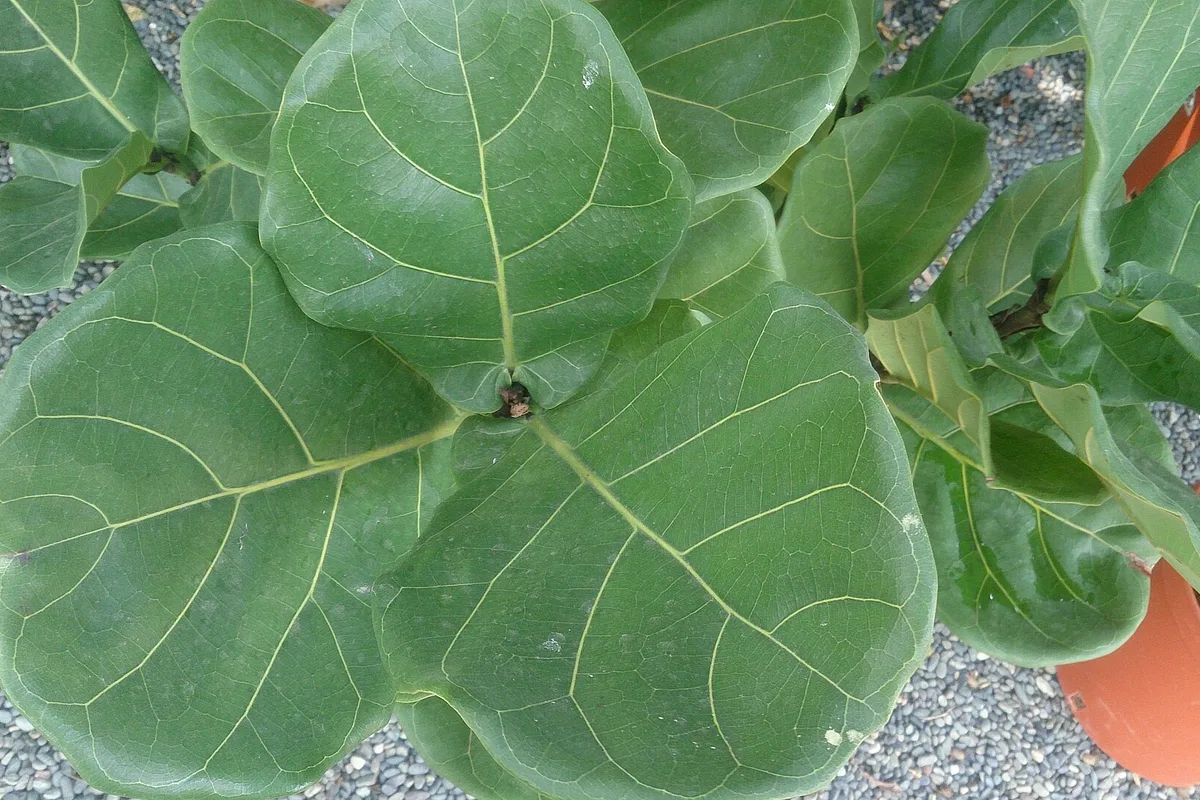
Outdoors, the plant only survives year-round in USDA zones 10 to 12. Everywhere else, it is a houseplant, and it rarely flowers or fruits indoors. It is a cousin of the edible fig, Ficus carica, which you can grow for fruit with our fig tree guide. Like other figs, its stems bleed a milky sap when cut. UF/IFAS and NC State both warn that the sap can irritate skin, so wear gloves when you prune.
Light: Bright, Indirect And Some Direct Sun
Light is the single biggest factor in fiddle leaf fig care. NC State Extension says the plant prefers bright indirect light or partial shade, with protection from afternoon sun. In practice, that means a spot close to a bright window, where the plant sees plenty of sky.
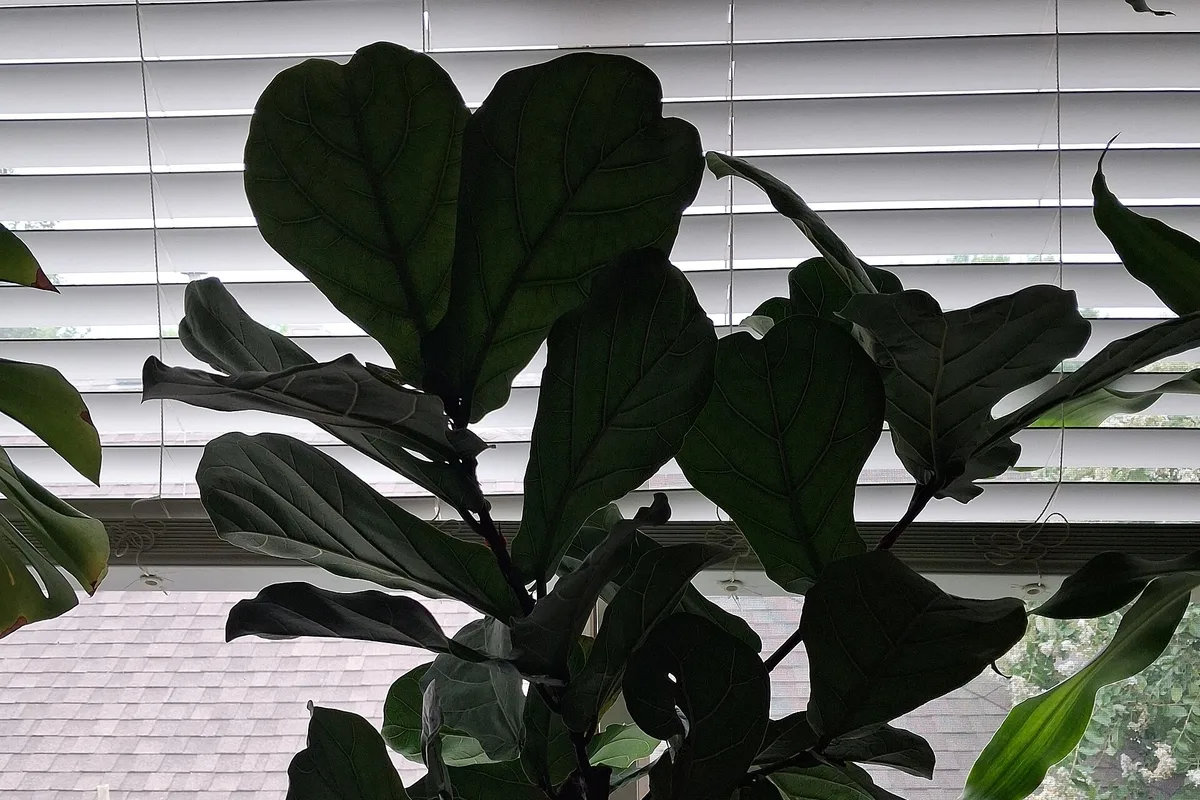
Which Window Works Best
- East-facing: often ideal. Gentle morning sun plus bright light for the rest of the day.
- South-facing: very bright. Set the plant a few feet back, or filter the light with a sheer curtain.
- West-facing: workable, but hot afternoon sun can scorch the leaves. Filter it.
- North-facing: usually too dim on its own. Expect slow growth and leaf loss, or add a grow light.
Can It Take Direct Sun?
Some, yes. A UF/IFAS fact sheet from Santa Rosa County lists partial shade, with 2 to 6 hours of direct sun a day, for plants grown outdoors. Indoors, a few hours of soft morning sun is usually welcome. Harsh midday or afternoon sun is the problem. NC State notes that leaf scorch can occur when the plant gets too much direct sunlight.
Introduce any increase in sun slowly. UF/IFAS research on interior ficus notes that the plants are sensitive to abrupt changes in light. A fig moved from a dim corner straight into a sunny window may scorch, while one moved the other way often drops leaves. Like an olive tree grown indoors, a fiddle leaf fig does best in the brightest spot you can give it, reached gradually.
Signs Of Too Little Light
Low light shows up slowly. New leaves come in smaller, the gaps between them stretch out and the plant leans hard toward the window. Eventually it sheds lower leaves. UF/IFAS lists low light stress as a cause of green leaf drop in ficus and recommends moving the plant to a brighter area.
How To Water A Fiddle Leaf Fig
NC State describes Ficus lyrata as sensitive to overwatering, and notes that both too much and too little water can cause leaf drop. The fix is not a calendar. It is a simple check before every watering.

- Check: push a finger into the mix. The University of Maryland Extension advises letting fig soil dry about a finger’s depth before watering. If the top 1 to 2 inches still feel damp, wait.
- Soak: water slowly over the whole surface until water runs from the drainage hole. This wets the whole root ball, right down to the bottom roots.
- Drain: let the pot finish dripping, then empty the saucer. Clemson HGIC warns that ficus should never be waterlogged or left sitting in water.
How often that adds up to depends on your home. A large plant in a bright, warm room in summer dries out much faster than the same plant in winter, when light is weaker and growth slows. That is why a fixed schedule fails. Clemson suggests letting ficus dry slightly more between waterings in winter.
Overwatering Vs Underwatering
Both cause drooping and leaf loss, so let the soil tell them apart. Wet soil and spreading dark patches point to overwatering. Dry soil pulling away from the pot, with crispy edges, points to thirst. The New York Botanical Garden’s plant help desk notes that swinging between the two extremes also stresses the plant.
Humidity, Temperature And Drafts
Humidity
NC State says the fiddle leaf fig performs best in medium relative humidity. Most homes are fine for much of the year. Winter heating is the main risk, because forced air dries both the room and the soil quickly.
If the air is very dry, run a humidifier nearby or group plants together. A humidifier is a better choice than frequent misting, because wet foliage favors leaf spot diseases. UF/IFAS advises reducing overhead watering to limit bacterial leaf spot on ficus. Keep the plant well away from heating and cooling vents, which blast it with dry air.
Temperature
UF/IFAS recommends 65 to 80°F for interior ficus. NC State advises keeping the plant above 55°F, and UF/IFAS research on ficus goes further: keep plants above 60°F at all times, including during transport. Chilling injury shows up as slimy, dark spots on the leaves and heavy leaf drop.
Drafts And Heaters
Clemson HGIC warns that placing ficus near a heat vent or draft causes excessive leaf drop. NC State links brown spots to temperature swings near vents, and UF/IFAS names malfunctioning space heaters, which release ethylene. Keep the plant away from exterior doors, drafty windows, radiators and air conditioners.
Soil, Pot And Drainage
NC State lists moist, well-drained, loamy, acidic soil as ideal. Indoors, that translates to a quality potting mix that holds some moisture but drains freely. Colorado State University Extension notes that most potting mixes are soilless blends, with peat for moisture and perlite for drainage. Adding extra perlite or fine bark to a standard indoor mix helps air reach the roots.
The pot matters as much as the mix. Use a container with drainage holes. If you love a decorative pot without holes, use it as an outer cover and lift the plant out to water it. Skip the gravel layer at the bottom, too. NC State Extension notes that research shows gravel under the soil actually decreases drainage.
Size the pot to the root ball. A pot that is much too large holds a mass of wet soil the roots cannot use, which raises the risk of rot. The same drainage rules apply to any potted tree, from a fiddle leaf fig to a lemon tree in a container.
Feeding A Fiddle Leaf Fig
Fiddle leaf figs grow mostly in spring and summer, so that is when they need fertilizer. Clemson HGIC recommends feeding healthy ficus every month or two during the growing season with a liquid fertilizer, and skipping feeding while growth is dormant.
- What to use: a balanced or nitrogen-leaning liquid houseplant fertilizer. The University of Maryland Extension suggests a general-purpose fertilizer for leafy houseplants rather than a bloom booster. UF/IFAS research on commercial ficus production uses an N-P-K ratio of about 3:1:2.
- How much: follow the label rate, or dilute it. More is not better.
- When to stop: in fall and winter, when light drops and growth slows.
- When to skip: right after repotting or moving the plant, and whenever it is dropping leaves from stress.
Fertilizer salts build up over time and can burn roots. Water thoroughly enough that some drains out each time, which helps flush excess salts from the mix.
When And How To Repot
Fiddle leaf figs do not need repotting often. Clemson HGIC notes that ficus tolerate being slightly root bound, though badly crowded plants make small leaves and grow slowly. Repot when you see these signs:
- Roots circling the inside of the pot or poking out of the drainage holes.
- Soil that dries out within a day or two of a thorough watering.
- Growth that stalls in spring and summer despite good light and feeding.
- Old soil that has compacted and stays soggy. The University of Maryland Extension suggests fresh mix if a plant has sat in the same soil for more than a year or two.
Spring is the best time, as growth starts. Choose a pot no more than 2 inches wider than the current one, the size step both NC State and Colorado State extension services recommend. Loosen circling roots gently, set the plant at the same depth and water it in well. Then leave it alone: no fertilizer and no moves for a few weeks while it settles.
Some plants eventually get too big to repot. For those, NC State suggests scraping away the top inch of soil where salts have built up and replacing it with fresh mix.
Pruning And Notching For A Fuller Plant
Many fiddle leaf figs grow as a single tall stem. You can leave yours that way, or shape it into a branched tree. Clemson HGIC notes that ficus can be pruned to shape as needed. Do it in spring or early summer, when the plant is growing and can respond with new shoots.
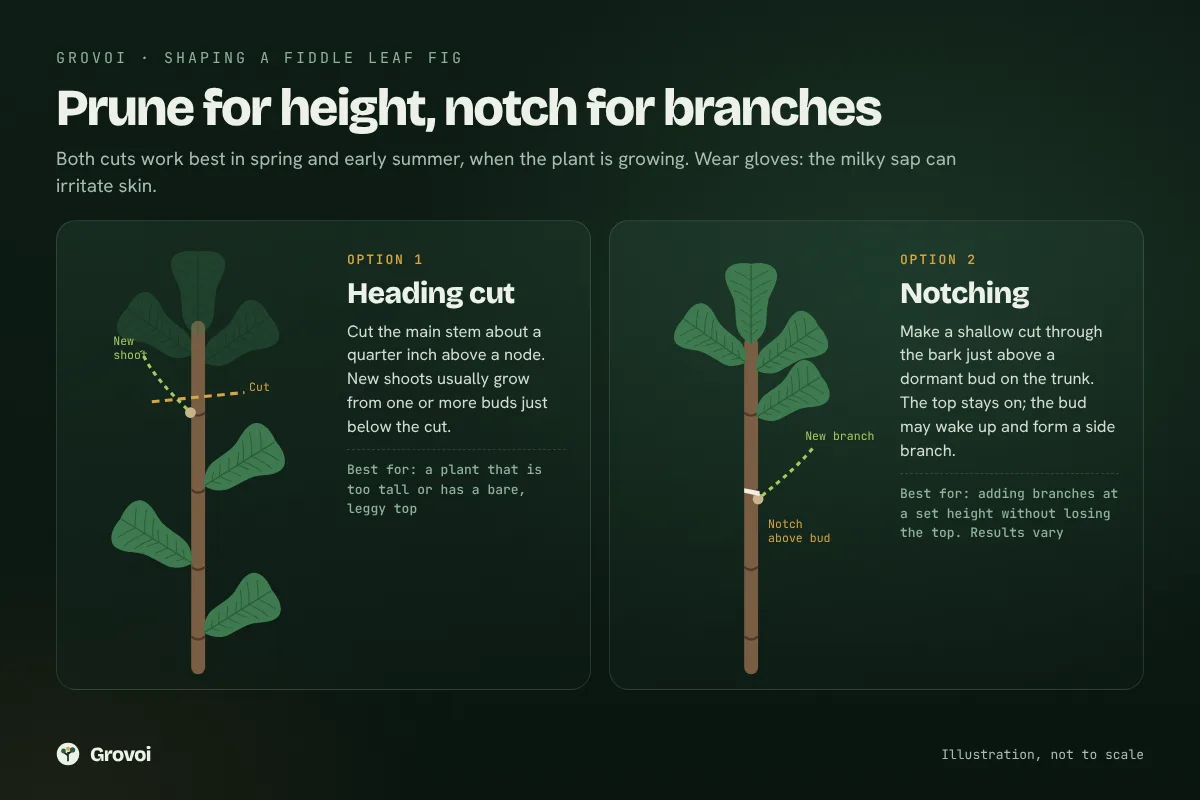
Pruning (Heading Cuts)
To control height or fix a leggy plant, cut the main stem just above a node, the point where a leaf joins the stem. One or more buds just below the cut usually wake up and form new branches. This is the same heading-cut principle covered in our guide on how to prune fruit trees. Use clean, sharp pruners, wear gloves and expect the cut to bleed white sap for a while.
The cut top can become a new plant. NC State recommends stem cuttings for propagation, and UF/IFAS also lists air layering.
Notching
Notching is a gentler option for adding branches without losing height. You make a small, shallow cut through the bark just above a dormant bud on the trunk, at the height where you want a branch. The aim is to interrupt the growth signal coming down from the tip, so that one bud grows out. It is a grower’s technique rather than a guaranteed result. Some notches produce a branch within weeks, while others do nothing. Keep each cut small, and never cut deep into the trunk.
Remove Damaged Leaves
Damaged leaves will not heal, but they still feed the plant. Once new growth fills in, snip them off at the base of the leaf stalk.
Wiping Leaves And Rotating The Pot
Those huge leaves collect dust fast. Clemson HGIC points out that keeping fiddle leaf fig leaves dusted or rinsed matters, because dust interferes with light absorption. Wipe both sides with a soft, damp cloth every few weeks, supporting each leaf with your other hand. Clemson’s houseplant pest guide adds that washing smooth-leaved plants every two to three weeks helps discourage pests.
Skip leaf shine products. The University of Maryland Extension lists leaf shines and home remedies among the things that can cause spotting damage on fig leaves.
Rotate the pot a quarter turn every week or two. Plants grow toward their light source, so a fig that never turns develops a lopsided crown and a leaning trunk. Turn it in place rather than moving it.
Fiddle Leaf Fig Problems: A Symptom Table
When something goes wrong, check three things before you treat: the soil moisture, the roots if the plant is small enough to slide out, and any change in the last few weeks. Then match the symptom below.
| Symptom | Most likely cause | What to do |
|---|---|---|
| Large dark brown or black patches, soil stays wet | Overwatering and root rot | Check roots; trim mushy ones, repot into fresh, fast-draining mix; water less often |
| Crispy tan edges and tips, soil bone dry | Underwatering or very dry air | Water deeply and consistently; move away from vents |
| Scorched, bleached or brown patches on sun-facing leaves | Too much direct sun | Filter afternoon sun or move the plant back from the glass |
| Small water-soaked spots that turn brown | Bacterial leaf spot | Remove affected leaves; keep foliage dry; improve airflow |
| Tiny red or brown dots on new leaves | Edema from uneven moisture | Let the soil dry properly between waterings; empty saucers |
| Green leaves dropping after a move | Shock from new light or conditions | Keep it in its new spot and keep care steady |
| Sudden heavy leaf drop with dark, slimy spots | Cold or chilling injury | Move away from cold glass and drafts; keep above 60°F |
| Lower leaves yellowing one at a time | Normal aging, or a nutrient shortage | Remove spent leaves; feed in spring and summer |
| Fine speckling and webbing | Spider mites | Rinse leaves; treat with insecticidal soap |
| Bumps on stems, sticky leaves | Scale insects | Scrape off early; treat with insecticidal soap |
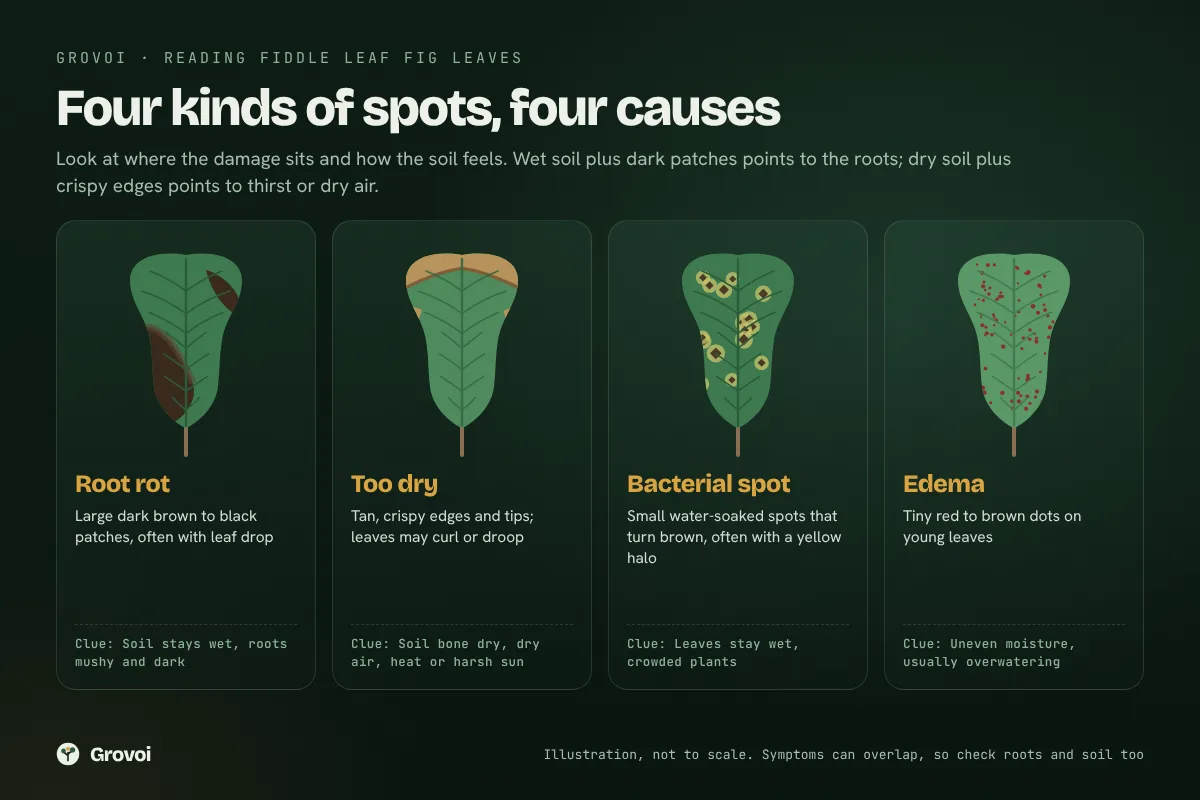
Brown Spots: Root Rot, Dry Edges Or Bacteria?
Brown spots are the most common fiddle leaf fig complaint, and they have several causes. Look closely at the pattern.
- Root rot: large dark brown or black patches, often with leaves dropping, in a pot that stays wet. A Michigan State University Extension master gardener answering a reader’s question linked brown and black spots plus leaf loss to poor drainage and root rot. UF/IFAS notes that root rot organisms such as Pythium and Phytophthora cause yellowing, wilting and root dieback, with well-drained media as the main defense. Slide the plant out: rotted roots are dark, soft and smelly. Trim them, repot into fresh, fast-draining mix and water less often.
- Dry, crispy edges: brown that starts at the leaf edges or tips and feels papery. This points to underwatering, dry heated air or a spot near a vent. Water deeply and consistently, and move the plant away from heat sources.
- Bacterial leaf spot: small, scattered spots that look water-soaked at first and then turn brown. UF/IFAS identifies Pseudomonas leaf spot on Ficus lyrata, with water-soaked, randomly spaced lesions, and also describes Xanthomonas spots on ficus that turn yellow, then brown. Remove affected leaves, keep the foliage dry and avoid splashing water on the plant.
- Sun scorch: pale or brown patches on the leaves facing the window, appearing after a move into stronger light.
Leaf Drop: Moves, Drafts And Cold
Losing several healthy-looking leaves in a few weeks is a stress signal. The usual triggers:
- Move shock: Clemson HGIC notes that ficus often shed leaves when moved to a new location or repotted. UF/IFAS advises not moving, pruning, repotting or fertilizing newly placed ficus for about four weeks. A new plant from the store may drop a few leaves as it adjusts. Pick a good spot and let it settle.
- Drafts: cold air from doors and windows, or hot air from vents and heaters.
- Cold: temperatures below about 60°F, especially leaves pressed against cold winter glass.
- Watering problems: both overwatering and underwatering cause leaf drop, according to NC State.
- Low light: a slow loss of lower leaves in a dim room.
Yellow Leaves
One older, lower leaf yellowing now and then is normal. The University of Maryland Extension notes that gradual yellowing of older lower leaves is a natural process. Several leaves yellowing at once is different. Check the soil first, since overwatering is the most common cause. UF/IFAS links yellow leaf drop in ficus to moisture stress. If watering is right and the plant has not been fed in months, a lack of nitrogen may be to blame; Clemson lists it among the causes of ficus leaf drop.
Red Spots On New Leaves (Edema)
Tiny red or rusty dots on young leaves alarm many owners. They are usually edema, a watering issue rather than a disease. The University of Maryland Extension explains that plant edema is caused by an imbalance of water in the soil and water moving out of the leaf, usually from overwatering. UF/IFAS also lists small red spots on the undersides of ficus leaves as a sign of moisture stress.
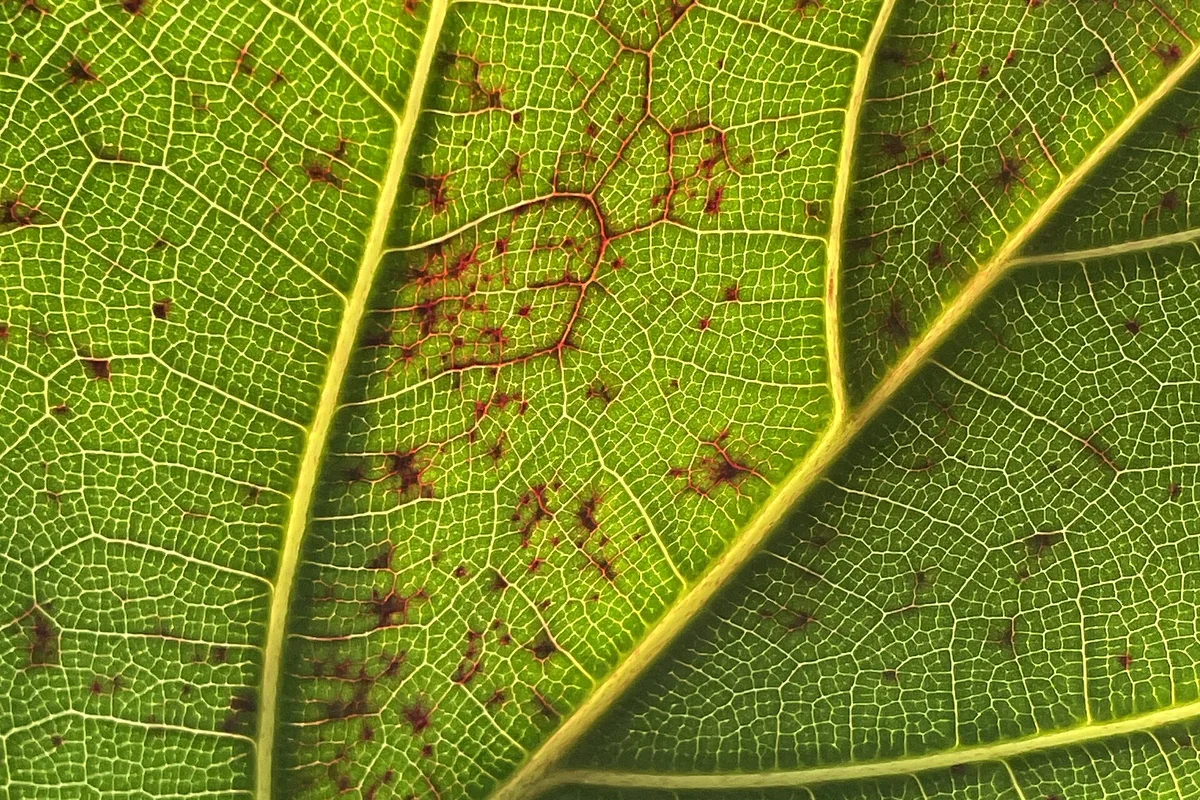
The spots will not fade from affected leaves, but new leaves come in clean once watering evens out. Let the top of the soil dry before each watering, make sure the pot drains and empty the saucer. Maryland’s experts also note that spray damage from pesticides or leaf shine can look similar, so think back to anything you applied.
Pests: Spider Mites, Scale And Mealybugs
NC State lists scale, aphids, mealybugs, thrips and spider mites as pests to watch for on fiddle leaf figs, though it calls none of them serious. Check the undersides of leaves and the stems whenever you wipe the foliage. Clemson HGIC also recommends isolating new plants from the rest of your collection for six weeks.
- Spider mites: too small to see easily, so damage is the first sign. Clemson describes light-colored speckling on the upper leaf surface and, in heavier infestations, a silky web. Rinse the leaves well, then treat with insecticidal soap.
- Scale: small brown or tan bumps stuck to stems and leaf veins. Soft scales excrete sticky honeydew, which leads to black sooty mold. Clemson notes that early infestations can be scraped off with a fingernail. Scale is a familiar problem on potted citrus too, and our citrus tree care guide covers it in more detail.
- Mealybugs: white, cottony clusters in leaf joints and along stems. Clemson suggests wiping each insect with a cotton swab dipped in rubbing alcohol.
Insecticidal soap only works on contact, as Clemson points out, so coat the undersides of leaves as well as the tops. Repeat treatments as the label directs, since one round rarely catches every egg.
Is A Fiddle Leaf Fig Toxic To Pets?
Yes. The ASPCA has no separate entry for the fiddle leaf fig, but its entry for fig plants (Ficus) lists them as toxic to dogs, cats and horses. It names the irritants ficin and ficusin, with gastrointestinal and skin irritation as the clinical signs. NC State Extension’s Ficus lyrata profile rates the poison severity as low and lists oral irritation, drooling and vomiting as symptoms.
Low severity does not mean harmless. Place the plant where pets cannot chew it, and pick up fallen leaves promptly. If a pet eats part of the plant, contact your veterinarian or the ASPCA Animal Poison Control Center at (888) 426-4435.
Fiddle Leaf Fig Care FAQs
How Often Should You Water A Fiddle Leaf Fig?
There is no fixed schedule. Check the soil and water when the top 1 to 2 inches feel dry, then soak the pot until water drains from the bottom. A plant in a bright, warm room in summer needs water far more often than the same plant in winter.
Can A Fiddle Leaf Fig Take Direct Sun?
Some, if you introduce it slowly. A few hours of gentle morning sun usually suits it, but harsh afternoon sun can scorch the leaves. Bright, indirect light near an east window or a filtered south window is the safest choice.
Why Is My Fiddle Leaf Fig Dropping Leaves?
The most common causes are a recent move, cold drafts or hot air from vents, temperatures below about 60°F, overwatering or underwatering, and low light. Keep the plant in one bright spot away from drafts, and water only when the top of the soil is dry.
What Causes Brown Spots On Fiddle Leaf Fig Leaves?
Large dark patches with soggy soil usually mean overwatering and root rot. Crispy tan edges point to dry soil or dry air. Small water-soaked spots that turn brown suggest bacterial leaf spot, and pale patches on sun-facing leaves suggest sun scorch.
Why Does My Fiddle Leaf Fig Have Red Spots On New Leaves?
Tiny red or brown dots on young leaves are usually edema, caused by uneven moisture and most often by overwatering. The spots will not fade, but new leaves come in clean once you let the soil dry properly between waterings and empty the saucer.
Is A Fiddle Leaf Fig Toxic To Cats And Dogs?
Yes. The ASPCA lists ficus plants as toxic to dogs, cats and horses, with stomach upset and skin irritation as the main signs. Keep the plant out of reach, and call your vet or the ASPCA Animal Poison Control Center if a pet eats it.
How Do You Make A Fiddle Leaf Fig Branch?
In spring or early summer, cut the main stem just above a node, and new shoots usually form below the cut. To keep the height, try notching: a small, shallow cut just above a dormant bud on the trunk. Notching does not always work.
When Should You Repot A Fiddle Leaf Fig?
Repot in spring when roots circle the pot or grow out of the drainage holes, or when the soil dries out very quickly. Move up to a pot no more than 2 inches wider, with drainage holes, and use fresh, well-drained potting mix.
Pingback: Bonsai Tree Care For Beginners: Watering, Pruning And Repotting - Grovoi