Rubber Tree Plant (Ficus Elastica): Indoor Care, Pruning And Propagation
On this page
- Rubber Tree Plant Care: The Short Answer
- What Is A Rubber Tree Plant?
- Light: Bright, With Gentle Morning Sun
- How To Water A Rubber Tree Plant
- Humidity, Temperature And Drafts
- Soil, Pot And Drainage
- Feeding A Rubber Tree Plant
- When And How To Repot
- Pruning A Rubber Tree Plant
- Rubber Tree Plant Propagation: Cuttings And Air Layering
- Wiping The Leaves
- Rubber Plant Varieties: Burgundy, Tineke, Ruby And More
- Rubber Tree Plant Problems: A Symptom Table
- Pests: Mealybugs, Scale, Spider Mites And Thrips
- Is A Rubber Tree Plant Toxic To Pets?
- Rubber Tree Plant FAQs
Rubber Tree Plant Care: The Short Answer
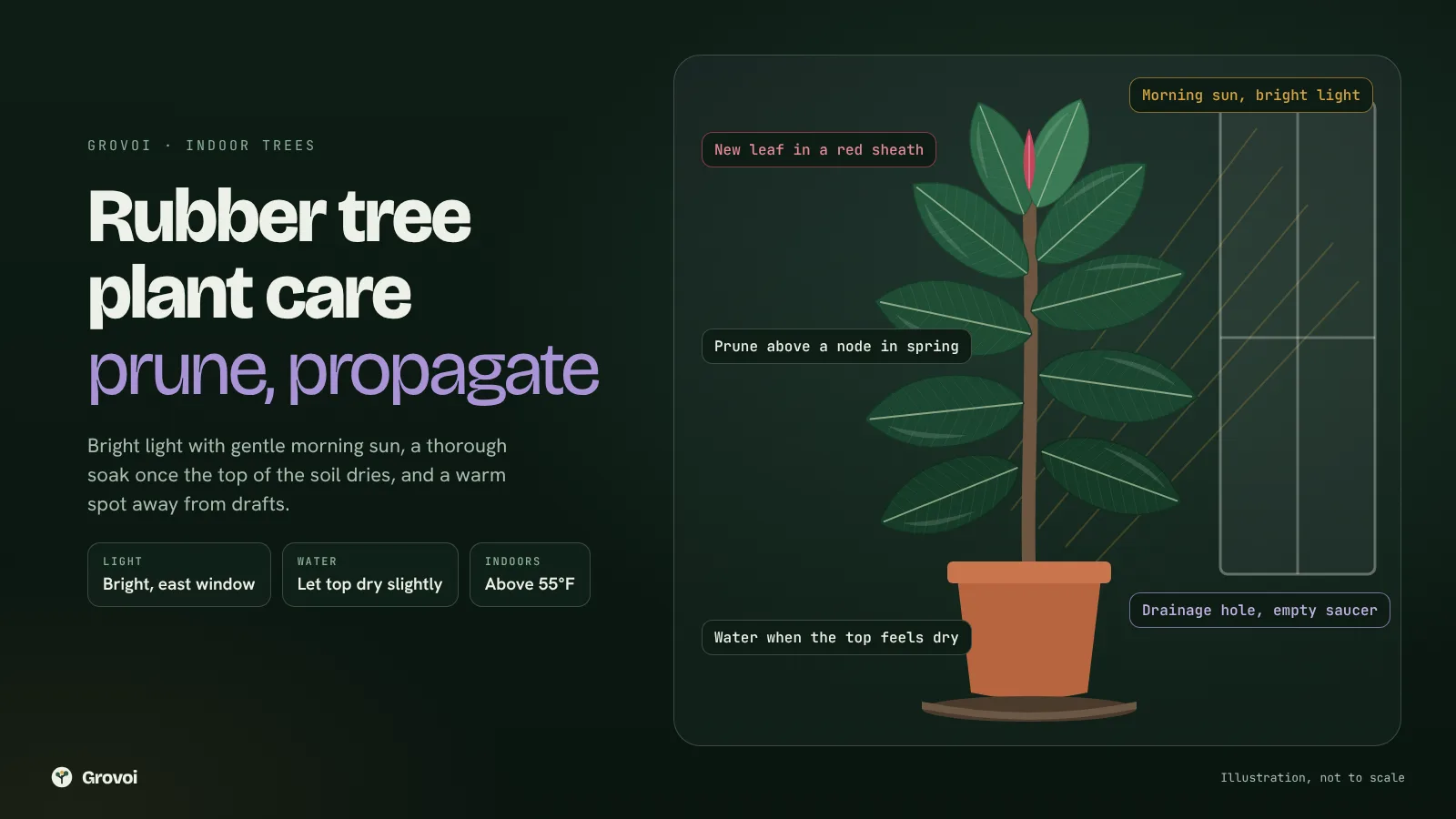
A rubber tree plant is one of the easiest indoor trees to keep happy. Give it bright light, ideally with some gentle morning sun. Water it thoroughly, then let the top of the soil dry before the next drink. Keep it warm, out of drafts and in a pot that drains.
Clemson Cooperative Extension calls rubber plants excellent plants for beginners, and with good reason. They forgive the odd missed watering, tolerate average household air and grow fast in good light. Most problems trace back to the same few causes: too much water, too little light or a sudden change in temperature.
Below, you will find the full care routine, then pruning, propagation, the best varieties and a symptom table for leaf drop, yellow leaves and brown edges. The advice draws on NC State Extension, UF/IFAS, Clemson HGIC, Iowa State University Extension, University of Missouri Extension and the ASPCA. For more trees that thrive indoors, browse our bonsai and indoor trees collection.
What Is A Rubber Tree Plant?
The rubber tree plant is Ficus elastica, a member of the fig and mulberry family. NC State Extension gives its native range as Nepal to China and western Malesia. In the wild, it becomes a huge tree, reaching about 100 feet. UF/IFAS notes that landscape trees in frost-free climates usually reach 35 to 45 feet.
Indoors, it stays far smaller. Clemson HGIC says rubber plants can easily grow 6 to 10 feet tall indoors if there is enough room, and pruning keeps them shorter. Outdoors, NC State lists USDA zones 9a to 12b, while UF/IFAS rates it for zones 10B to 11. Everywhere else, it is a houseplant.
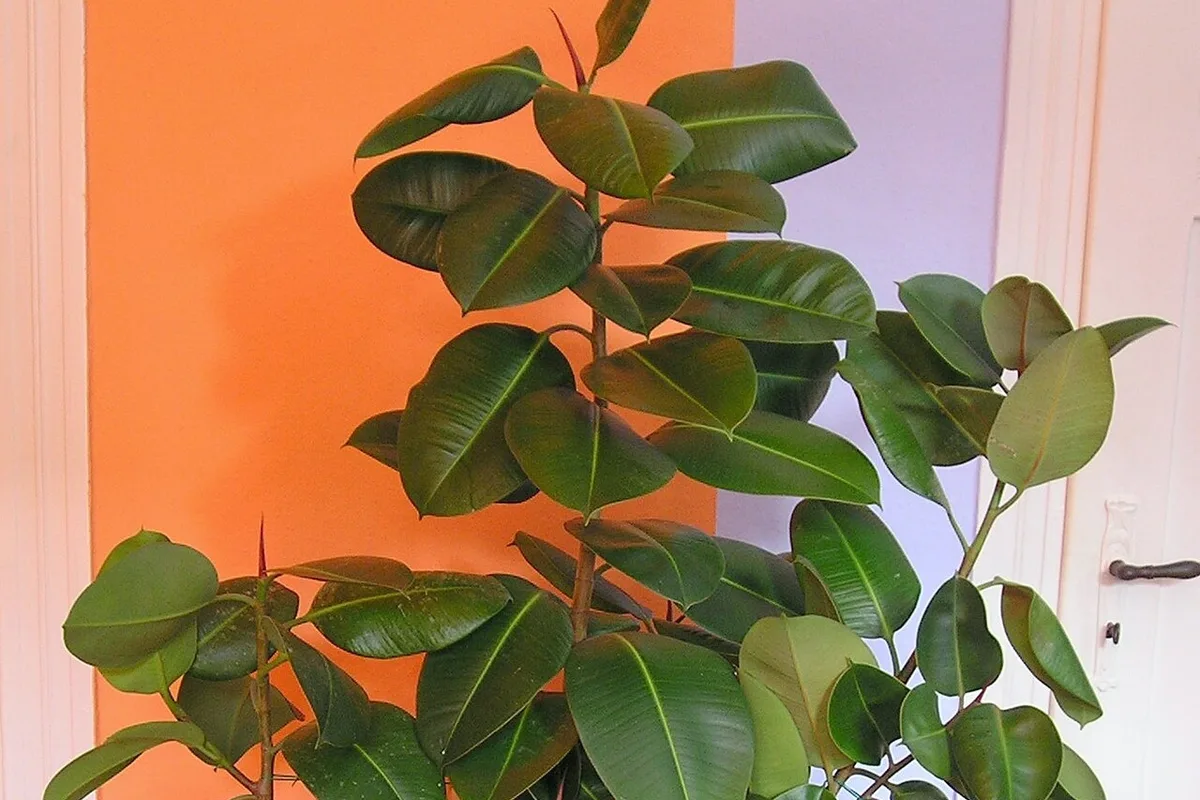
The name comes from the milky latex in its stems and leaves. NC State notes that the sap was once drained to make rubber. The leaves are the main attraction: thick, leathery and glossy, with a raised midrib. Clemson describes them as 8 to 12 inches long, and the cultivar ‘Robusta’ can reach 18 inches.
Watch the growing tip and you will see one of the plant’s best features. Each new leaf unfurls from a slim sheath, which is often red or pink. UF/IFAS notes that the leaves emerge red and turn dark, glossy green. The sheath then dries and drops away. This is normal, not a sign of trouble.
It is a cousin of the edible fig, Ficus carica, which you can grow for fruit with our fig tree guide. Indoors, a rubber plant rarely flowers or fruits, so grow it for the foliage.
Light: Bright, With Gentle Morning Sun
Rubber plants are more flexible about light than many indoor trees. Clemson HGIC says they prefer bright light but adapt to low light, and grow best with morning light from an east window. NC State Extension recommends bright, indirect light or partial shade, with protection from afternoon sun.
Which Window Works Best
- East-facing: the top choice. Soft morning sun, then bright light for the rest of the day.
- South-facing: very bright. Set the plant a few feet back, or filter the light with a sheer curtain.
- West-facing: usable, but filter the hot afternoon sun.
- North-facing: the plant will survive, but growth slows and stems stretch. Add a grow light if you can.
Low Light: Survival Vs Growth
A rubber plant in a dim corner rarely dies quickly. Instead, it slows down. New leaves come in smaller, the gaps between them grow longer and the plant leans toward the window. Over time, it may shed lower leaves. Clemson lists too little light among the causes of leaf loss.
Dark-leaved types such as ‘Burgundy’ and ‘Robusta’ cope best with lower light. Clemson notes that ‘Robusta’ is good in low light. Variegated types such as ‘Tineke’ and ‘Ruby’ have less green tissue in each leaf, so give them your brightest spot to keep growth strong.
Rotate The Pot
Turn the pot a quarter turn every week or two. Plants grow toward their light source, so a rubber plant that never turns develops a lopsided crown and a leaning stem. Change sunlight levels gradually, too. Like an olive tree grown indoors, a rubber plant adjusts best to brighter light in stages.
How To Water A Rubber Tree Plant
Overwatering is the most common way to harm a rubber tree plant. UF/IFAS notes that the soil should become fairly dry between waterings, especially in containers, and that rubber tree makes a nice houseplant if it is not overwatered. Clemson gives the same advice in practical terms.
- Check: touch the soil before you water. If it still feels damp, wait a day or two and check again.
- Soak: once the surface feels slightly dry, water thoroughly until water runs from the drainage holes. Clemson advises watering rubber plants thoroughly, then letting the soil dry slightly to the touch.
- Drain: empty the saucer after watering. Clemson warns that root rot usually comes from a mix that drains slowly or from watering too often.
How often that works out to depends on your home. A plant in a bright, warm room in summer dries out much faster than the same plant in winter. NC State Extension advises reducing watering substantially while the plant is dormant, from fall to late winter. That is why a fixed calendar fails, and the finger test works.
Overwatering Vs Underwatering
Both can cause drooping and lost leaves, so check the soil before you act. Soil that stays wet, with yellowing lower leaves, points to too much water. Clemson notes that leaf yellowing may occur if the soil stays too wet. Soil that has shrunk from the sides of the pot, with limp or curling leaves, points to thirst. UF/IFAS rates the tree’s drought tolerance as high, so a rubber plant usually recovers from a missed watering faster than from soggy roots.
Humidity, Temperature And Drafts
Humidity
Clemson HGIC says rubber plants prefer humid conditions but tolerate the dry air common in homes. NC State lists medium relative humidity. In practice, most homes are fine. Winter heating is the main risk, because forced air dries both the leaves and the soil.
If the air is very dry, run a humidifier nearby or group plants together. Keep the plant well away from heating and cooling vents, which blast it with dry air.
Temperature
Clemson gives ideal temperatures of 75 to 80°F during the day and 60 to 65°F at night. Avoid temperatures below 55°F, sudden drops and cold drafts. NC State also advises keeping the plant above 55°F, and notes that it does poorly in drafts or cold and prefers to stay in one location.
Drafts And Cold Glass
Keep your rubber plant away from exterior doors, drafty windows, radiators and air conditioners. In winter, make sure the leaves do not touch cold window glass. A sudden chill is one of the fastest ways to trigger leaf drop.
Soil, Pot And Drainage
Clemson recommends a well-drained houseplant mix. NC State suggests a soil-based potting mix with good drainage, and notes the plant tolerates occasionally dry soil. A quality indoor potting mix with some extra perlite or fine bark works well. Avoid heavy garden soil, which packs down in a pot.
The pot matters as much as the mix. Use a container with drainage holes. If you love a decorative pot without holes, use it as an outer cover and lift the plant out to water it. Clemson stresses proper drainage holes and an empty saucer.
Size the pot to the root ball. A pot that is far too large holds a mass of wet soil the roots cannot use, which raises the risk of rot. The same drainage rules apply to any potted tree, from a rubber plant to a lemon tree in a container.
Feeding A Rubber Tree Plant
Rubber plants grow mostly in spring and summer, so that is when they need fertilizer. Clemson HGIC recommends a water-soluble houseplant fertilizer every two weeks during active growth. Plants in lower light should be fed less often, because they grow more slowly.
- What to use: a balanced liquid houseplant fertilizer. Leafy plants do not need a bloom booster.
- How much: follow the label rate, or dilute it for plants in lower light. More is not better.
- When to stop: in fall and winter, when light drops and growth slows.
- When to skip: right after repotting, and whenever the plant is stressed or dropping leaves.
Fertilizer salts build up over time and can burn roots. Water thoroughly enough that some drains out each time. For a deeper look at reading fertilizer labels and N-P-K ratios, see our guide to the best fertilizer for fruit trees; the label basics apply to houseplants too.
When And How To Repot
Clemson HGIC advises repotting in late winter or early spring, if needed. A fast-growing rubber plant may need a bigger pot every year or two while young. Older plants can stay put longer. Look for these signs:
- Roots circling the inside of the pot or poking out of the drainage holes.
- Soil that dries out within a day or two of a thorough watering.
- A top-heavy plant that tips over easily.
- Growth that stalls in spring and summer despite good light and feeding.
Choose a pot only one size larger, about 1 to 2 inches wider than the current one. Loosen circling roots gently, set the plant at the same depth and water it in well. Then leave it alone. Skip fertilizer and avoid moving it for a few weeks while it settles.
Once a plant gets too big to repot, refresh it instead. Scrape away the top inch or two of old mix, where salts collect, and replace it with fresh potting mix.
Pruning A Rubber Tree Plant
Rubber plants often grow as a single tall stem. Left alone, they can become tall and lanky indoors. Clemson HGIC suggests supporting them with a stake or pruning them in spring to rejuvenate. NC State notes that pruning the main stems makes a bushier plant, while an unpruned plant keeps a tall, narrow, tree-like shape.
How To Make The Cut
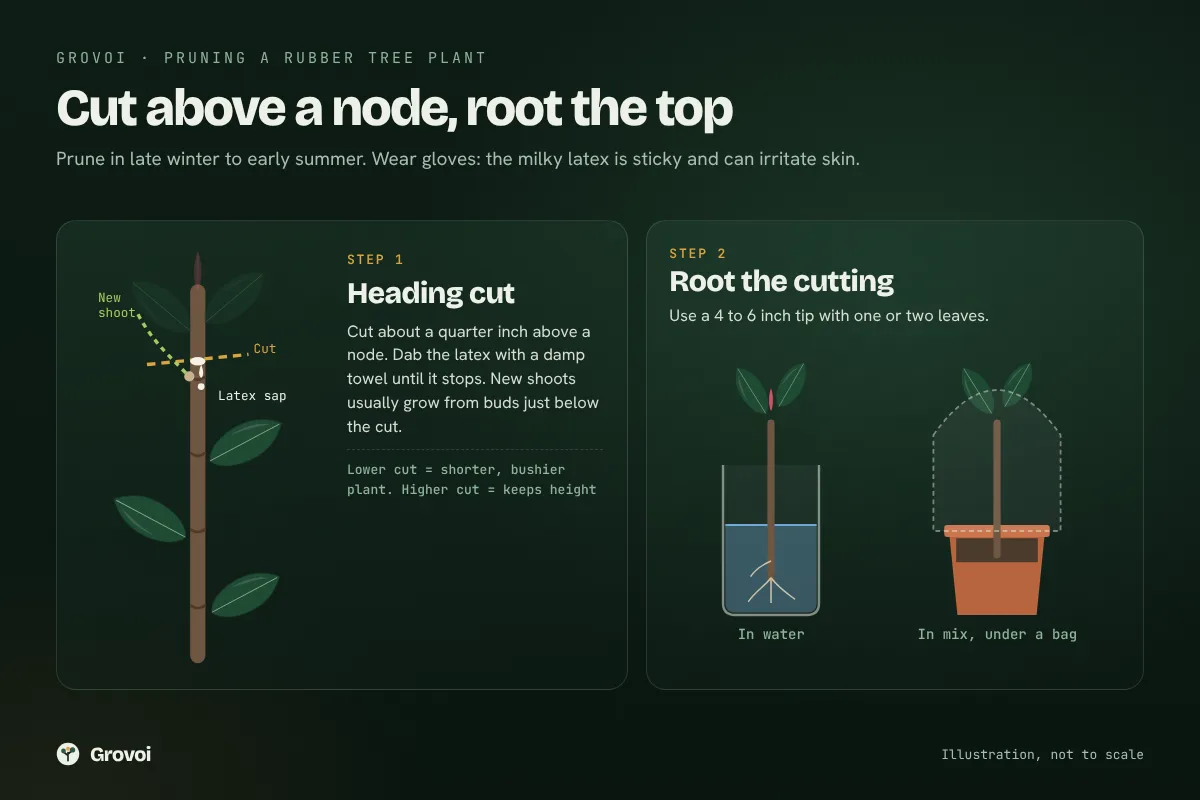
- Pick the timing: late winter to early summer, while the plant is ready to grow.
- Find a node: the point where a leaf joins the stem. Each node has a dormant bud.
- Cut just above it: use clean, sharp pruners and cut about a quarter inch above the node. One or more buds just below the cut usually grow into new branches.
- Manage the sap: the cut will bleed white latex. Hold a damp paper towel against it until the flow slows.
This is the same heading-cut principle covered in our guide on how to prune fruit trees. Cutting higher keeps more height. Cutting lower gives a shorter, bushier plant, but the new shoots take longer to fill in.
Latex Sap: Wear Gloves
The sap is sticky, stains and can irritate. Clemson HGIC warns that the sticky white sap may irritate the skin, or the stomach if eaten. Wear gloves and long sleeves, keep the sap away from your eyes and lay a sheet or newspaper under the plant. If sap gets on your skin, wash it off with soap and water. Anyone with a known latex allergy should take extra care, or ask someone else to do the pruning.
Remove Damaged Leaves
A torn or brown leaf will not heal. Once new growth fills in, snip it off where the leaf stalk meets the stem. Wipe away any sap that beads up.
Rubber Tree Plant Propagation: Cuttings And Air Layering
Clemson HGIC lists stem or tip cuttings and air layering as ways to propagate rubber plants, and UF/IFAS lists layering and cuttings. Pruning gives you the material for free, so plan your cuts with propagation in mind.
Stem Cuttings In Soil
University of Missouri Extension describes rubber plant cuttings as softwood cuttings, since they contain more woody tissue than soft herbaceous cuttings. Its general method suits them well:
- Take a 4 to 6 inch cutting from a vigorous, healthy shoot, cutting just below a node.
- Remove the leaves from the lower half. On a rubber plant, that often leaves just one or two leaves at the top.
- Rinse or blot away the sap, then dip the base in rooting hormone.
- Stick it 1 to 2 inches deep in a moist mix such as equal parts perlite and peat moss.
- Cover the pot with a clear plastic bag to hold in humidity, and keep it out of direct sun.
Missouri’s propagation table notes that rubber plant cuttings need high humidity while rooting. If a large leaf makes the cutting wilt, you can gently roll it up and hold it with a loose rubber band to cut moisture loss. Missouri also notes that rubber plants are sometimes started from leaf-bud cuttings: a single leaf with a small piece of stem and its bud.
Stem Cuttings In Water
Many home growers root rubber plant tip cuttings in a jar of water instead. Set the cutting so that only the bare lower stem sits in water, and keep the leaves dry. Change the water every few days, and keep the jar in bright, indirect light. Once roots are a couple of inches long, pot the cutting in fresh mix and keep it evenly moist for the first few weeks while it adjusts to soil. Water rooting is convenient, but extension guides favor a humid rooting mix, so try both if your first cutting struggles.
Air Layering
Air layering roots a stem while it is still attached to the parent plant. It is ideal for a tall rubber plant with a bare lower stem, because the leafy top becomes a new, shorter plant. Iowa State University Extension lists the rubber tree among the plants suited to this method.
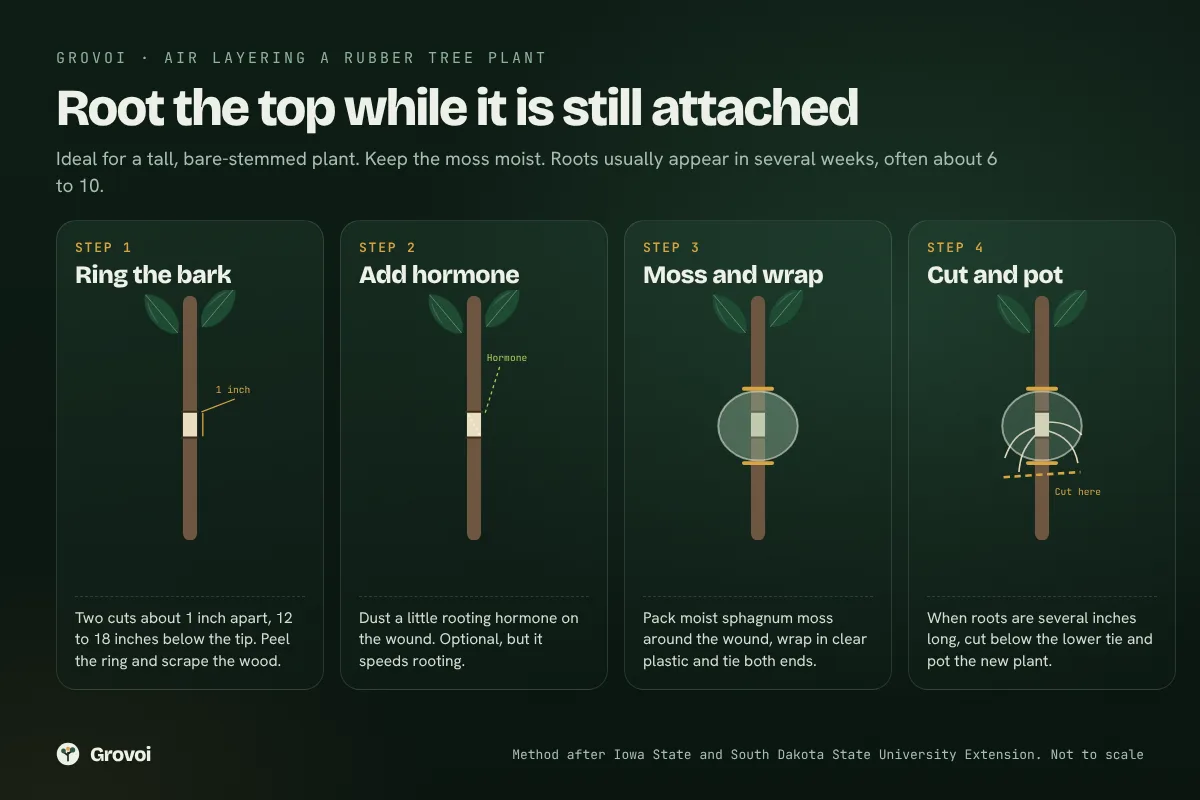
- Choose the spot: Iowa State suggests a point on the stem about 12 to 18 inches from the shoot tip. Remove leaves from that area.
- Remove a ring of bark: make two cuts around the stem, about 1 inch apart, down to the woody center. Join them with a third cut, peel away the ring of bark and scrape off the soft green layer underneath.
- Add rooting hormone: dust a little on the wound. Iowa State notes this is optional but speeds rooting.
- Wrap in moss: pack one or two handfuls of moist sphagnum moss around the wound. Wrap it in clear plastic and tie the plastic above and below so no moss sticks out.
- Wait and check: keep the moss moist. Iowa State says roots should appear within several weeks, and South Dakota State University Extension suggests about 6 to 10 weeks.
- Cut and pot: once roots are several inches long, cut the stem just below the lower tie, remove the plastic and pot the new plant in fresh potting mix.
The parent plant does not need to go to waste. Cut back the remaining bare stem and it will usually push out new shoots below the cut.
Wiping The Leaves
Those broad, glossy leaves collect dust fast. Clemson HGIC suggests washing them with water when they get dusty, to keep the plant attractive and healthy. NC State recommends a damp, soft cloth or sponge. Support each leaf with one hand while you wipe it with the other, and clean both sides. A wipe-down is also a good moment to check for pests on the undersides.
Skip leaf shine products. The natural gloss returns once the dust is gone, and shine sprays can leave residue or spot the leaves.
Rubber Plant Varieties: Burgundy, Tineke, Ruby And More
All rubber plant cultivars share the same care routine. The main differences are leaf color, eventual size and how much light they want. The NC State Extension Plant Toolbox and Clemson HGIC describe these popular choices:
| Variety | Leaves | Notes |
|---|---|---|
| ‘Burgundy’ | Very dark green with deep burgundy tones | NC State lists it at up to 6 feet. Handles medium light well. |
| ‘Tineke’ | Green with cream to pale yellow variegation | NC State lists it at up to 13 feet. Needs bright light. |
| ‘Ruby’ (sold as ‘Red Ruby’) | Green splashed with purple, red and white; reddish pink stems and ribs | NC State lists ‘Red Ruby’ at up to 6 feet. Needs bright light. |
| ‘Robusta’ | Deep green, waxy and very large | The most common type. Clemson says it is good in low light. |
| ‘Decora’ | Broad, thick, dark green with a pale midrib | A widely available classic, per Clemson. |
| ‘Tricolor’ | Green with cream and pink patches | Similar look to ‘Ruby’. Clemson describes cream and pink patches. |
| ‘Doescheri’ | Green with gray and cream splotches and pink ribs | NC State lists it at up to 13 feet. |
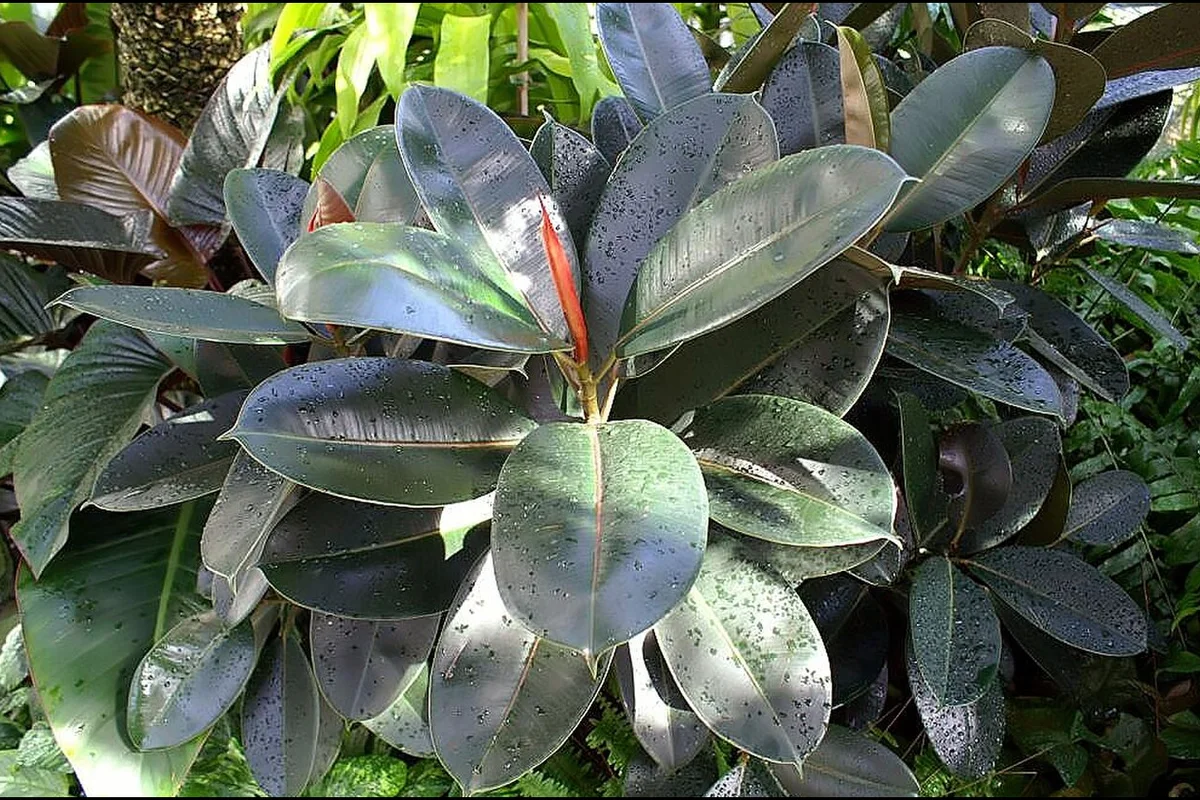
Burgundy Rubber Plant
‘Burgundy’ is the dark, dramatic rubber plant most people picture. Its leaves are deep green with strong burgundy tones, and the new leaves unfurl from a red sheath. Dark green leaves cope better with medium light than variegated ones, so it is a good pick for a room without perfect light.
Tineke Rubber Plant
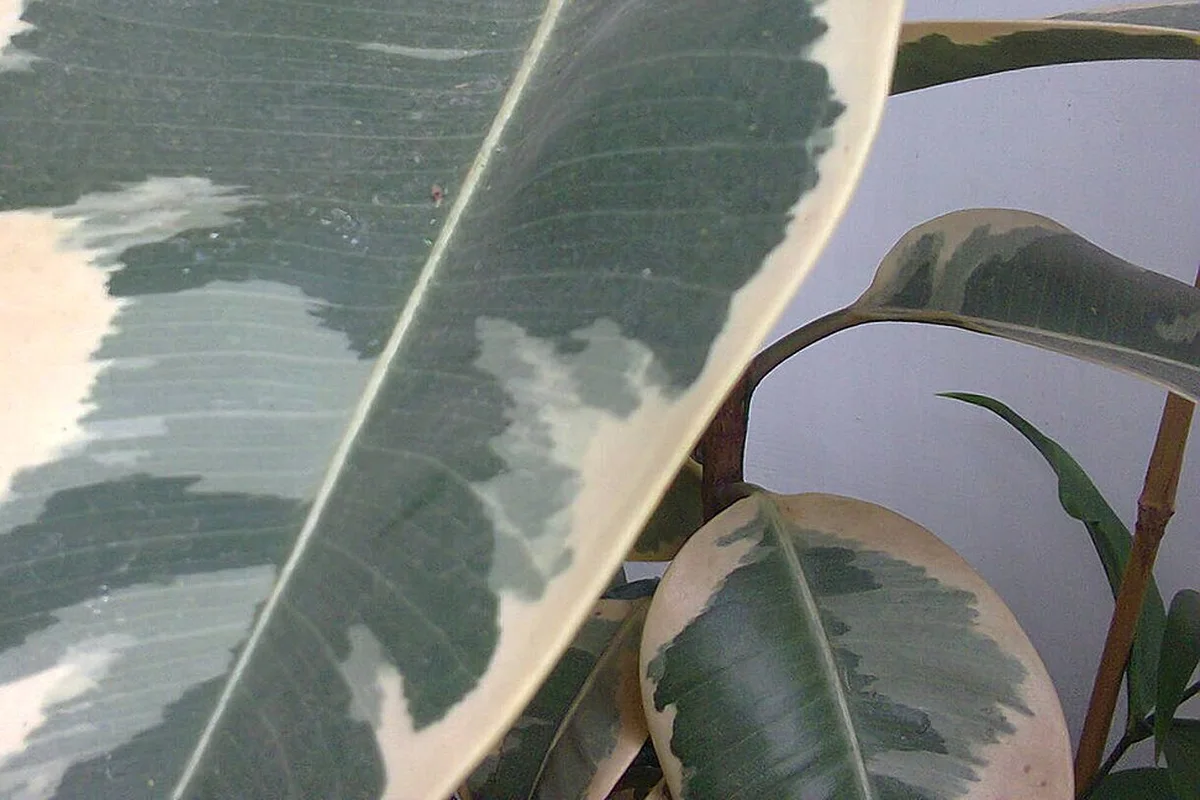
‘Tineke’ has green leaves edged and marbled with cream or pale yellow. The pale areas have little chlorophyll, so the plant may grow a little more slowly than plain green types. Give it bright, indirect light and a little gentle morning sun.
Ruby Rubber Plant
‘Ruby’ looks like ‘Tineke’ with pink. NC State describes green leaves splashed with purple, red and white, with reddish pink stems and ribs. Like ‘Tineke’, it has less green tissue, so give it one of the brightest spots in your home.
Rubber Tree Plant Problems: A Symptom Table
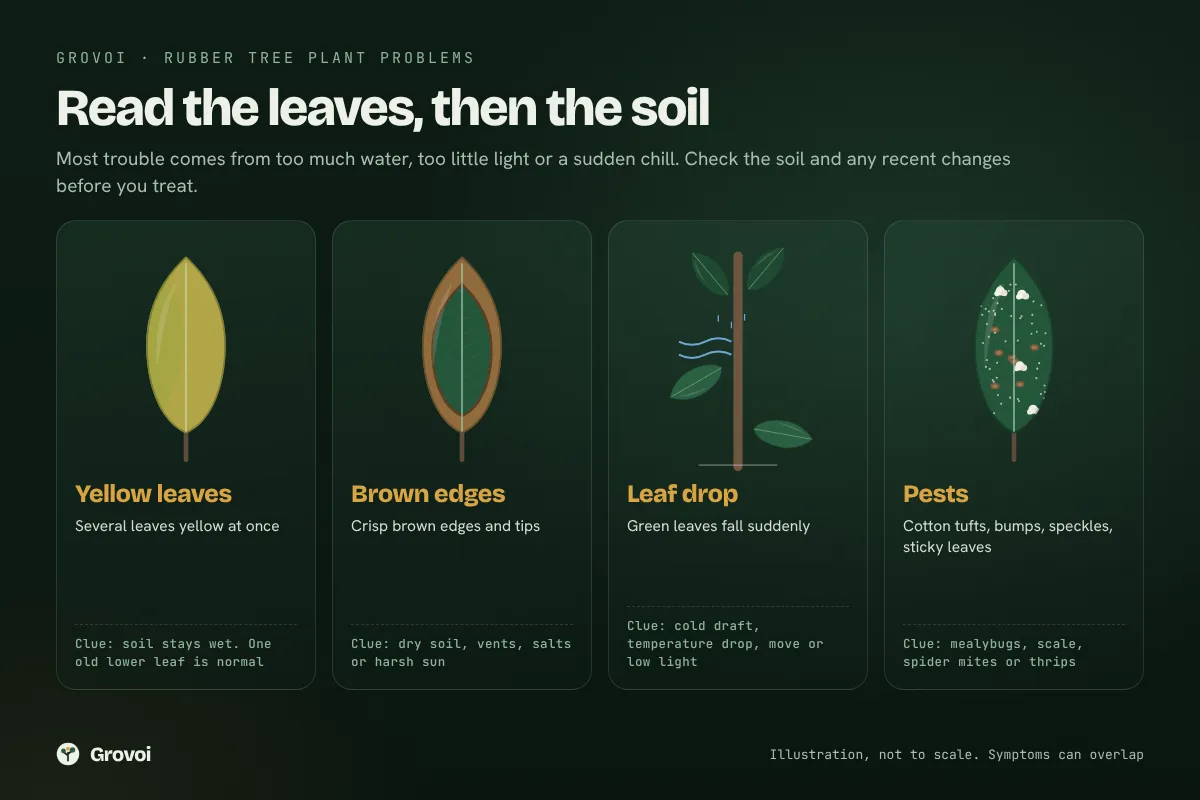
When something goes wrong, check three things before you treat: the soil moisture, any change in the last few weeks and the undersides of the leaves. Clemson HGIC notes that diseases are rarely a problem indoors. Too much or too little water, plus insects and mites, cause most trouble. Match the symptom below.
| Symptom | Most likely cause | What to do |
|---|---|---|
| Green leaves dropping suddenly | Cold draft, temperature drop or a recent move | Move away from doors, vents and cold glass; keep above 55°F; keep it in one spot |
| Slow loss of lower leaves, leggy stems | Too little light | Move to a brighter spot, ideally near an east window |
| Several leaves yellowing at once, soil wet | Overwatering or poor drainage | Let the soil dry more between waterings; check for root rot |
| One old, lower leaf yellowing now and then | Normal aging | Remove it once it yellows fully |
| Brown, crispy leaf edges or tips | Dry soil, dry heated air or salt buildup | Water thoroughly and consistently; move away from vents; flush the soil |
| Brown, soft patches and a sour-smelling mix | Root rot | Trim mushy roots; repot in fresh, fast-draining mix; water less |
| Drooping, curled leaves, soil bone dry | Underwatering | Soak thoroughly and let the pot drain |
| White cottony clusters in leaf joints | Mealybugs | Dab with rubbing alcohol on a cotton swab; treat with insecticidal soap |
| Brown bumps on stems, sticky leaves | Scale insects | Scrape off early; treat with insecticidal soap or horticultural oil |
| Fine pale speckling, fine webbing | Spider mites | Rinse leaves; raise humidity; treat with insecticidal soap |
Rubber Plant Dropping Leaves
Leaf drop is the most common complaint. NC State Extension lists overwatering, temperature drops and cold drafts as causes. Clemson adds too little light and dry air. A rubber plant moved to a new home often loses a few leaves as it adjusts, so pick a good spot and leave it there. NC State also notes that the yellowing and loss of some lower leaves is normal.
Yellow Leaves
Check the soil first. Clemson notes that leaf yellowing may occur if the soil stays too wet, and that root rot usually follows a slow-draining mix or watering too often. If several leaves yellow at once and the soil feels soggy, let it dry more between waterings. Slide the plant out of its pot if the problem continues. Healthy roots are firm and pale, while rotted roots are dark, soft and smelly.
Brown Edges And Tips
Brown that starts at the leaf edges and feels crisp usually means the leaf is losing water faster than the roots can supply it. Dry soil, hot air from a vent and harsh afternoon sun are the usual triggers. Fertilizer salts can also burn the edges. Water deeply, empty the saucer, keep the plant away from heat sources and flush the pot with plain water now and then.
Pests: Mealybugs, Scale, Spider Mites And Thrips
NC State lists mealybugs, scales, spider mites and thrips as pests of Ficus elastica. UF/IFAS notes that no pests are of major concern on the tree, but scales occasionally cause problems. Check the undersides of leaves and the stems whenever you wipe the foliage, and isolate new plants for a few weeks before they join your collection.
- Mealybugs: white, cottony clusters in leaf joints and along stems. Clemson names them as a common pest of rubber plants. Wipe each one with a cotton swab dipped in rubbing alcohol, then follow up with insecticidal soap.
- Scale: small brown or tan bumps stuck to stems and leaf veins. Soft scales excrete sticky honeydew, which can lead to black sooty mold. Scrape off early infestations. Scale is also a familiar problem on potted citrus, and our citrus tree care guide covers it in more detail.
- Spider mites: tiny pests that leave pale speckles on the leaves and fine webbing in heavy cases. They thrive in hot, dry air. Rinse the leaves well and treat with insecticidal soap.
- Thrips: slender insects that cause silvery streaks or distorted new leaves. Rinse the plant and treat with insecticidal soap.
Insecticidal soap works only on contact, so coat the undersides of the leaves as well as the tops. Repeat as the label directs, since one round rarely catches every egg.
Is A Rubber Tree Plant Toxic To Pets?
Yes. The ASPCA’s entry for fig plants (Ficus), which also lists the name Indian rubber plant, rates them as toxic to dogs, cats and horses. It names the irritants ficin and ficusin, with gastrointestinal and skin irritation as the clinical signs. NC State Extension’s Ficus elastica profile also flags the plant as a problem for cats, dogs and horses.
Do not confuse it with the baby rubber plant, Peperomia obtusifolia. That is a different, much smaller plant, and the ASPCA lists it as non-toxic to dogs and cats.
Place your rubber plant where pets and young children cannot chew it, and pick up fallen leaves promptly. If a pet eats part of the plant, contact your veterinarian or the ASPCA Animal Poison Control Center at (888) 426-4435.
Rubber Tree Plant FAQs
How Often Should You Water A Rubber Tree Plant?
There is no fixed schedule. Water thoroughly when the top of the soil feels slightly dry, let the excess drain and empty the saucer. Expect to water more often in a bright, warm room in summer and much less from fall to late winter.
Can A Rubber Tree Plant Live In Low Light?
It can survive in low light, but it grows slowly, stretches toward the window and may drop lower leaves. Bright light with some gentle morning sun, such as near an east window, gives the best growth. Dark green types cope with lower light better than variegated ones.
Why Is My Rubber Plant Dropping Leaves?
The usual causes are cold drafts, a sudden temperature drop, overwatering, too little light or a recent move. Keep the plant above 55°F, away from doors and vents, in one bright spot, and water only when the top of the soil is dry.
Why Are My Rubber Plant Leaves Turning Yellow?
Several yellow leaves at once usually mean the soil is staying too wet. Let it dry more between waterings and check that the pot drains. One old, lower leaf yellowing now and then is normal aging.
How Do You Make A Rubber Plant Bushier?
Prune the main stem in late winter to early summer, cutting just above a node. One or more buds below the cut usually grow into new branches. Wear gloves, because the milky latex sap can irritate skin.
Can You Root Rubber Plant Cuttings In Water?
Yes, many growers root tip cuttings in a jar of water, keeping only the bare stem submerged and changing the water every few days. Extension guides favor rooting in a humid potting mix. Air layering is the most reliable option for large stems.
Is A Rubber Tree Plant Toxic To Cats And Dogs?
Yes. The ASPCA lists ficus plants, including the Indian rubber plant, as toxic to dogs, cats and horses, with stomach upset and skin irritation as the main signs. Keep it out of reach and call your vet if a pet chews it.
How Big Does A Rubber Tree Plant Get Indoors?
Clemson Extension says rubber plants can easily reach 6 to 10 feet indoors if there is room. You can keep one much smaller by pruning it in spring. Outdoors in frost-free climates, the tree grows far larger.