Money Tree (Pachira) Care: How To Grow A Healthy Braided Money Tree Indoors

On this page
- Money Tree Care: The Short Answer
- What Is A Money Tree?
- Light: Bright, Indirect And Filtered
- How To Water A Money Tree
- Humidity, Temperature And Drafts
- Soil, Pot And Drainage
- Feeding A Money Tree
- Braided Money Trees: How They Are Made And Kept Healthy
- Pruning A Money Tree
- When And How To Repot
- How To Propagate A Money Tree
- Money Tree Problems: A Symptom Table
- Is A Money Tree Safe For Pets?
- Money Trees And Feng Shui
- Money Tree Care FAQs
Money Tree Care: The Short Answer
Good money tree care rests on a few simple habits. Give the plant bright, indirect light. Water it deeply, then wait until the top 2 inches of mix are dry. Keep it warm, out of drafts and never standing in water.
That last rule matters most. A money tree grows wild in swamps and along rivers, yet a potted one hates soggy soil. Most problems trace back to the roots: too much water, too little drainage or a sudden change. The braided trunk adds one more twist, because each strand in the braid is a separate plant.
Below, you will find the full routine, how braids are made and kept healthy, and a symptom table for yellow leaves, leaf drop, root rot and pests. The advice draws on NC State Extension, the Missouri Botanical Garden, the New York Botanical Garden, the RHS, extension master gardeners and the ASPCA. For more trees that live happily inside, browse our bonsai and indoor trees collection.
What Is A Money Tree?
The money tree is Pachira aquatica, a tropical tree in the mallow family, Malvaceae. It also goes by Guiana chestnut, Malabar chestnut and French peanut. NC State Extension gives its native range as southern Mexico to Bolivia and northern Brazil. There it grows in freshwater swamps, along riverbanks and in estuaries. The species name, the Missouri Botanical Garden notes, means growing in or near water.
In the wild, the tree can reach about 60 feet. As a houseplant, both NC State and the Missouri Botanical Garden put a typical height at 6 to 8 feet. Outdoors, it survives year-round only in USDA zones 10 to 12.
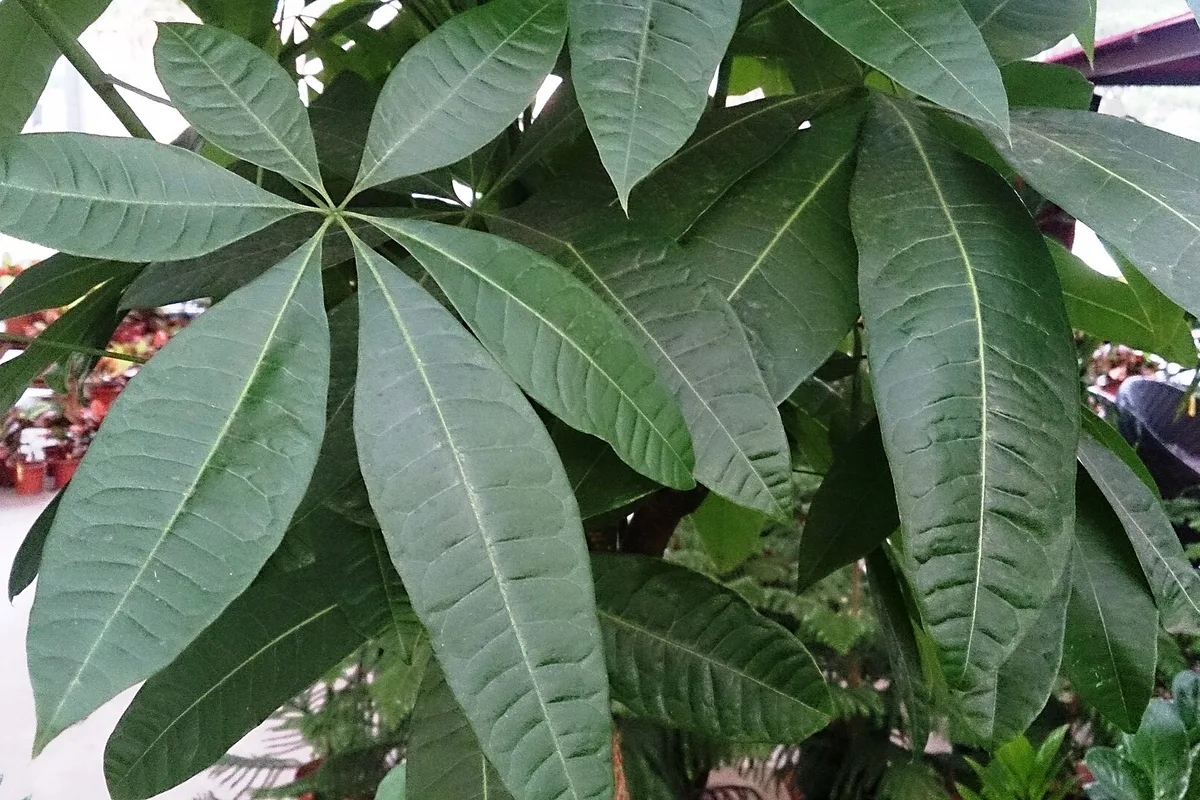
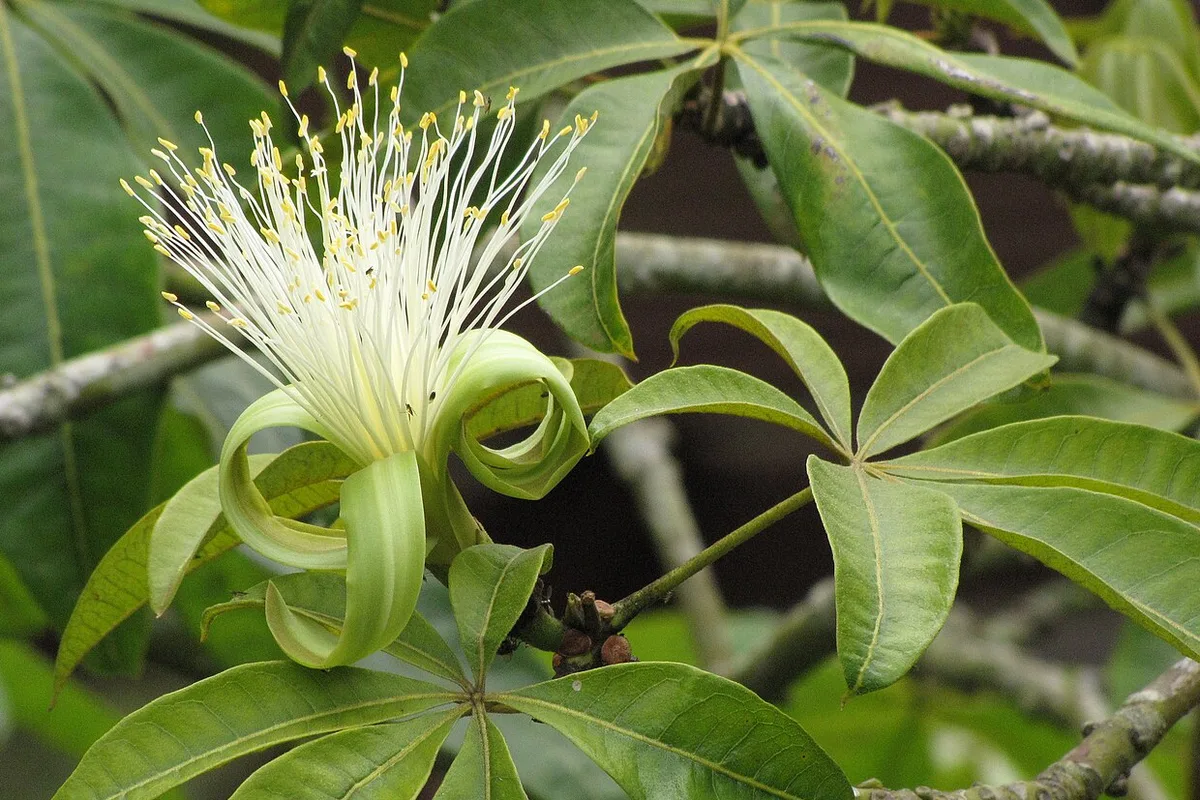
The leaves are what most people recognize. Each one is palmately compound, with 5 to 9 shiny leaflets spreading from the end of a long stalk. The Missouri Botanical Garden describes leaflets up to about 10 inches long. In the tropics, the tree carries huge, fragrant flowers that open for a single night, followed by woody pods of edible nuts. Houseplants rarely flower, and NC State notes that braided plants do not flower at all.
Pachira Aquatica Or Pachira Glabra?
Here is a naming wrinkle worth knowing. Pachira glabra is a separate, accepted species in the same genus, and the two look very alike when young. Some botanists and nurseries say that many small money trees sold as P. aquatica are actually P. glabra. The differences show up mostly in mature trees: P. glabra has all-white flowers and a smoother, greener trunk, while P. aquatica has red-tipped stamens.
For care purposes, the label makes no practical difference. Both are grown the same way indoors, and every step in this guide applies to either one. Like a mango tree, the money tree is a true tropical, so think warm, bright and never frozen.
Light: Bright, Indirect And Filtered
NC State Extension says the money tree prefers indirect sunlight or a mix of sun and shade, and that direct sun can scorch the leaves. The New York Botanical Garden recommends bright, filtered light, adding that the plant will put up with some light shade and keep growing.
In most homes, that means a spot near a bright window, where the plant sees plenty of sky but little harsh sun.
- East-facing: often ideal. Soft morning sun, then bright light for the rest of the day.
- South-facing: very bright. Set the plant a few feet back, or filter the light with a sheer curtain.
- West-facing: workable, but hot afternoon sun can burn the leaflets. Filter it.
- North-facing: usually too dim on its own. Expect slow, stretched growth, or add a grow light.
Rotate the pot a little each time you water. The NYBG suggests this to keep growth even, since the plant leans toward the light. Like an olive tree kept indoors, a money tree does best in the brightest spot you can give it without direct midday sun.
Low light shows up slowly. New leaves come in smaller and paler, stems stretch toward the window and the crown thins. Scorch is faster: bleached or brown patches on the leaflets facing the glass, often after a move into stronger sun.
How To Water A Money Tree
Watering is where most money trees succeed or fail. NC State is blunt: standing water is not tolerated and can cause root rot. Yet the Missouri Botanical Garden notes that the plant also drops leaves if the soil dries out. The goal sits between the two.
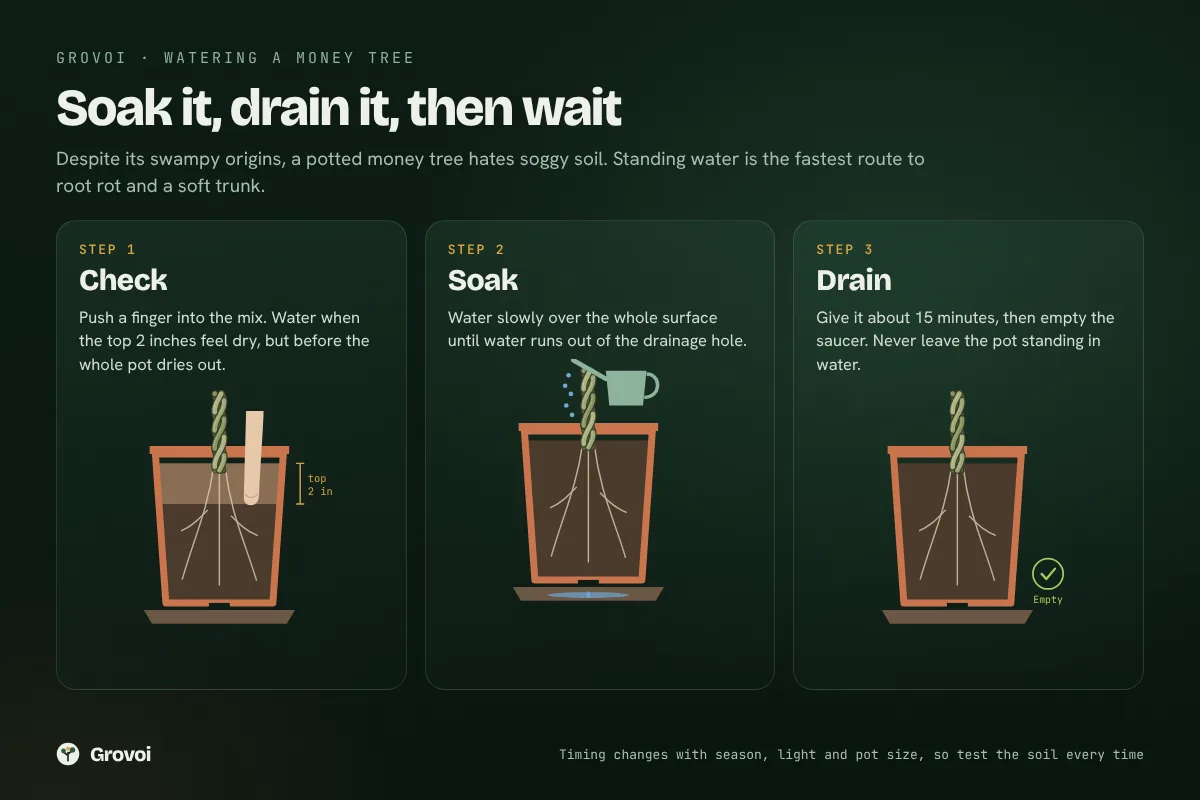
- Check: push a finger into the mix. A Colorado State University Extension master gardener advises watering a money tree when the top 2 inches of soil are dry. The NYBG puts it another way: let the soil nearly dry, but do not let the roots dry out.
- Soak: water slowly over the whole surface until water runs from the drainage hole. This wets the whole root ball, right down to the bottom roots.
- Drain: the NYBG suggests emptying the saucer after about 15 minutes. Never leave the pot sitting in water.
How often that works out depends on your home. A plant in a warm, bright room in summer dries out far faster than the same plant in winter. The NYBG advises adjusting how often you water in winter, when growth slows. That is why a fixed weekly schedule so often leads to rot.
Signs You Are Overwatering Or Underwatering
Overwatering shows as yellow leaves that are not wilted, a mix that stays wet for days and, in time, a soft trunk base. Underwatering shows as drooping, crispy leaflets, soil pulling away from the pot and, in bad cases, a wrinkled, shriveled strand. Feel the soil before you decide, because both can cause leaf drop.
Humidity, Temperature And Drafts
Humidity
NC State says the money tree thrives in a humid environment, and that yellow leaves can appear when humidity is too low. The NYBG suggests gentle humidity of around 50%. Most homes reach that in summer, but winter heating dries the air fast.
If your air is dry, run a small humidifier nearby or group plants together. A pebble tray also helps, as the NYBG notes: set the pot on pebbles in a tray of water, with the pot base above the waterline so the roots never sit wet.
Temperature
NC State gives an ideal range of 65 to 75°F, and the NYBG calls 65 to 85°F ideal. Normal room temperatures suit it well. The RHS rates it as a tender plant that needs a minimum of about 50 to 59°F.
A money tree can spend summer outdoors in dappled shade. NC State advises bringing it inside before temperatures drop to 45°F. The NYBG adds two tips: check leaves and soil for pests before it comes back in, and expect some leaf loss as it adjusts to lower indoor light.
Drafts And Vents
Keep the plant away from air conditioning vents, heating vents, radiators and drafty doors. The NYBG warns against all of these. A blast of hot or cold air can trigger crispy tips and sudden leaf drop.
Soil, Pot And Drainage
NC State recommends a moist, well-drained potting mix of peat moss, perlite, loam or sand. The NYBG asks for a good houseplant soil with plenty of moisture-holding organic matter that still drains fast. Those two needs sound opposed, but a standard indoor mix with extra perlite or fine bark handles both.
The pot matters as much as the mix. Always use a container with drainage holes. Many money trees come in decorative pots without holes, or with plastic sleeves and moss that trap water. Lift the plant out, or move it into a draining pot, before the first watering at home.
Choose a pot sized to the root ball. A pot much too large holds a mass of wet mix that the roots cannot use, which raises the risk of rot. The same rule applies to any potted tree, from a money tree to a young avocado tree growing on a sunny windowsill.
Feeding A Money Tree
A money tree grows mostly in spring and summer, so that is when it needs fertilizer. The NYBG recommends a balanced fertilizer at half strength every two weeks during the growing season, roughly March through September. A Michigan State University Extension master gardener gave similar advice: a balanced liquid feed every two to three weeks at half the label rate.
- What to use: a balanced liquid houseplant fertilizer, with roughly equal numbers for nitrogen, phosphorus and potassium. Our guide to fertilizer numbers and ratios explains what those three figures mean.
- How much: half the label strength is plenty. More is not better, and excess salts can burn roots.
- When to stop: in fall and winter, when light drops and growth slows. The NYBG advises no feeding in winter.
- When to skip: right after repotting, and whenever the plant is dropping leaves from stress.
Water thoroughly enough that some runs out of the pot each time. This flushes built-up fertilizer salts out of the mix.
Braided Money Trees: How They Are Made And Kept Healthy
The braided trunk is the money tree’s signature look. It is also the part of the plant that confuses owners most, so it pays to know what is going on inside the pot.
How The Braid Is Made
A braided money tree is not one plant. The NYBG explains that money trees are often sold with the trunks of several plants braided together. Growers plant young seedlings side by side, then weave their stems while they are still green and supple. NC State notes that the flexible trunks can be braided, and that braiding seedling stems began in Taiwan. A tie or band at the top holds the weave while the trunks thicken.
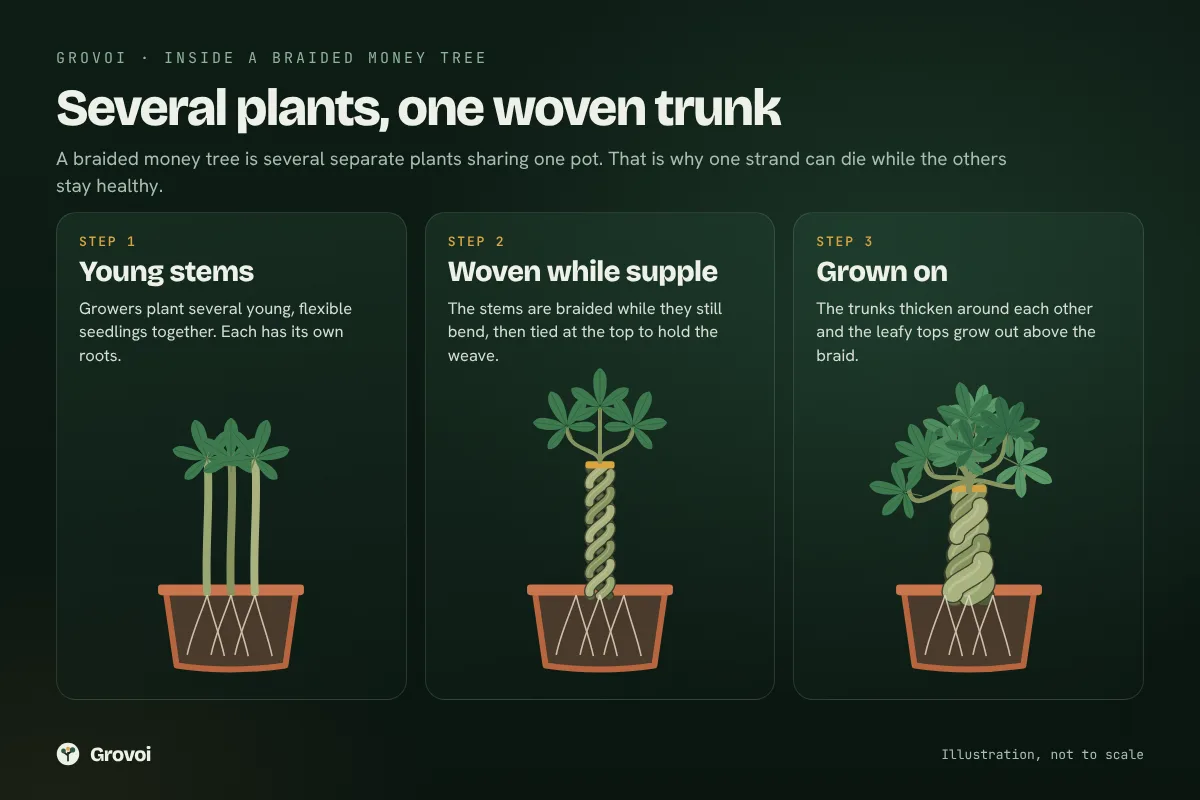
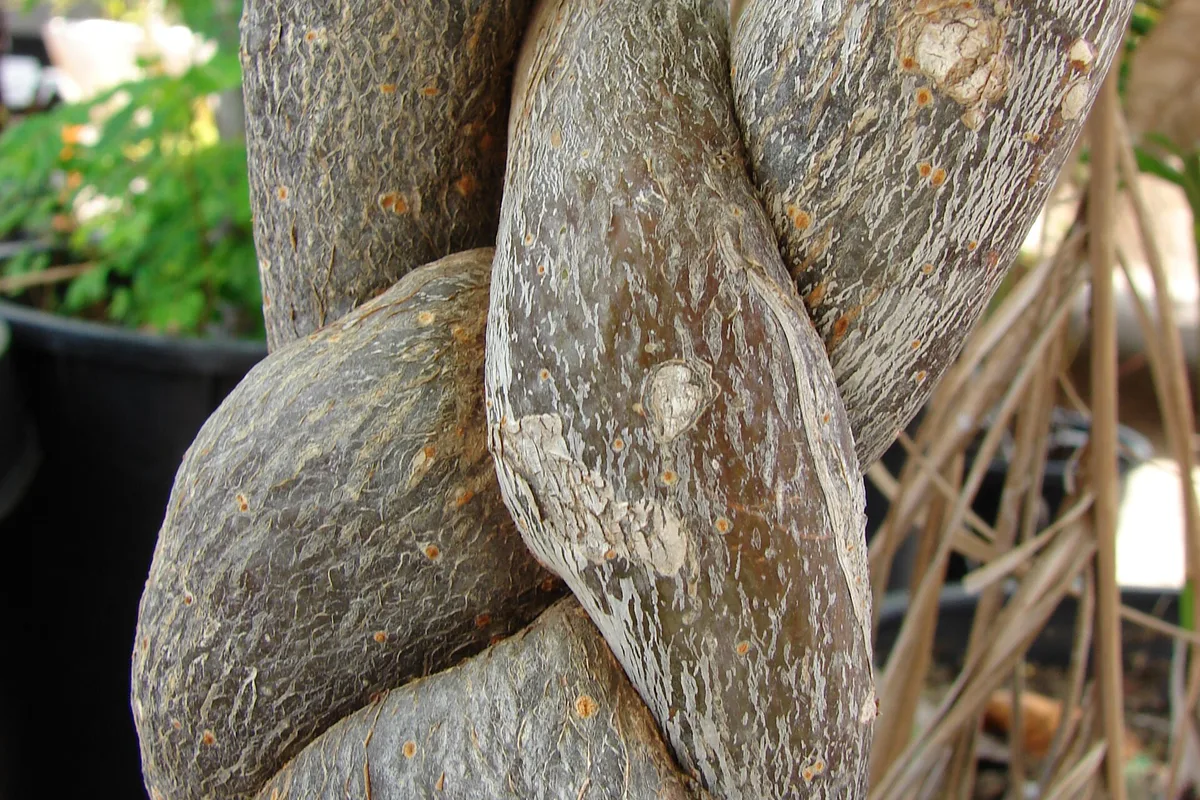
Each strand keeps its own roots, its own leaves and its own health. The trunks press against each other as they grow, which is why an older braid looks swollen and knotted at the base.
Keeping The Braid Healthy
- Water evenly: soak the whole surface of the pot, not one side, so every strand’s roots get a drink.
- Check the tie: look at any band, wire or tape at the top of the braid. If it starts to cut into the bark as the trunks thicken, loosen it or snip it off.
- Do not cut into the braid: the NYBG advises against cutting braided sections. Prune only the leafy stems above it.
- Watch the base: press each trunk gently near the soil once in a while. Firm is good. Soft or wrinkled is an early warning.
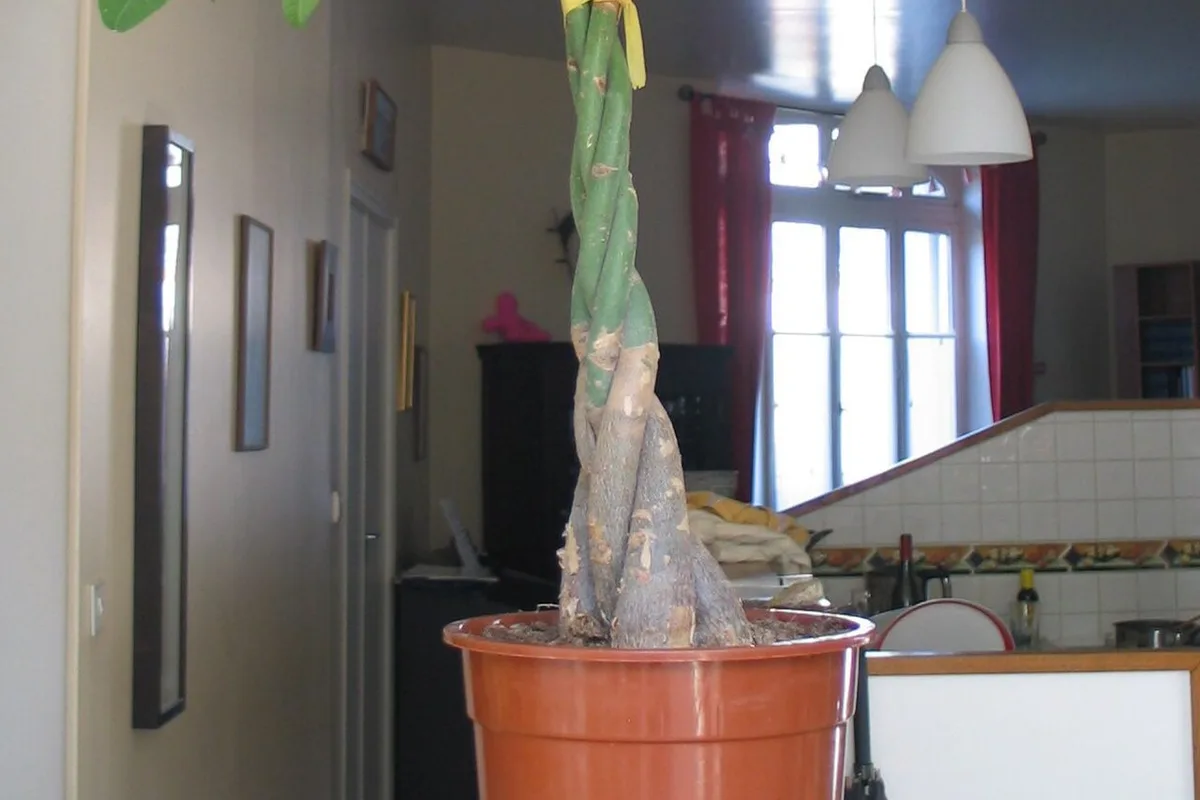
You can also extend the braid. While new top growth is still green and bendy, some owners weave it loosely and tie it softly. Never force a stiff, woody stem, because it can crack.
When One Trunk Dies
Because each strand is its own plant, one can die while the others stay healthy. The usual causes are root rot from soggy mix or a strand that dried out completely. The signs: one trunk turns soft and mushy, or wrinkled and hollow, and its leaves yellow and drop.
A dead strand will not recover, so remove it to protect the rest:
- Check the other trunks. If they are firm with healthy leaves, the plant is worth saving.
- Gently unwind the dead strand from the braid. If it is stuck, cut it into short pieces with clean pruners as you go.
- Wipe the blades with rubbing alcohol between cuts, so you do not spread rot to healthy trunks.
- Pull out the old roots if they come away easily, then check the remaining roots. If several are dark and mushy, repot into fresh, fast-draining mix.
- Water less often from then on, and only when the top 2 inches are dry.
The gap in the braid is permanent, but the remaining trunks will keep growing. A soft tie can help hold a loosened braid together.
Pruning A Money Tree
A money tree can grow tall and leggy indoors, so occasional pruning keeps it bushy. The NYBG says you can remove dead material at any time but should save shaping for spring. The RHS also recommends cutting back shoots in spring to control size.
- Where to cut: the NYBG advises cutting about half an inch above a node or leaf. An Ask Extension expert in Michigan notes that cutting leggy stems just above a leaf node encourages branching lower down.
- How much: remove no more than half the length of any stem, the NYBG says.
- Tools: use clean, sharp pruners, sterilized between plants.
- What to leave: never cut into the braided trunk itself.
Cutting just above a node is the same heading-cut principle covered in our guide on how to prune fruit trees. Buds below the cut wake up and form new shoots. Snip off yellow or damaged leaves at the base of their stalks whenever you see them.
When And How To Repot
The NYBG says a money tree may need repotting every two or three years. Repot sooner if you see these signs:
- Roots circling the pot or growing out of the drainage holes.
- Mix that dries out within a day or two of a thorough watering.
- Old, compacted soil that stays soggy and smells sour.
- A plant that looks top-heavy and tips over easily.
Spring is the best time. The NYBG recommends a pot one size larger, with a drainage hole, and fresh mix. Handle the root ball gently, because the NYBG also notes that money trees often drop leaves when their roots are disturbed too much. Set the braid at the same depth as before, water it in well and skip fertilizer for a few weeks.
Some leaf drop after repotting is normal. An extension expert answering a reader whose money tree yellowed after repotting pointed to root stress, and advised giving it recovery time.
How To Propagate A Money Tree
NC State lists softwood cuttings, layering and seed as ways to propagate the money tree. The RHS adds semi-ripe cuttings and air layering. For most owners, stem cuttings are the easiest route, and pruning gives you the material.
- In spring or early summer, cut a healthy, non-woody stem tip several inches long, just below a node, with a few leaves attached.
- Remove the lower leaves, so only one or two remain at the top.
- Dip the cut end in rooting hormone if you have it.
- Insert it into a small pot of moist, well-drained mix, such as potting mix with extra perlite. Some growers root cuttings in a glass of water instead, then pot them up.
- Keep the cutting warm and in bright, indirect light, with the mix lightly moist. A clear bag over the pot helps hold humidity.
- Tug gently after a few weeks. Resistance means roots have formed.
A rooted cutting grows as a single stem. If you want your own braid, root several cuttings, pot them together and weave them while they are young and flexible.
Money Tree Problems: A Symptom Table
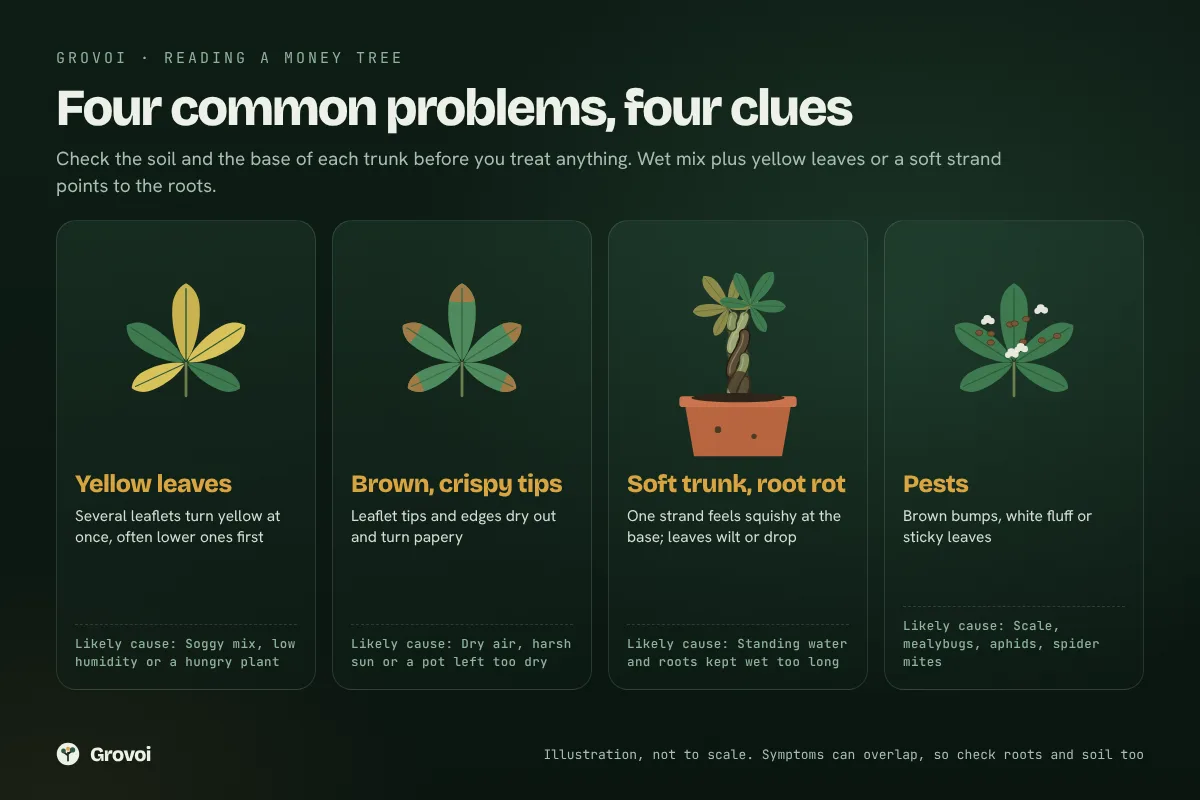
When something goes wrong, check three things before you treat: soil moisture, the base of each trunk, and any change in the last few weeks. Then match the symptom below.
| Symptom | Most likely cause | What to do |
|---|---|---|
| Yellow leaves, soil still wet | Overwatering | Let the top 2 inches dry; check drainage and roots |
| Yellow leaves, soil fine | Low humidity or low nutrients | Raise humidity; feed at half strength in spring and summer |
| Green leaves dropping after a move | Shock from new light, drafts or root disturbance | Keep it in one bright spot and keep care steady |
| Leaves dropping, soil bone dry | Underwatering | Soak thoroughly and check the soil more often |
| Brown, crispy leaflet tips | Dry air, harsh sun or uneven watering | Move out of direct sun and away from vents; raise humidity |
| Bleached or brown patches on sun-facing leaves | Leaf scorch from direct sun | Filter the light or move the plant back from the glass |
| Soft, mushy trunk base, sour smell | Root or crown rot | Remove rotted strands; trim mushy roots; repot into fresh mix |
| One trunk wrinkled and hollow | That strand has died, often from drying out | Remove the dead strand carefully |
| Small pale, stretched leaves | Too little light | Move closer to a bright window or add a grow light |
| Brown bumps, sticky leaves | Scale insects | Dab with rubbing alcohol; rinse; recheck weekly |
| White cottony clusters | Mealybugs | Dab with rubbing alcohol; treat with insecticidal soap |
| Tiny black flies around the soil | Fungus gnats | Let the top of the mix dry; use yellow sticky traps |
Yellow Leaves
One older leaf yellowing now and then is normal. Several at once is a signal. Check the soil first, since overwatering is the most common cause. The NYBG links overwatering to yellowing leaves and rotting stems. A Colorado master gardener notes that yellow leaves that are not wilted suggest overwatering.
If the soil is fine, think about the air and the food. NC State lists low humidity and inadequate soil nutrients as causes of yellow leaves. A bright spot, steady humidity and light feeding in the growing season usually fix it.
Leaf Drop
Losing a handful of healthy-looking leaves in a few weeks is a stress response. The NYBG says money trees dislike being moved and respond by dropping leaves. Other triggers include drafts, root disturbance, dry air, the drop in light each autumn and soil that has dried out completely. Pick a good spot, keep care steady and wait. New leaves usually follow once the plant settles.
Root Rot And A Soft Trunk
Root rot is the most serious money tree problem. NC State names root rot from standing water as a key disease. Signs include wilting or yellowing despite wet soil, a sour smell from the pot and a trunk base that feels soft when pressed.
Act quickly. Slide the plant out and look at the roots. Healthy roots are firm and pale. Rotted roots are dark, mushy and often smell. Trim the rotted roots with clean pruners, remove any strand that has gone soft and repot into fresh, fast-draining mix. Water sparingly until new growth appears.
Pests
NC State lists aphids, mealybugs, scale and fungus gnats as pests of the money tree, and the RHS adds red spider mite. Check leaf undersides and stems each time you water.
- Scale: small brown bumps stuck to stems and leaflets, often with sticky leaves. The NYBG suggests dabbing them with alcohol on a cotton swab, rinsing the plant and checking again weekly. Scale is a familiar pest on potted citrus too, and our citrus tree care guide covers it in more depth.
- Mealybugs: white, cottony clusters in leaf joints. Treat them the same way, then follow up with insecticidal soap.
- Spider mites: fine speckling on leaves and, in bad cases, light webbing. Rinse the plant and treat with insecticidal soap.
- Fungus gnats: tiny dark flies around the pot. The University of Wisconsin Extension says the adults do not harm plants and calls changing conditions the single most important step. Let the top inch of mix dry before watering, and use yellow sticky traps.
Insecticidal soap works only on contact, so coat the undersides of leaves as well as the tops. Repeat as the label directs, since one round rarely gets every pest.
Is A Money Tree Safe For Pets?
Generally, yes. The ASPCA lists the money tree (Pachira aquatica) as non-toxic to dogs, cats and horses. That makes it a popular pick for homes with pets.
Non-toxic does not mean pets should eat it. Any plant can upset a pet’s stomach if chewed in quantity. NC State Extension’s Pachira aquatica profile rates its poison severity as low, notes that cats may get mild stomach upset, and points to the seeds as the part of concern. Houseplants do not produce seeds, so the risk indoors is small. If your pet chews a lot of leaves and seems unwell, call your veterinarian or the ASPCA Animal Poison Control Center at (888) 426-4435.
Money Trees And Feng Shui
The money tree’s name comes from its long link with good fortune in Chinese tradition and feng shui. NC State notes that braiding seedling stems began in Taiwan and was thought to lock in luck or fortune. That history is a big part of why the braided form is so closely tied to the plant’s lucky reputation.
If you place one with feng shui in mind, choose a spot that also suits the plant: bright, indirect light, steady warmth and no drafts. A healthy tree in a good spot is the best way to keep that lucky look.
Money Tree Care FAQs
How Often Should You Water A Money Tree?
There is no fixed schedule. Check the mix and water when the top 2 inches feel dry, then soak the pot until water drains from the bottom. Empty the saucer after about 15 minutes. Expect to water more often in a warm, bright summer room than in winter.
Why Are My Money Tree Leaves Turning Yellow?
Overwatering is the most common cause, especially if the soil stays wet. Low humidity and a lack of nutrients can also turn leaves yellow. Let the top of the mix dry between waterings, raise humidity and feed lightly in spring and summer.
Why Is My Money Tree Dropping Leaves?
Money trees often shed leaves after a move, a repot or exposure to drafts and vents. Dry soil, dry air and the drop in light each autumn can also cause leaf loss. Keep the plant in one bright spot and keep care steady while it settles.
What Should I Do If One Trunk Of My Braided Money Tree Is Soft?
A soft, mushy trunk usually means rot, and that strand will not recover. Gently unwind or cut it out in pieces with clean pruners, check the roots of the remaining trunks and repot into fresh, fast-draining mix if the roots are dark and mushy.
Can You Cut The Top Off A Money Tree?
Yes. Cut about half an inch above a node or leaf in spring, and remove no more than half the length of any stem. New shoots usually grow below the cut. Never cut into the braided section of the trunk.
Is A Money Tree Toxic To Cats And Dogs?
The ASPCA lists the money tree (Pachira aquatica) as non-toxic to dogs, cats and horses. Eating a lot of leaves can still upset a pet’s stomach, so keep the plant out of reach and call your vet if your pet seems unwell.
How Much Light Does A Money Tree Need?
A money tree grows best in bright, indirect or filtered light, such as near an east window or a few feet back from a south window. It tolerates some light shade, but harsh direct sun can scorch the leaves.
When Should You Repot A Money Tree?
Repot in spring every two or three years, or sooner if roots circle the pot or grow out of the drainage holes. Move up one pot size, use a pot with drainage holes and fresh mix, and disturb the roots as little as possible.