How To Prune Fruit Trees: When, Where And How Much To Cut
On this page
- How To Prune Fruit Trees: The Short Answer
- Dormant Pruning Vs Summer Pruning
- When To Prune Each Type Of Fruit Tree
- Central Leader, Modified Leader Or Open Center?
- Where To Cut: Thinning Cuts, Heading Cuts And Branch Collars
- How Much To Cut In One Year
- What To Remove First: The Pruning Order
- Know Where Your Tree Bears Fruit
- Pruning Young, Mature And Neglected Trees
- Pruning Tools And Sanitation
- Fruit Thinning: The Pruning Job After Bloom
- Common Fruit Tree Pruning Mistakes
- Fruit Tree Pruning FAQs
How To Prune Fruit Trees: The Short Answer
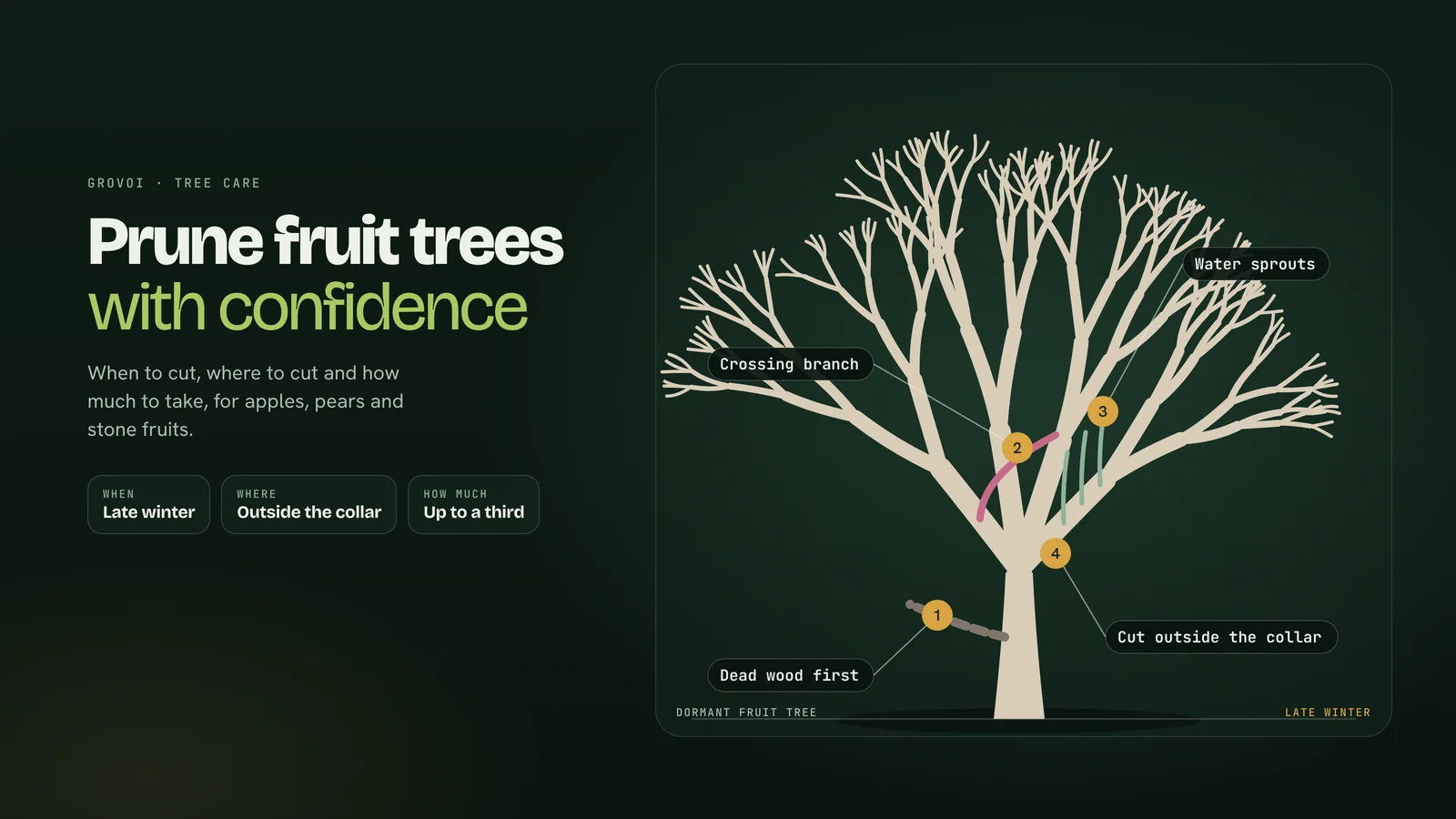
Learning how to prune fruit trees comes down to three questions: when to cut, where to cut and how much to take. Get those right and almost any apple, pear, peach or plum will reward you with stronger limbs, better light and bigger fruit.
Here is the short version. Prune most fruit trees in late winter, just before the buds swell. Cut just outside the branch collar, never flush with the trunk and never leaving a stub. Remove dead, damaged and diseased wood first, then water sprouts, suckers and crossing branches. Finally, stop before you have taken roughly a quarter to a third of the live canopy.
The exceptions matter, though. Apricots and sweet cherries are prone to canker diseases that enter fresh wounds, so they are often pruned in dry summer weather instead. Peaches fruit only on last year’s shoots and need harder cuts every year. The guidance below draws on extension advice from Penn State, UC IPM, Utah State, Oregon State, the University of Nebraska and the University of Missouri.
Dormant Pruning Vs Summer Pruning
Pruning at different seasons produces different results. That is why timing is the first decision, before you pick up a tool.
Dormant Pruning
Dormant pruning happens in late winter while the tree is leafless. It is the main pruning session for most fruit trees. Without leaves, you can see the whole framework, spot crossing limbs and judge how much light reaches the center.
Dormant cuts are also invigorating. The roots hold the same stored energy, but there are fewer buds left to feed. As a result, the tree pushes strong new shoots near the cuts in spring. That is useful on a young tree you are training, and on an older tree that has stopped making new growth.
Timing within winter matters too. Nebraska Extension in Lancaster County notes that cuts made too early leave trees open to cold injury at the pruning sites. Its advice is to prune in late winter, just before new growth starts. Wounds also heal fastest at that point.
Summer Pruning
Summer pruning removes leaves along with wood, so it slows growth rather than spurring it. Gardeners use it to control size, to remove water sprouts while they are still soft and to open the canopy so fruit colors well.
Summer is also the safer season for trees that suffer from canker diseases spread by rain. Keep summer cuts light, though. Heavy pruning in late summer can expose bark to sunscald and encourage soft growth that will not harden before frost.
When To Prune Each Type Of Fruit Tree
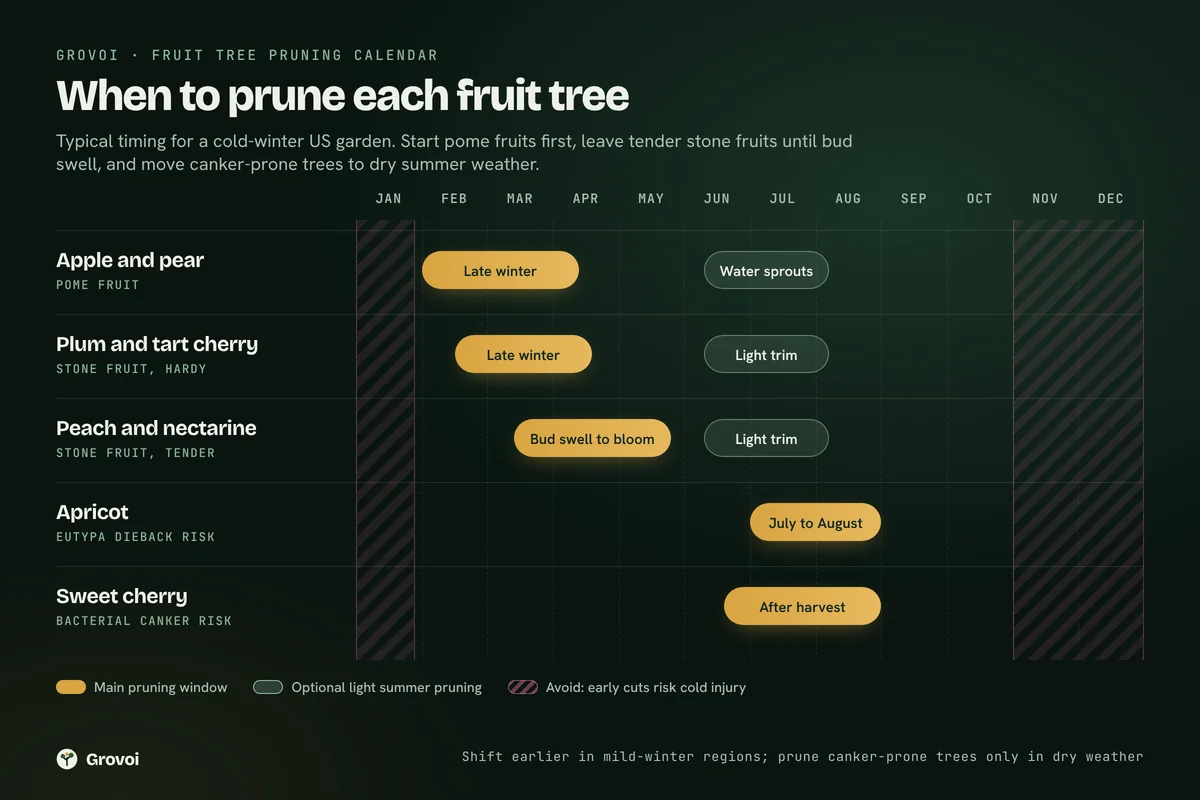
Fruit trees fall into two broad groups. Pome fruits, such as apples and pears, are hardy and forgiving. Stone fruits, such as peaches, cherries, plums and apricots, are more tender and more prone to wood diseases. Use the table as a starting point, then adjust for your own climate.
| Fruit tree | Best pruning time | Why |
|---|---|---|
| Apple and pear | Late winter, before bud swell | Hardy wood; prune these first. Remove fire blight cankers while dormant. |
| Plum and tart cherry | Late winter, after apples and pears | Fairly hardy; light pruning is enough on most trees. |
| Peach and nectarine | Just before or during bloom | Tender wood; late cuts lower the risk of cold injury and canker. |
| Apricot | Summer in dry weather (July or August in California) | Eutypa dieback spores infect fresh wounds during rain. |
| Sweet cherry | After harvest or in dry summer weather | Bacterial canker spreads through wounds in cool, wet weather. |
| Fig, persimmon, pomegranate | Late winter while dormant | Light structural pruning; little annual cutting needed. |
Apples, Pears, Plums And Tart Cherries
Nebraska Extension recommends pruning hardy fruit trees, such as apple, pear, plum and tart cherry, in late winter just before new growth starts. Prune them first, but not before the coldest weather has passed. Tender peaches, apricots and sweet cherries come later, usually from mid-March to early April in Nebraska.
Peaches And Nectarines
Peaches and nectarines are the least cold-hardy of the common fruit trees, so prune them last. Penn State suggests pruning from just before bloom until about 2 weeks after petal fall. Earlier cuts, made before bud swell, raise the risk of Cytospora canker.
Why Apricots And Sweet Cherries Are Pruned In Summer
Apricots and cherries are vulnerable to two wound diseases. The first is Eutypa dieback, a fungal disease whose spores are released during rain and infect freshly cut wood. The UC IPM guide to Eutypa dieback advises pruning apricots and cherries only in July and August in inland California, and in August near the coast. Wounds made in cool weather can stay open to infection for 6 weeks or more, while summer wounds stay susceptible for about 2 weeks.
The second is bacterial canker. Oregon State University calls it most serious on sweet cherry and recommends pruning in dry weather or in summer. If your region has dry summers, pruning these two trees after harvest is the simplest rule. For variety-specific tips, see our apricot tree guide and our guide to growing a cherry tree.
Central Leader, Modified Leader Or Open Center?
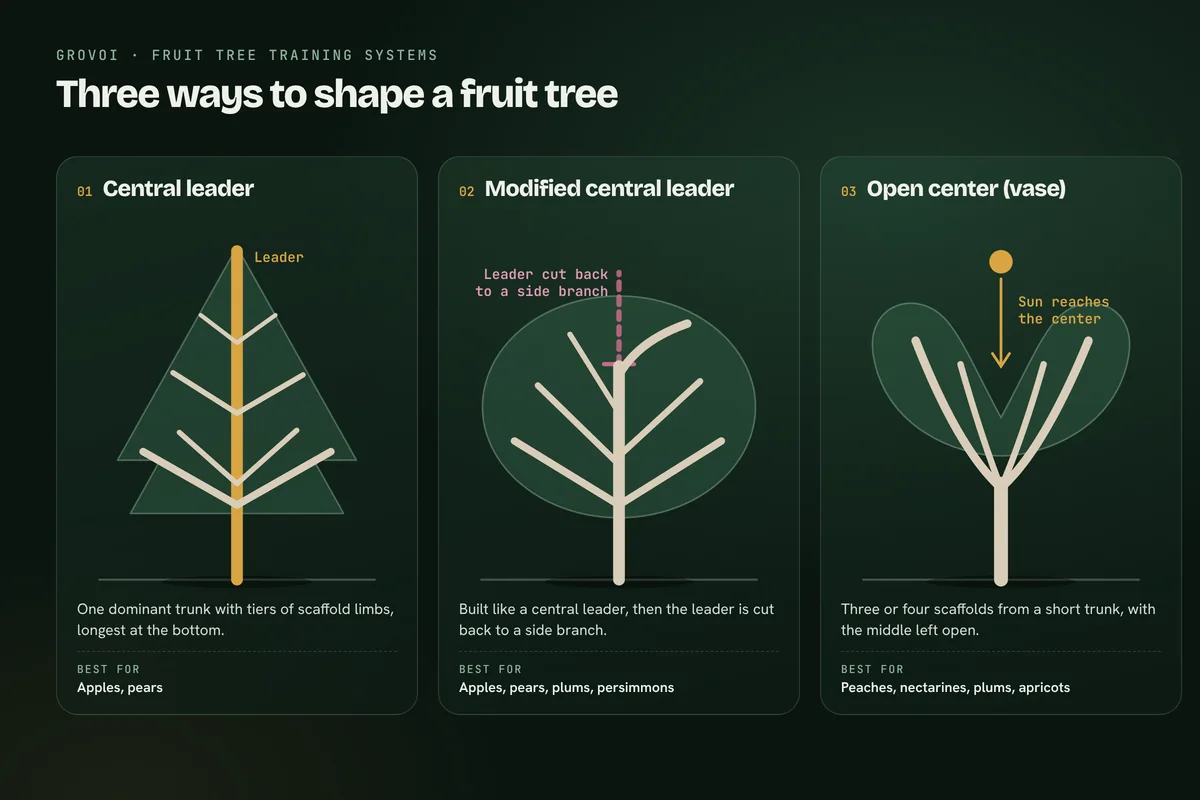
Every pruning cut should support a training system: the long-term shape you are building. Pick one system when the tree is young and prune toward it every year.
Central Leader
A central leader tree has one dominant upright trunk with tiers of scaffold branches spaced along it, so it forms a Christmas tree shape. Lower limbs are longest and upper limbs are shorter, which lets light reach every level. This is the classic system for apples and pears. Keep the leader taller than any side branch, and remove competing uprights that try to replace it.
Modified Central Leader
A modified central leader starts like a central leader. Once the tree has built 4 or 5 good scaffolds, you cut the leader back to a side branch. The result is a lower, more spreading tree that is easier to pick from. Many home growers use it for apples, pears, plums and persimmons.
Open Center (Vase)
An open center tree has no central trunk above the scaffolds. Instead, 3 or 4 main limbs grow outward from a short trunk, leaving the middle open to sun and air. Penn State recommends the system for stone fruits, which are prone to brown rot. Peach, plum and tart cherry also tend to grow in a vase shape naturally.
The Penn State open center training guide gives clear numbers. Head an unbranched young tree at about 24 to 30 inches. Choose 3 or 4 scaffolds that grow 60 to 90 degrees from vertical, about 6 inches apart up the trunk. Then cut each one back by half to an outward-facing bud. On a mature tree, keep the height to about 7 to 9 feet so most fruit stays within reach. Our peach tree guide covers the rest of peach care.
Where To Cut: Thinning Cuts, Heading Cuts And Branch Collars
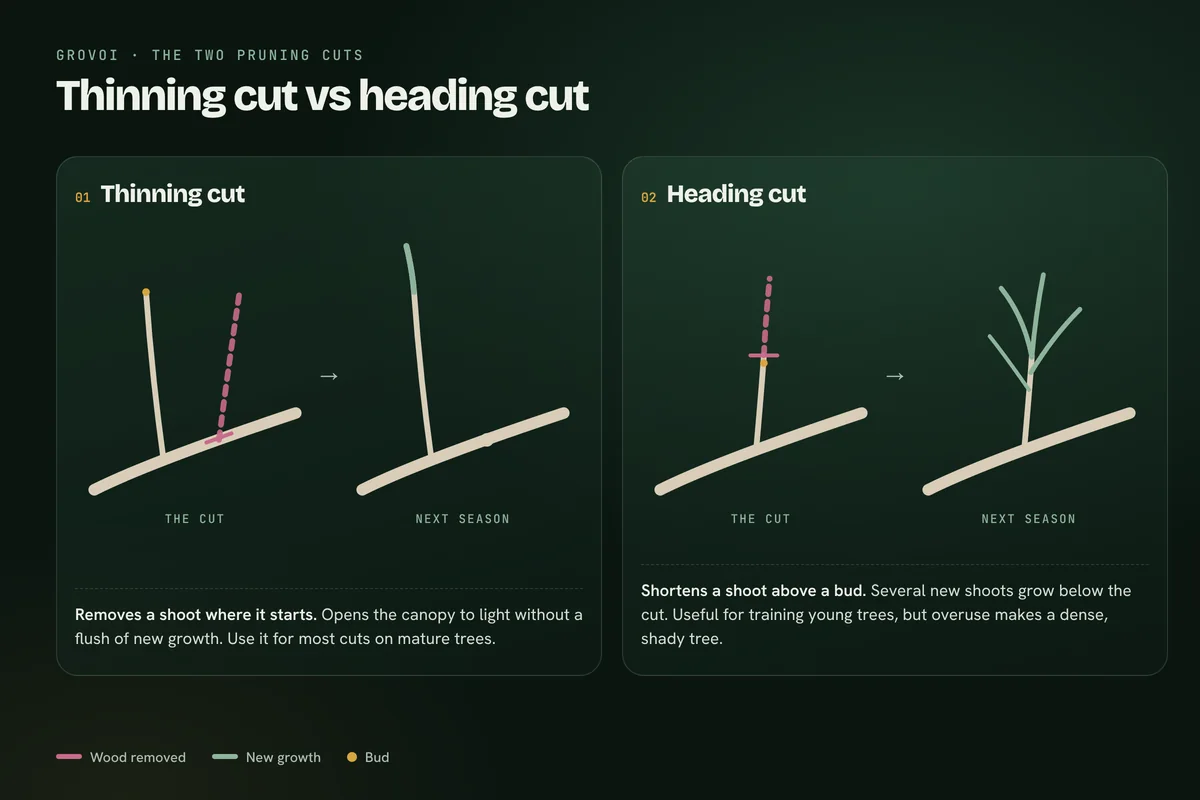
There are only two basic pruning cuts. Knowing which one you are making, and where to place it, is the real skill.
Thinning Cuts
A thinning cut removes a shoot or limb completely, either back to the branch it grew from or back to a side branch. It opens the canopy without triggering a flush of new growth. Utah State University describes it as removing a branch back to a lateral. Most of the cuts on a mature tree should be thinning cuts.
Heading Cuts
A heading cut shortens a shoot partway along its length, just above a bud. Utah State notes that heading cuts encourage lateral growth. Several shoots usually sprout just below the cut. That makes heading useful for forcing branches on a young whip or stiffening a long scaffold. Used all over a mature tree, though, it creates a dense broom of upright shoots that shade the fruit.
When you head a shoot, cut about a quarter inch above a bud that points outward. The new shoot will then grow away from the center of the tree.
Cut Just Outside The Branch Collar
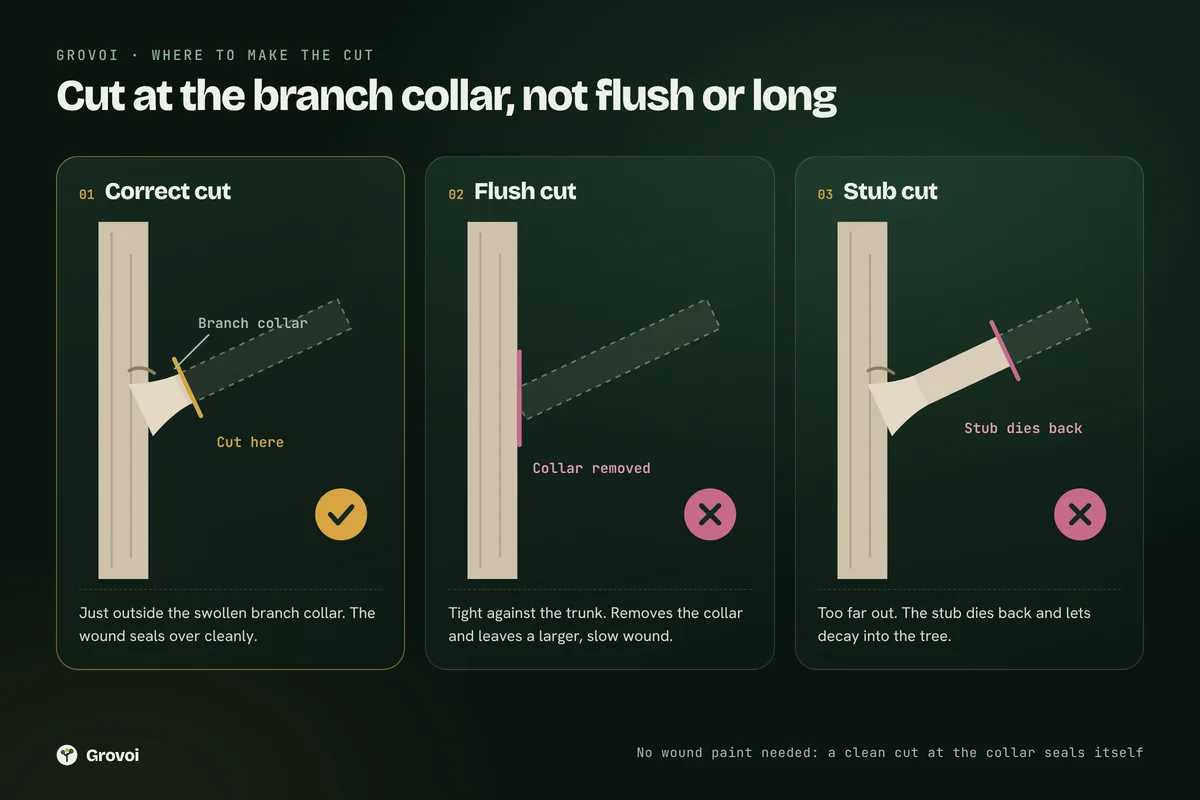
Look where a branch joins the trunk and you will see a slightly swollen ring of bark: the branch collar. It holds the tissue that seals the wound. Utah State advises cutting just outside the collar.
- Flush cut: a cut tight against the trunk removes the collar. The wound is larger and seals slowly.
- Stub cut: a stub left beyond the collar dies back, rots and gives decay an easy entry point.
- Correct cut: a cut just outside the collar, angled slightly away from the trunk, closes over cleanly within a few seasons.
Skip the wound paint. Oklahoma State University Extension says tree wound dressings are not necessary. A clean cut at the collar is the best protection.
Use The Three-Cut Method For Big Limbs
A heavy limb cut from the top will tear a strip of bark down the trunk as it falls. To prevent that, use three cuts:
- Undercut: about a foot out from the trunk, cut upward a third of the way through the limb.
- Top cut: a little farther out, cut down from the top until the limb drops cleanly.
- Final cut: remove the remaining stub just outside the branch collar.
Choose Wide Crotch Angles
Branches that leave the trunk at a narrow, upright angle trap bark in the joint and form a weak crotch. Under a heavy crop or ice, they split. Keep scaffolds with wide angles, and remove narrow ones while they are small. On young trees, wooden spreaders or clothespins can push a new shoot outward.
How Much To Cut In One Year
Most extension guides cap annual pruning at about one-quarter to one-third of the live canopy. The University of Arizona Cooperative Extension puts the limit at one-third. The guide on our apple tree page uses a more cautious quarter for mature apples.
Heavy cuts backfire. A tree that loses too much wood responds with a thicket of water sprouts, which you will have to remove next year. It also sacrifices fruiting wood, so the crop drops.
Peaches and nectarines are the main exception. They fruit only on shoots that grew the previous season, so they need hard cuts every year to keep new fruiting wood coming. Apples and pears need much less, and a lightly pruned persimmon or fig may only need a little thinning.
What To Remove First: The Pruning Order
Working in a fixed order keeps you from overcutting. Step back after each stage and look at the whole tree before moving on.
- The three D’s: remove dead, damaged and diseased wood first, at any time of year.
- Suckers: cut out shoots rising from the rootstock or from the ground near the trunk, right at their base.
- Water sprouts: remove vigorous vertical shoots growing straight up from scaffold limbs.
- Crossing and rubbing branches: keep the better placed of the two and remove the other.
- Inward and downward growth: remove shoots growing into the center or hanging below the main limbs.
- Crowding: finally, thin crowded areas so sunlight reaches the fruiting wood.
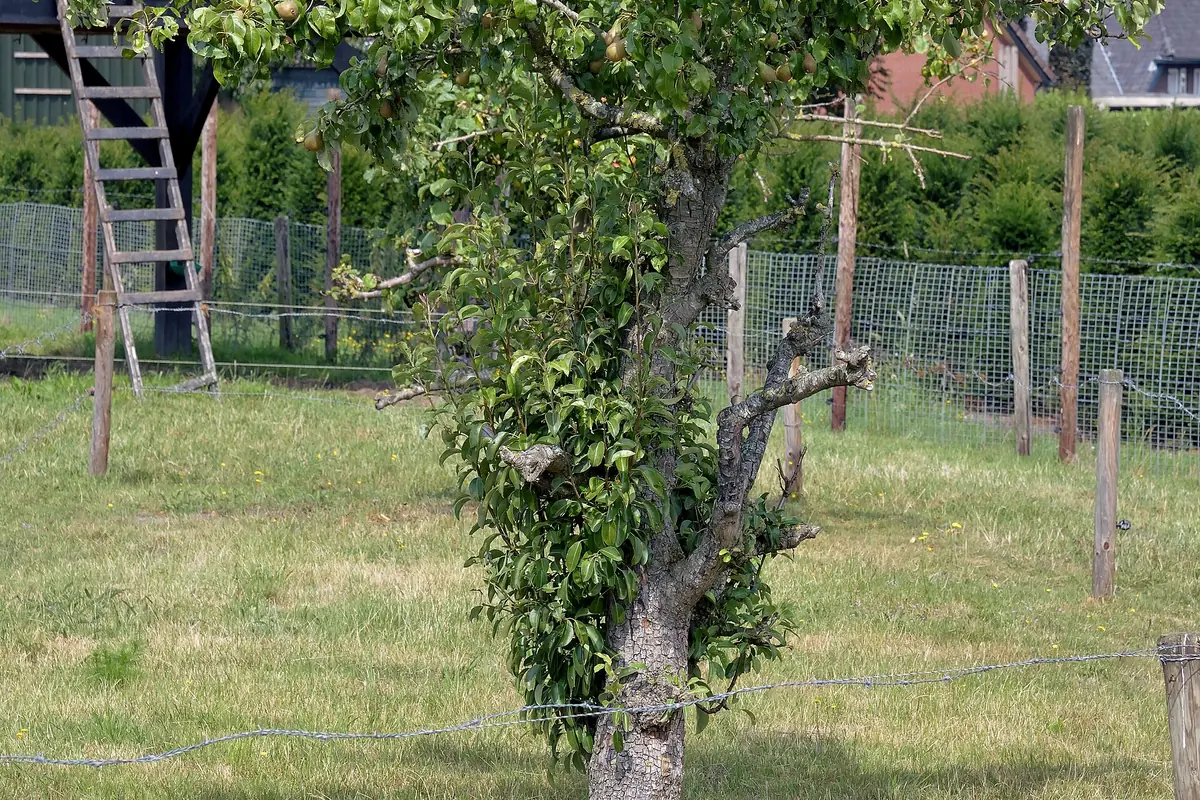
Diseased wood deserves extra care. Cut well into healthy wood and clean your tools between cuts. With Eutypa dieback, UC IPM recommends cutting at least 1 foot below any canker and checking that no discolored wood remains.
Know Where Your Tree Bears Fruit
Before you cut, find the fruit buds. Different trees flower on different ages of wood. A cut that suits a peach can wipe out next year’s crop on an apple.
| Fruit tree | Where fruit forms | Pruning style |
|---|---|---|
| Apple | Short spurs on wood 2 years and older | Moderate thinning cuts; keep healthy spurs |
| Pear | Spurs on older wood | Light to moderate; avoid heavy cuts that push soft growth |
| Peach and nectarine | Only on 1-year-old shoots | Hard annual pruning to renew fruiting shoots |
| Plum and apricot | Spurs and 1-year-old shoots | Moderate thinning; keep some young wood |
| Cherry | Long-lived spurs on older wood; tart cherry also on 1-year shoots | Light pruning, timed for dry weather |
Apples And Pears Fruit On Spurs
Apples bloom mostly on spurs, short and stubby side shoots that carry fat flower buds. Utah State notes that apple fruit forms on spurs 2 years and older, and advises leaving them alone. A healthy spur can bear for years, so a tree with good spur cover only needs moderate thinning. Pears behave similarly. See our pear tree guide for fire blight tips that affect where you cut.
Peaches Fruit On Last Year’s Shoots
Oregon State points out that peaches bear only on 1-year-old shoots. Those are the reddish shoots that grew last summer. A shoot fruits once and is then finished, so the tree must grow fresh shoots every year. That is why peaches are pruned harder than any other common fruit tree. Leave plenty of pencil-thick shoots spread evenly through the tree, and remove old, gray, unproductive wood.
Plums, Apricots And Cherries
Plums, apricots and cherries fall between the two. They carry fruit on spurs, and many also fruit on young shoots. Thin crowded growth and remove some older wood each year, but avoid hard heading cuts. Our plum tree guide covers the differences between European and Japanese plums.
Pruning Young, Mature And Neglected Trees
Young Trees: Build The Framework
The first 3 or 4 years are about structure, not fruit. At planting, head an unbranched whip to set the height of the first scaffolds. Then choose well-spaced, wide-angled branches each winter. Remove shoots that compete with the leader on a central leader tree, or that crowd the center of an open center tree.
Prune young trees lightly overall. Too much cutting delays the first crop.
Mature Trees: Maintain Light And Renewal
A mature, well-trained tree needs a steady routine. Follow the pruning order above, thin crowded growth, and keep the height within reach. Rely mainly on thinning cuts so you do not trigger a mass of new shoots.
Neglected Trees: Renovate Over 2 To 3 Years
An overgrown old tree is tempting to fix in one weekend. Resist. The University of Wisconsin recommends spreading renovation over 2 to 3 years. University of Maine Extension suggests removing only one or two large branches at a time on vigorous trees.
- Year 1: remove dead, diseased and broken limbs, plus one or two large limbs that make the tree too tall or crowded.
- Year 2: thin the water sprouts that appeared after the first cuts. Keep a few well-placed ones to become new fruiting branches.
- Year 3: refine the shape, lower the height further if needed and begin a normal annual routine.
Pruning Tools And Sanitation
Three tools handle almost every home orchard job. Sharp blades make clean cuts that seal quickly, while dull blades crush bark and leave ragged wounds.
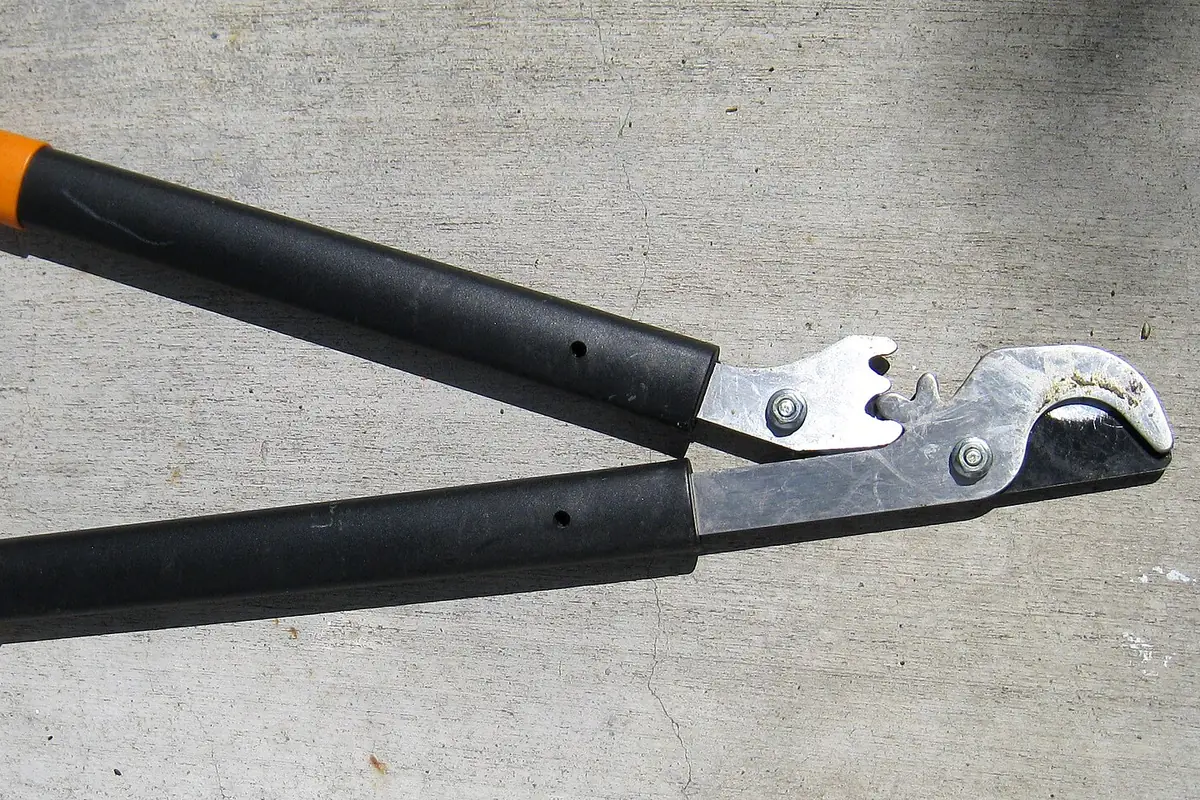
- Bypass hand pruners: for shoots up to about the thickness of your finger. Bypass blades slice like scissors, which is cleaner than anvil pruners that crush.
- Bypass loppers: long handles give leverage for thicker branches and reach into the canopy.
- Pruning saw: a curved, pull-stroke saw for limbs too thick for loppers.
- Pole pruner and orchard ladder: useful on taller trees. A three-legged orchard ladder is steadier on soft ground than a stepladder.
Clean tools stop you from spreading disease from tree to tree. Nebraska Extension suggests dipping blades in 70% alcohol or in a solution of 1 cup household bleach to 9 cups water. Disinfect after each cut when you are removing fire blight or other diseased wood. Bleach corrodes steel, so rinse, dry and oil your tools afterward.
Fruit Thinning: The Pruning Job After Bloom
Pruning reduces the number of flower buds, but most trees still set far more fruit than they can size. Thinning the young fruit by hand finishes the job. It produces larger fruit, eases the weight on branches and helps stop apples from bearing only every other year.
University of Missouri Extension suggests thinning a few weeks after fruit set. Its spacing guide reads:
- Apples, pears, peaches and nectarines: leave about one fruit every 6 to 8 inches along the branch. Early-ripening varieties can be spaced about 10 inches apart.
- Plums: wait until mid to late June, then leave one fruit every 3 to 4 inches.
Twist fruit off gently, or snip it with small scissors so you do not damage the spur. Remove small, damaged or misshapen fruit first.
Common Fruit Tree Pruning Mistakes
- Pruning too early in winter: fresh cuts in midwinter are open to cold injury. Wait until late winter.
- Topping the tree: heading every limb to the same height produces a forest of water sprouts and little fruit.
- Flush cuts and stubs: both slow wound sealing. Cut just outside the collar.
- Removing fruiting spurs: stripping short spurs from apples, pears and cherries removes next year’s crop.
- Too much at once: taking more than about a third of the canopy shocks the tree and triggers vigorous regrowth.
- Winter pruning apricots and sweet cherries in wet climates: rainy-season wounds invite Eutypa dieback and bacterial canker.
- Painting wounds: sealants are not needed and can trap moisture against the cut.
Pruning is only one part of fruit tree care. Some trees need a gentler hand, and our persimmon tree guide shows how little cutting they need. Citrus growers can turn to our citrus tree care guide, since citrus needs only light pruning.
Fruit Tree Pruning FAQs
When Is The Best Time To Prune Fruit Trees?
For most fruit trees, the best time is late winter, just before the buds swell. Prune hardy apples, pears, plums and tart cherries first, and leave peaches and nectarines until just before bloom. Apricots and sweet cherries are often pruned in dry summer weather to avoid canker diseases.
Can You Prune Fruit Trees In Summer?
Yes, but keep summer pruning light. Summer cuts slow growth rather than stimulating it, so they suit water sprout removal and size control. Summer is also the preferred season for apricots and sweet cherries in many climates, because dry weather lowers the risk of wound infections.
How Much Can You Cut Off A Fruit Tree In One Year?
Most extension guides advise removing no more than about one-quarter to one-third of the live canopy in a single year. Heavier cuts trigger a flush of water sprouts and cost you fruit. Spread the renovation of a neglected tree over 2 to 3 years.
Should You Seal Pruning Cuts On Fruit Trees?
No. Extension specialists say wound dressings are not necessary. A clean cut made just outside the branch collar seals naturally, while paint or sealant can trap moisture against the wound.
What Is The Difference Between A Thinning Cut And A Heading Cut?
A thinning cut removes a shoot or limb completely, back to its point of origin or to a side branch, and opens the canopy without much regrowth. A heading cut shortens a shoot above a bud and causes several new shoots to grow just below the cut.
How Do You Prune An Old, Overgrown Fruit Tree?
Renovate it gradually over 2 to 3 years. Start with dead, diseased and broken wood, then remove only one or two large limbs that make the tree too tall or crowded. In later years, thin the water sprouts that appear and keep a few to form new fruiting branches.
Why Does My Fruit Tree Grow So Many Water Sprouts?
Water sprouts are usually a response to heavy pruning, especially large dormant cuts or topping. The tree replaces the lost wood with fast, vertical shoots. Prune more moderately, rely on thinning cuts and remove unwanted sprouts while they are young.
Pingback: Best Fertilizer For Fruit Trees: What, When And How Much
Pingback: Oak Tree: Types, Growth Rate And How To Plant And Care For Oaks - Grovoi
Pingback: How To Graft Fruit Trees: Whip, Cleft And Bud Grafting For Beginners - Grovoi