Dwarf Fruit Trees For Pots: 15 Best Varieties And How To Grow Them
On this page
- Dwarf Fruit Trees For Pots: The Short Answer
- Dwarf, Semi-Dwarf, Columnar And Genetic Dwarf Trees
- Dwarfing Rootstocks For Container Trees
- 15 Best Dwarf Fruit Trees For Pots
- Dwarf Fruit Trees For Pots Compared
- Pollination: Which Trees Need A Partner?
- Pot Size And Material
- Potting Mix And Planting
- How To Water Fruit Trees In Pots
- Feeding Potted Fruit Trees
- Pruning A Dwarf Tree In A Pot
- Overwintering Potted Fruit Trees
- Repotting And Root Pruning
- Common Problems And Fixes
- Dwarf Fruit Trees For Pots FAQs
Dwarf Fruit Trees For Pots: The Short Answer
The best dwarf fruit trees for pots are small by nature or grafted onto a dwarfing rootstock. Good picks include Improved Meyer lemon, calamondin, kumquat, Key lime, a genetic dwarf peach such as ‘Bonanza’, the fig ‘Little Miss Figgy’, the pomegranate ‘Nana’, and apples or cherries on dwarfing roots.
Size alone does not make a tree easy in a pot, though. You also need to know whether it sets fruit on its own, how cold it can take and how big its final pot will be. A citrus tree can live on a sunny patio all summer, then spend winter by a bright window. An apple wants a cold winter outdoors and a second apple nearby for pollen.
This guide covers how dwarf trees are kept small, 15 proven varieties, pollination, pot size, mix, watering, feeding, pruning, winter care, repotting and root pruning. The advice draws on the RHS, NC State Extension, UF/IFAS, Mississippi State, Washington State, Utah State, Iowa State, Wisconsin and Illinois Extension, plus UC Master Gardeners. If you have room for a full-size tree, our apple tree growing guide covers planting in the ground.
Dwarf, Semi-Dwarf, Columnar And Genetic Dwarf Trees
A “dwarf” label can mean three different things. Utah State University Extension splits dwarf fruit trees into two main groups: genetic dwarfs, and normal varieties grafted onto a dwarfing rootstock. Columnar trees are a third, narrow shape. Each one behaves a little differently in a pot.
Trees On Dwarfing Rootstocks
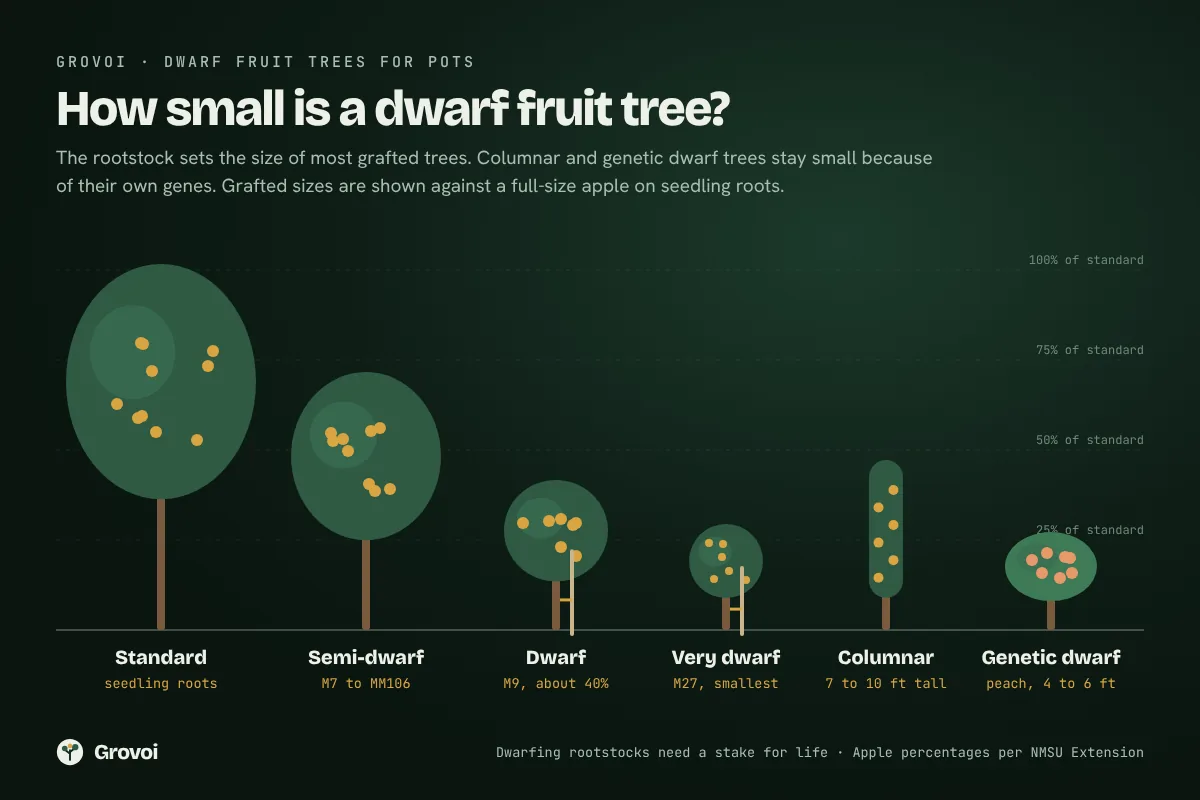
Most dwarf apples, pears and cherries are two plants joined together. The top part, called the scion, decides the fruit. The bottom part, the rootstock, decides how big the tree gets. A ‘Gala’ apple on a very dwarfing root may stay a small fraction of the size of the same ‘Gala’ on seedling roots.
Utah State notes that most trees on dwarfing roots need a strong stake or trellis wire for their whole life. The roots are small and often brittle, so a loaded tree can lean or snap at the graft.
Semi-Dwarf Trees
Semi-dwarf trees sit between dwarf and full size. On apple, New Mexico State University Extension puts M7 at about 60% of standard size and MM106 at about 70%. These trees are fine in the ground, but they soon outgrow most pots. For containers, look for “dwarf” or “very dwarf” on the label instead.
Genetic Dwarfs
A genetic dwarf is small because of its own genes, not its roots. These trees grow short, thick stems and pack their leaves close together. UConn Extension says dwarf peaches typically reach 4 to 6 feet, about half the height of a standard tree, yet still produce full-size fruit. Utah State adds that genetic dwarfs are sturdier and often do not need a stake.
Columnar Trees
Columnar apples grow as one upright stem lined with short fruiting spurs. University of Illinois Extension traces them to a natural mutation found on ‘McIntosh Wijcik’ and gives a mature size of 7 to 10 feet tall and 2 to 3 feet wide, depending on the variety. That narrow shape makes them a good fit for balconies and the corners of a patio.
Dwarfing Rootstocks For Container Trees
When you buy a grafted tree, the rootstock name is often printed on the tag. It tells you more about the final size than the variety name does. Here are the ones you are most likely to see.
Apple: M27, M9 And M26
M27 is the most dwarfing of the common apple rootstocks. The extension apple team (apples.extension.org) calls it very dwarfing, very early to bear and in need of permanent support. M9 is the best-known dwarfing stock; NMSU puts it at about 40% of standard size, with brittle wood that needs a stake. M26 gives about 50%.
Sources differ on which is best for a pot. Washington State University Extension recommends a true dwarf such as M27 for containers. The RHS suggests M9 or M26 for pots and says M27 is too dwarfing, because the weakest roots can struggle when they are also limited by a container. In practice, M27 suits a small pot and a patient grower, while M9 and M26 give a stronger tree in a large pot.
Cherry: Gisela 5
Gisela 5 is the standard dwarfing root for sweet cherries. Washington State gives it about 50% of the size of a cherry on Mazzard roots, calls it very precocious and says trees may need staking. Utah State says it keeps cherries under 10 feet. The RHS also lists Colt as a rootstock for cherries in pots.
Pear, Plum, Peach And Citrus
- Pear: Quince C, per the RHS.
- Plum, peach and nectarine: Pixy or St Julien A, per the RHS.
- Apricot: St Julien A or Torinel, per the RHS.
- Citrus: Mississippi State Extension notes that citrus on ‘Flying Dragon’ rootstock is strongly dwarfed, which extends its useful life in a container.
Figs, olives and blueberries are usually grown on their own roots, so they do not need a dwarfing rootstock at all.
15 Best Dwarf Fruit Trees For Pots
The list below mixes tender trees that can winter indoors with hardy trees that stay outside. Check the hardiness notes against your own winters before you buy.
1. Improved Meyer Lemon
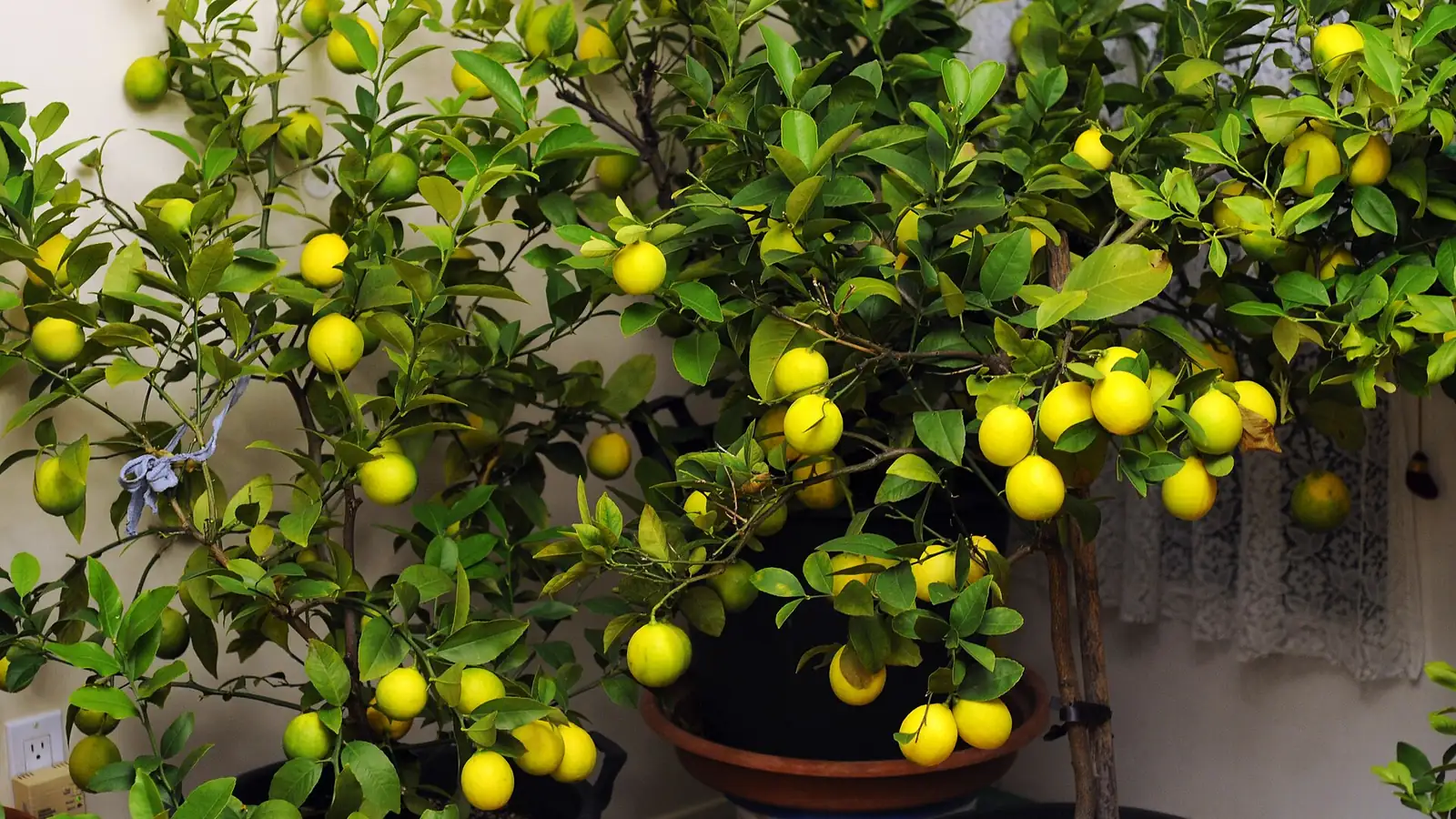
Improved Meyer lemon is the classic potted citrus. UF/IFAS describes it as a lemon and sweet orange cross brought from China in 1908, with fruit that is sweeter than a common lemon. It is self-pollinating, so one tree can fruit, and it bears mostly in fall and winter.
Mississippi State calls it the only lemon it recommends for containers and says plants from rooted cuttings do better than grafted ones. UF/IFAS adds a useful warning: a Meyer lemon grows well in a container but is unlikely to fruit if it stays indoors all year. Give it a summer outside in full sun. Our lemon tree guide covers harvest and ripening in more detail.
2. Calamondin
Calamondin (Citrus × microcarpa) is one of the easiest citrus to keep small. NC State Extension describes round fruit 1 to 1¾ inches across, with a thin, fragrant peel and sour pulp used for drinks and flavoring. Flowers and fruit often appear at the same time, which makes it highly ornamental.
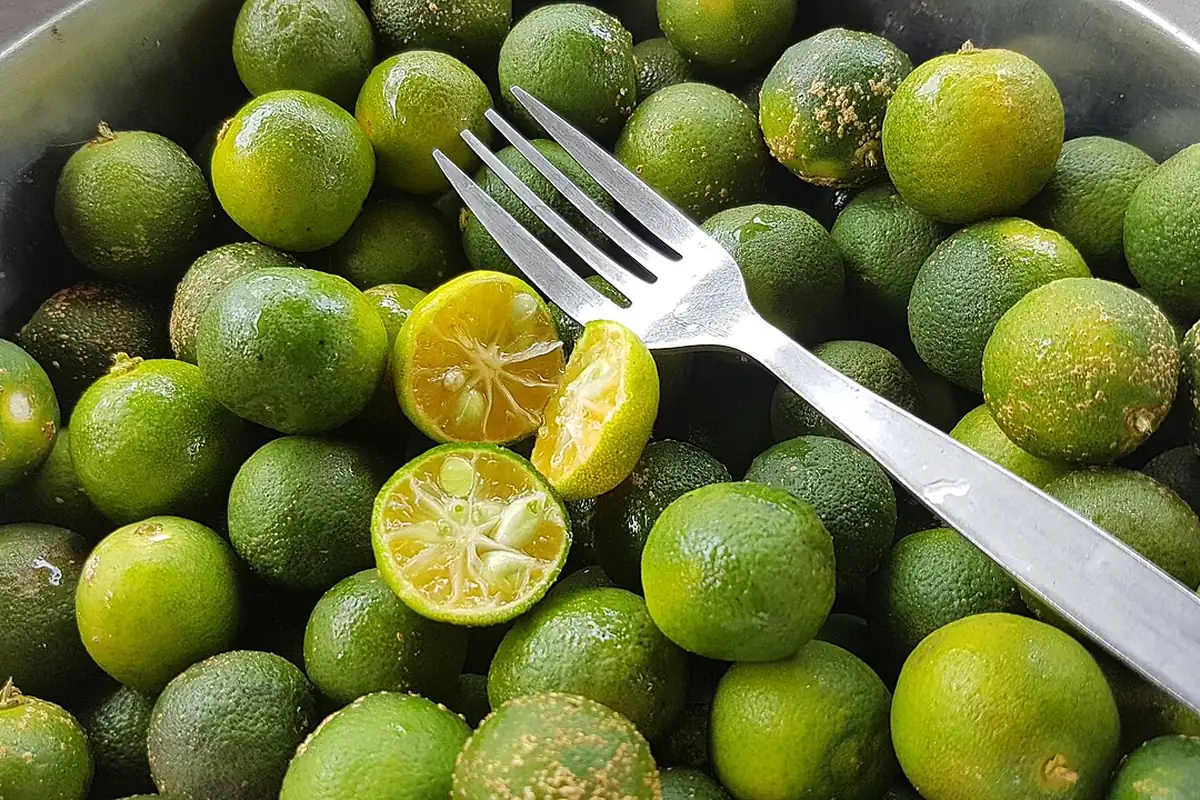
In the ground in warm climates it can reach 10 to 20 feet, so a pot keeps it far smaller. Mississippi State lists it among the more cold-hardy citrus. It still needs to come indoors in a freeze.
3. Kumquat (‘Nagami’ Or ‘Meiwa’)
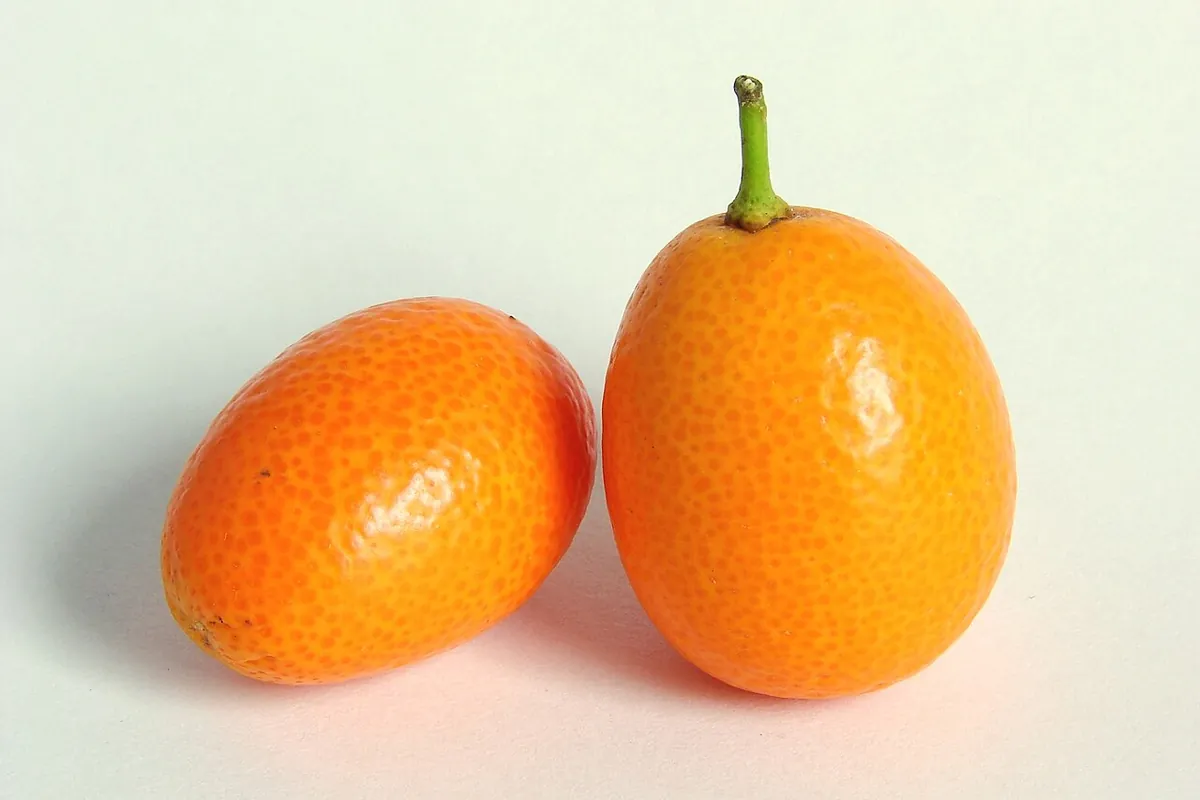
Kumquats are small trees with fruit you eat whole, sweet peel and all. A UF/IFAS county agent notes they grow well in large pots with drainage holes and can withstand temperatures in the low teens when semi-dormant. That makes them the toughest citrus on this list.
‘Nagami’ has oval, tart fruit with a few seeds. ‘Meiwa’ has rounder fruit with almost no seeds and is sweeter and juicier. Our kumquat tree guide has more on choosing between them.
4. Key Lime
Key lime is a small, bushy, thorny tree. UF/IFAS says it rarely tops 12 feet and suggests pruning it to 6 to 8 feet in home landscapes, so it adapts well to a pot. It does not need a second tree for pollen, and some fruit can ripen year-round.
It is also the most cold-tender tree here. UF/IFAS reports leaf damage at 30 to 32°F and wood damage below 29°F. Bring it inside well before the first frost.
5. Dwarf Apple On M27 Or M9
Almost any apple you like can be grown in a pot if it sits on a dwarfing root. Utah State mentions dwarf ‘Gala’ and dwarf ‘Golden Delicious’ as common examples. Choose M27 for the smallest tree and M9 or M26 for a sturdier one in a large pot.
Apples need a pollination partner, and every grafted dwarf needs a stake. Pick a variety suited to your chill hours and disease pressure, just as you would for a full-size apple tree. To compare apples with pears, stone fruits and citrus before you buy, see our guide to the main types of fruit trees.
6. Columnar Apple
Columnar apples, also sold as Ballerina, Urban Apple and Spire types, carry fruit on short spurs along a single trunk. Illinois Extension notes that Urban Apples are hardy to zone 4 and that a container apple needs a second variety for a full crop. Two columnar trees side by side solve that in very little space.
7. ‘Bonanza’ Genetic Dwarf Peach
‘Bonanza’ is the most common genetic dwarf peach, according to Utah State. The RHS describes it as a naturally dwarf peach well suited to containers, about 3 to 5 feet tall and wide. It is self-fertile and bears large, yellow-fleshed fruit in late summer.
It flowers early, so it needs frost protection in spring and cover from winter rain to reduce peach leaf curl. UConn notes that genetic dwarf peaches usually cannot overwinter outdoors in most areas and should move to an unheated garage or similar shelter. Other genetic dwarf peaches include ‘Pix Zee’, ‘Honey Babe’ and the red-leaved ‘Bonfire’. Our peach tree guide covers thinning and harvest.
8. ‘Nectar Babe’ Dwarf Nectarine
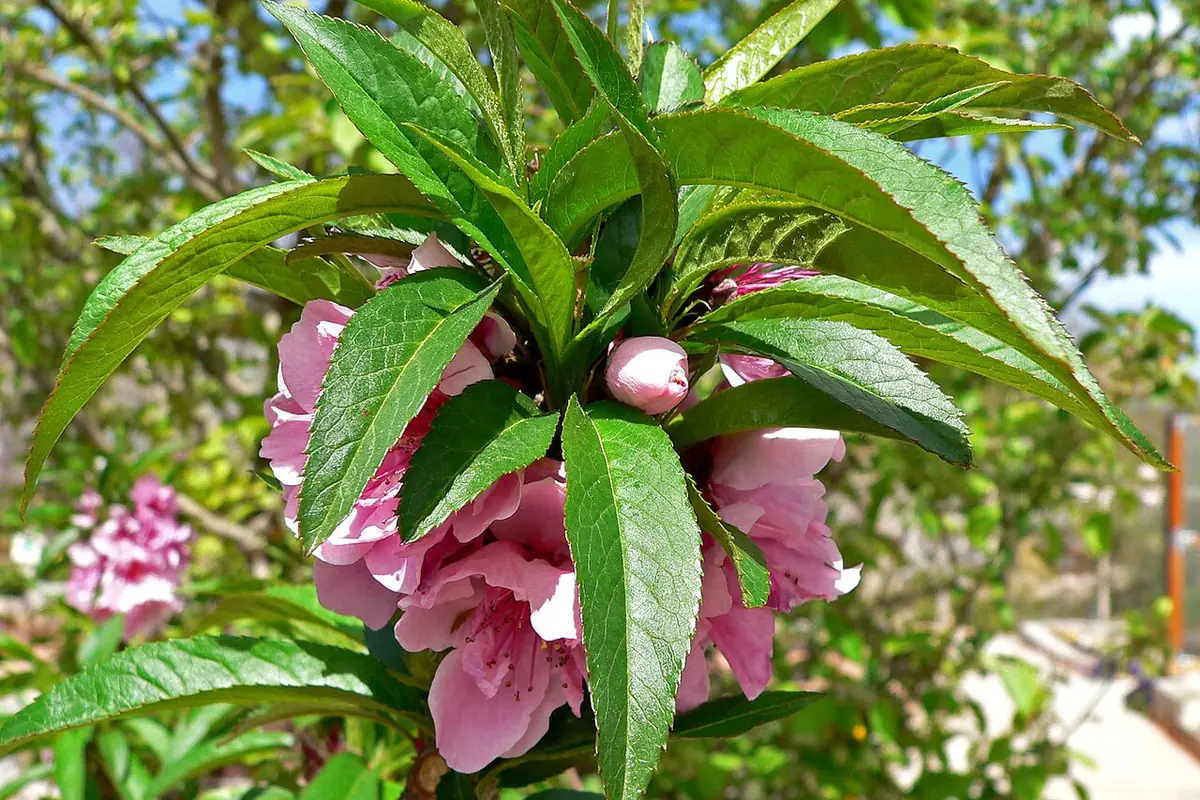
A nectarine is a peach with smooth skin, and several genetic dwarfs exist. Dave Wilson Nursery lists ‘Nectar Babe’ as a heavy-bearing 5 to 6 foot tree needing 400 or fewer chill hours. It is pollinized by ‘Honey Babe’ or another peach or nectarine, so plan for a second tree.
That makes ‘Nectar Babe’ and ‘Honey Babe’ a natural pair. Other dwarf nectarines named by extension sources include ‘Garden Delight’ and ‘Nectacrest’.
9. ‘Little Miss Figgy’ Fig
‘Little Miss Figgy’ is a compact fig bred for small spaces. The RHS lists it at about 5 to 8 feet tall and 3 to 5 feet wide and calls it an ideal variety for patio containers. It notes that root restriction actually helps figs, because it controls size and improves fruiting.
Figs do not need a pollinator. In cold regions, Iowa State Extension suggests growing figs in large containers and moving them to an unheated garage or cool basement for winter. Our fig tree guide explains how figs ripen.
10. Sweet Cherry On Gisela 5
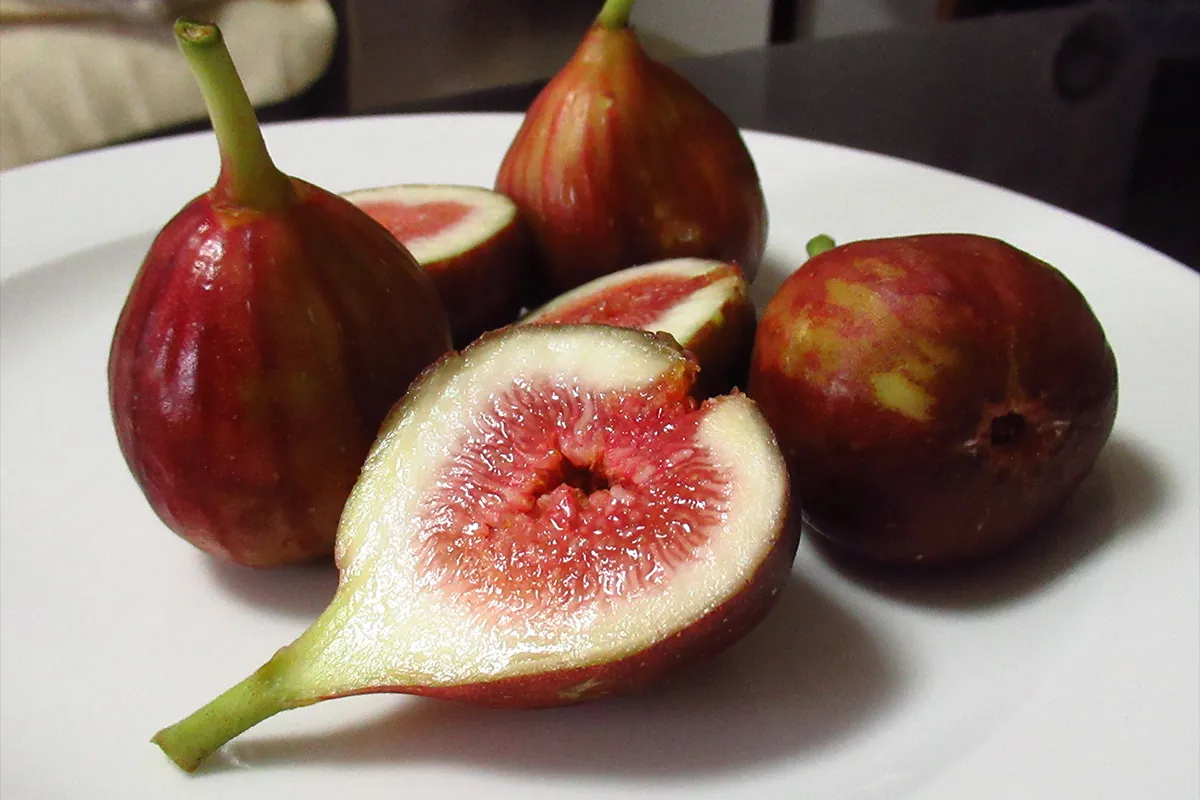
A self-fertile sweet cherry on Gisela 5 is the easiest cherry for a pot. The RHS names ‘Stella’, ‘Lapins’ and ‘Sunburst’ as self-fertile choices. Utah State says cherries on Gisela 5 usually stand on their own after 2 to 3 years, but a pot tree is safer with a stake.
If you prefer pie cherries, the Canadian dwarf sour cherries such as ‘Romeo’ and ‘Juliet’ are self-fruitful shrubs, according to North Dakota State University. Birds love cherries, so plan to net a potted tree when the fruit colors.
11. ‘Nana’ Dwarf Pomegranate
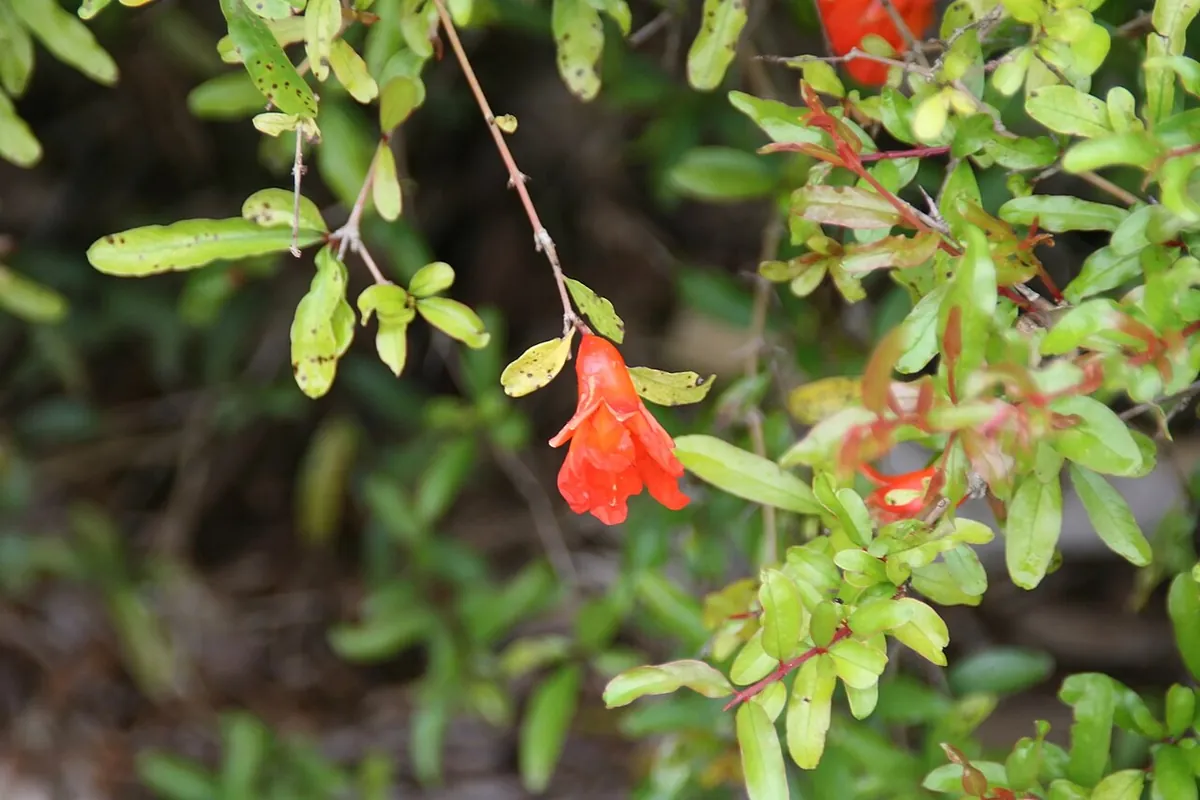
The dwarf pomegranate, Punica granatum ‘Nana’, stays tiny. NC State gives about 3 feet tall, and the RHS lists 0.5 to 1 meter each way. It has glossy leaves, bright orange-red flowers and round fruit with edible pulp, according to the RHS.
NC State says pomegranates in cooler areas may need a container that can come indoors for winter, and notes plants are killed to the ground below 10°F. For larger fruit, a standard pomegranate on a sunny patio is the better pick in warm zones.
12. ‘Arbequina’ Olive
Olives are slow, tough and handsome in a pot. The RHS says olives need no pollinator and are self-fertile and fairly hardy. ‘Arbequina’ is widely sold in small pots as a self-fertile variety. NC State notes olives need about 2 months in the 40 to 50°F range to flower, so a cool winter spot helps a potted tree fruit.
NC State also recommends a second variety to raise yields. Our olive tree guide covers growing them indoors and in pots.
13. ‘Dwarf Everbearing’ Mulberry
‘Dwarf Everbearing’ is a black mulberry (Morus nigra) selection. Dave Wilson Nursery lists it as self-fruitful and a great choice for container growing. It fruits over a long stretch from spring into early summer.
In the ground it can reach 10 to 20 feet, so regular light pruning is what keeps it pot-sized. The dark berries stain, so keep the pot away from pale paving.
14. Half-High Or Dwarf Blueberry
Blueberries are shrubs rather than trees, but they are among the most reliable fruit in a pot. Wisconsin Extension suggests half-high types such as ‘Northsky’, ‘Northblue’ and ‘Chippewa’, and the compact lowbush ‘Top Hat’. Illinois Extension adds ‘Jelly Bean’, a super-dwarf about 1 to 2 feet tall.
Most cultivars set fruit alone, but Wisconsin notes that planting more than one improves pollination, yield and berry size. Blueberries need an acidic mix with a pH of 4.5 to 5.0, which is easier to manage in a pot than in most garden soil. Our list of the best fruit bushes covers more shrub fruits, from raspberries to haskap.
15. ‘Wurtz’ Dwarf Avocado
‘Wurtz’, also sold as ‘Littlecado’ or ‘Minicado’, is described by UC Master Gardeners as the only true dwarf avocado. UC sources give it about 8 to 10 feet, with a weeping shape that suits small gardens or large containers. It is a Type A flowering avocado and handles lows down to about 25°F.
That makes it a tree for warm patios and large tubs, not a windowsill. Move it under cover well before a hard frost.
Dwarf Fruit Trees For Pots Compared
Use this table to narrow your choice. Heights are typical figures from the sources above; a pot and regular pruning usually keep trees smaller.
| Tree | Typical size | Needs a partner? | Winter care |
|---|---|---|---|
| Improved Meyer lemon | Small in a pot | No | Cover or bring in at 28°F or below |
| Calamondin | 10 to 20 ft in ground; small in a pot | Usually no, like most citrus | Cover or bring in at 28°F or below |
| Kumquat | Small tree | No | Low teens when semi-dormant; shelter in hard freezes |
| Key lime | Prune to 6 to 8 ft | No | Indoors before 32°F |
| Apple on M27 or M9 | Very small to small; staked | Yes, a second apple | Outdoors, roots sheltered |
| Columnar apple | 7 to 10 ft x 2 to 3 ft | Yes, a second apple | Outdoors, roots sheltered |
| ‘Bonanza’ peach | 3 to 5 ft | No | Unheated garage or shelter |
| ‘Nectar Babe’ nectarine | 5 to 6 ft | Yes, such as ‘Honey Babe’ | Unheated garage or shelter |
| ‘Little Miss Figgy’ fig | 5 to 8 ft | No | Garage or cool basement in cold zones |
| Cherry on Gisela 5 | Under 10 ft | Not for ‘Stella’, ‘Lapins’, ‘Sunburst’ | Outdoors, roots sheltered |
| ‘Nana’ pomegranate | About 3 ft | Check the plant label | Indoors in cold areas |
| ‘Arbequina’ olive | Slow; small in a pot | No, but two raise yields | Cool, bright spot; needs some chill to flower |
| ‘Dwarf Everbearing’ mulberry | Pruned to pot size | No | Outdoors, roots sheltered |
| Half-high blueberry | Compact shrub; ‘Jelly Bean’ 1 to 2 ft | Mostly no, but two improve yield | Bury or shelter the pot |
| ‘Wurtz’ avocado | 8 to 10 ft | No | Indoors or sheltered below about 25°F |
Pollination: Which Trees Need A Partner?
A tree in a pot may be the only one of its kind for blocks around. Before you buy, check whether it can set fruit with its own pollen.
Self-Fertile Trees
Citrus is the easy group. Rutgers Extension notes that most citrus sets fruit on a single plant, and UF/IFAS confirms that Meyer lemon and Key lime need no partner. Figs and olives need no pollinator, per the RHS. UConn says nearly all peaches and nectarines are self-fruitful too, and the RHS lists self-fertile cherries such as ‘Stella’.
Trees That Need A Second Variety
Apples are the main group that need a partner. Illinois Extension says container apples need a second variety for a full crop, and the RHS advises choosing two trees in the same or a neighboring pollination group so their flowers open together. Some genetic dwarfs, such as ‘Nectar Babe’, also need a partner.
Hand Pollinating Indoors
Indoors, bees cannot reach the flowers. The RHS suggests moving pollen from flower to flower with a soft brush, especially for peaches, nectarines and apricots that bloom under cover. Rutgers gives the same advice for citrus flowering indoors.
Pot Size And Material
The pot is the root system’s whole world. Too small, and the tree dries out daily and starves. Too large too soon, and the mix stays wet and roots rot. Move up in stages.
How Big A Pot?
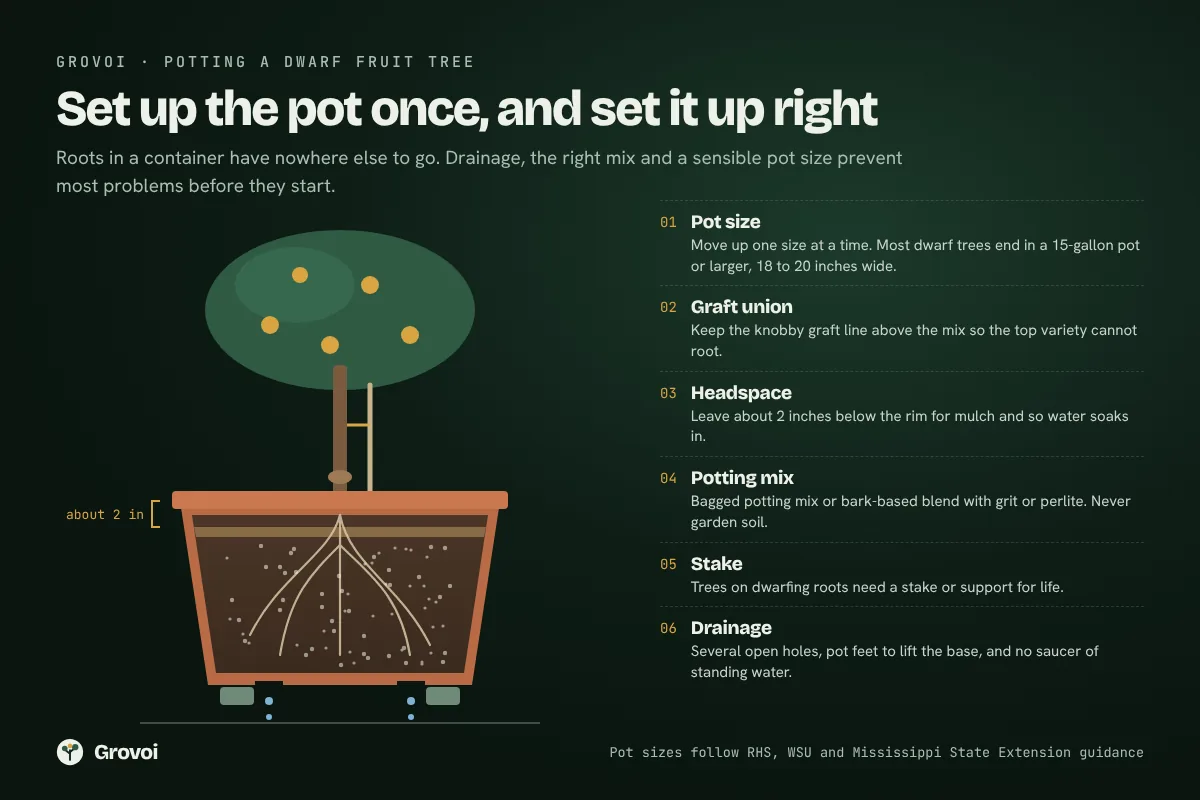
Most nursery fruit trees come in 2 to 3 gallon pots, Mississippi State notes. Move a young tree up one size at a time, every year or two. For the final pot, the RHS guide to fruit in containers recommends 18 to 20 inches across for most fruit. Washington State suggests a 15-gallon pot or a 24 by 36 inch box for a dwarf tree, and Mississippi State says citrus may eventually need about a 15-gallon container.
Blueberries can start smaller. Wisconsin Extension suggests a 5-gallon container for a young plant, moving to a 16 or 20 inch pot or a barrel as it matures.
Clay, Plastic, Glazed Or Wood?
- Clay and terracotta: heavy and stable in wind, the RHS notes, but small clay pots dry out fast.
- Plastic: light, durable and easy to move. Choose a pale color in hot climates, since dark pots absorb more heat.
- Glazed ceramic: Washington State calls it a better choice than small clay pots, which dry out fast.
- Wood: half barrels hold plenty of mix. Mississippi State advises rot-resistant or treated wood.
- Fiber: light, but Washington State notes fiber pots wear out quickly.
Drainage And Weight
Every pot needs drainage holes. Washington State advises against saucers, which trap water and promote root rot, and suggests raising the pot on bricks or pot feet instead. A 15 to 30 gallon pot of wet mix is very heavy, so check that your deck can take the load. A plant caddy with wheels makes moving a tree for winter much easier.
Potting Mix And Planting
What Mix To Use
Never fill a large pot with garden soil. Washington State says it is too heavy and may carry harmful organisms. Use a quality bagged potting mix made for containers or trees. Mississippi State gives a simple citrus recipe: 4 to 5 parts ground pine bark to 1 part sand, or 1 part peat in place of sand to hold more water. Rutgers suggests a citrus and cactus mix for citrus.
The RHS favors a soil-based compost for long-lived fruit trees, or a multipurpose mix with one third grit added by volume. Extra weight helps a tall tree stay upright on a windy day.
Acid Mix For Blueberries
Blueberries need their own mix. Wisconsin Extension suggests equal parts sphagnum peat moss and shredded pine bark, or 2 parts coir, 2 parts peat and 1 part perlite. Aim for a pH of 4.5 to 5.0 and use rainwater where you can, since hard, high-pH water pushes the pH up over time.
How To Plant
- Moisten the potting mix before you start.
- Add mix so the tree sits at the same depth it grew in the nursery pot, with the root flare at the surface.
- Keep the graft union, the knobby bend low on the trunk, well above the mix so the top variety cannot root.
- Tease out circling roots, fill around the root ball and firm gently.
- Leave about 2 inches below the rim for mulch and watering, as Washington State suggests.
- Drive in a stake for trees on dwarfing roots and tie it loosely.
- Water slowly until water runs from the drainage holes.
Spring is a good time to plant, the RHS notes, though container trees can go in at most times of year.
How To Water Fruit Trees In Pots
Watering is the biggest job with any potted fruit tree. A tree in the ground can chase water deep into the soil. A tree in a pot has only what you give it.
When To Water
Check the mix with your finger. Mississippi State suggests checking for moisture below the top 1 to 2 inches and watering once that layer is dry. The RHS says to water generously, then let the surface dry before the next watering, without letting the pot go bone dry. In hot, dry weather, Mississippi State notes, that can mean watering every day.
How To Water
Water slowly until water drains from the bottom, so the whole root ball gets wet. Mississippi State warns never to let the root ball dry out completely, since it can shrink from the pot and become hard to rewet. If that happens, stand the pot in a tub of water until the mix is wet through.
Why Steady Water Matters
The RHS links summer dryness in pots to fruit drop and brown leaf edges. During heat waves, Washington State suggests watering early in the morning and again in the evening. Drip lines, mulch on top of the mix and a little afternoon shade all help a potted tree through the hottest weeks.
Feeding Potted Fruit Trees
Frequent watering flushes nutrients out of the pot, so container trees need more regular feeding than trees in the ground. Feed from spring into summer, then stop by late summer so new growth can harden before winter.
Deciduous Fruit Trees
The RHS suggests either controlled-release fertilizer mixed into the compost, or a high-potassium liquid feed such as tomato fertilizer every two weeks. Washington State suggests a balanced liquid feed at half strength every two weeks, or slow-release granules at flowering and again when fruit forms.
Citrus
Mississippi State recommends a slow-release citrus fertilizer, such as 12-6-6 or 12-4-6, applied several times during the growing season. Choose one with iron, manganese and zinc, since citrus often runs short of these micronutrients. Our guide to fertilizer for fruit trees explains what those numbers mean.
Blueberries
Use an acid fertilizer for blueberries. Wisconsin Extension advises a light hand, because blueberry roots are sensitive to fertilizer salts. Always follow the label rate.
Pruning A Dwarf Tree In A Pot
Pruning keeps a potted tree in balance with its small root system. The RHS says to prune container fruit the same way you would prune the same tree in the ground.
At Planting
Washington State suggests removing about one third of the branches at planting to reduce demand on the young roots. Remove any shoots that rise from below the graft, too, since they come from the rootstock.
Each Year
- Apples, pears and cherries: prune in winter for shape and summer for size, keeping an open, balanced frame. Columnar apples need only side shoots shortened.
- Genetic dwarf peaches: the RHS says dwarf cultivars need little or no pruning. Just thin crowded shoots.
- Citrus: Rutgers suggests light pruning in fall when you move the tree indoors.
- Figs and mulberries: trim back long shoots in late winter to keep them compact.
Thin The Fruit
A small tree can set more fruit than its roots can support. Thin apples, pears and peaches after natural fruit drop so the branches do not snap and the remaining fruit sizes up. Remove any fruit that touches another, and leave a hand’s width between peaches.
Overwintering Potted Fruit Trees
Winter is where container trees differ most from trees in the ground. Iowa State Extension explains that the roots of most trees are less cold-hardy than their branches. In the ground, soil protects them. In a pot above ground, roots face the same cold as the air.
Hardy Deciduous Trees
Apples, pears, cherries, plums, mulberries and blueberries need winter cold to fruit, so leave them outside until they are dormant. Then protect the roots. Iowa State suggests either sinking the pots into a garden bed after the plants go dormant but before the soil freezes, or moving them somewhere that stays between 20 and 45°F.
An attached, unheated garage often works, but its temperature can swing. A cheap thermometer tells you for sure. Check stored pots now and then, and water lightly if the mix is dry. The Iowa State guide to overwintering container trees covers both methods.
Peaches, Nectarines And Figs
UConn says genetic dwarf peaches usually cannot stay outdoors over winter in most areas, so move them to an unheated garage or similar shelter. Iowa State gives the same advice for potted figs. The RHS adds that a rain cover from autumn to late winter reduces peach leaf curl on peaches and nectarines.
Citrus And Tropical Trees
Citrus, avocado and dwarf pomegranate come indoors for cold weather. Mississippi State advises covering potted citrus or moving it inside when the forecast calls for 28°F or below. Kumquat, calamondin and satsuma are the most cold-hardy, while lemon and lime are the most tender.
Indoors, citrus needs a lot of light. Mississippi State calls for 8 or more hours of direct sun or grow lights a day, and Rutgers suggests at least 6 hours from a south-facing window. Move the tree back out gradually in spring, after the last frost. Our citrus tree care guide covers indoor watering and leaf drop.
Repotting And Root Pruning
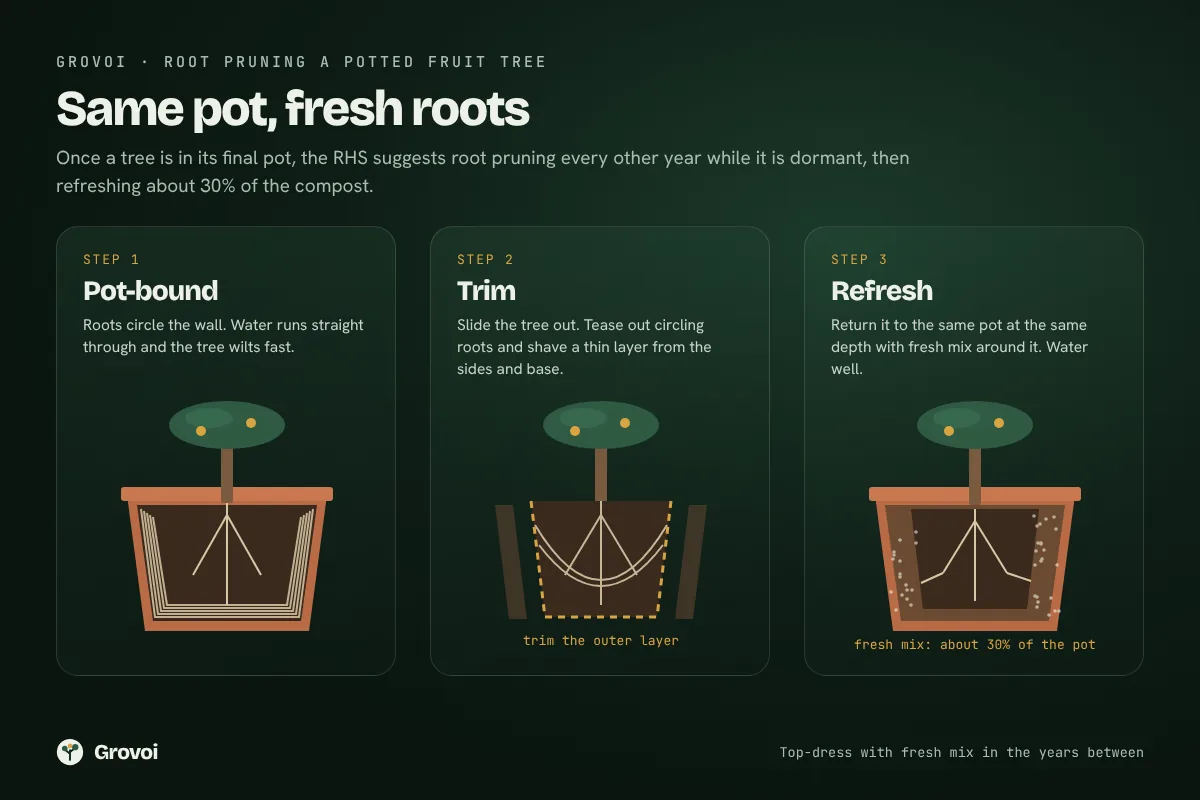
A potted tree slowly fills its pot with roots. Once that happens, water runs straight through, the tree wilts quickly and growth slows. You have two choices: move it up a size, or root prune it and return it to the same pot.
While The Tree Is Growing
The RHS advises repotting every year or every other year, after leaves fall, moving up one pot size each time. Mississippi State says citrus usually needs a larger pot within a year of purchase, then every 3 to 5 years depending on vigor.
Once It Reaches Its Final Pot
The RHS recommends root pruning every other year once a tree is in its final container. Do this while the tree is dormant:
- Water the day before, then slide the tree out of its pot.
- Tease out or cut away circling roots around the outside of the root ball.
- Shave a thin layer of roots from the sides and base with a clean saw or sharp knife.
- Replace about 30% of the old compost with fresh mix, as the RHS suggests.
- Return the tree to the same pot at the same depth and water it in well.
Top-Dressing In Between
In the years you do not root prune, the RHS suggests scraping off the top layer of old compost and replacing it with fresh mix. This renews nutrients near the surface without disturbing the roots.
Common Problems And Fixes
Most problems with fruit trees in pots trace back to water, cold or roots. Check the mix and the drainage holes before you treat anything else.
| Symptom | Most likely cause | What to do |
|---|---|---|
| Leaves wilt by afternoon, mix dry | Underwatering or a pot-bound tree | Water more often; repot or root prune when dormant |
| Yellow leaves, mix stays wet | Poor drainage or a saucer of water | Clear holes; raise the pot; remove the saucer |
| Yellow leaves with green veins on citrus | Iron, zinc or manganese shortage | Use a citrus fertilizer with micronutrients |
| Fruit drops in summer | Dry spells or too much fruit | Water steadily; thin fruit early |
| Brown, crisp leaf edges | Drought stress, heat or salts | Water deeply; flush the pot; shade it in heat waves |
| Puckered, red-blistered peach leaves | Peach leaf curl | Cover from rain in late fall to late winter |
| Citrus drops leaves indoors | Low light or a sudden move | Brightest window or grow light; move gradually |
| Sticky leaves, small bumps | Scale or aphids | Horticultural oil or insecticidal soap |
| Fine speckling and webbing | Spider mites | Rinse leaves; treat with insecticidal soap |
| Dead branches after winter | Root or bark cold injury | Shelter roots next winter; prune dead wood |
Pests
Rutgers lists scale, aphids and mites as year-round pests of container citrus, especially indoors. It suggests horticultural oil such as neem oil, or insecticidal soap, used as the label directs. Check leaf undersides each time you water.
Diseases
The RHS lists apple scab, apple canker, bacterial canker, brown rot, peach leaf curl and silver leaf among the diseases of container fruit. Good airflow, clean pruning cuts and removing fallen leaves and fruit all help. Choosing disease-resistant varieties helps most of all.
Poor Fruiting
If a healthy tree flowers but sets no fruit, check pollination first. Is there a partner variety nearby, and did bees reach the flowers? Indoors, hand pollinate with a soft brush. A tree that never flowers may need more sun, more winter chill or simply another year to mature.
Dwarf Fruit Trees For Pots FAQs
What Is The Best Dwarf Fruit Tree For A Pot?
For most beginners, an Improved Meyer lemon or a kumquat is the easiest choice. Both are self-pollinating, stay small in a container and can spend winter indoors. In colder areas with room outside, a genetic dwarf peach such as ‘Bonanza’ or a ‘Little Miss Figgy’ fig is also a reliable pick.
How Big Of A Pot Does A Dwarf Fruit Tree Need?
Start with a pot slightly larger than the nursery container, then move up one size every year or two. Most dwarf trees end in a pot about 18 to 20 inches wide, or a 15-gallon container or larger. Every pot needs drainage holes, and a pot that is far too big stays wet and invites root rot.
Can Dwarf Fruit Trees Stay In Pots Permanently?
Yes, as long as you keep the roots in check. Once a tree reaches its final pot, root prune it every other year while it is dormant and replace about 30% of the mix, as the RHS suggests. In the years between, scrape off the top layer of old mix and add fresh.
Do I Need Two Dwarf Fruit Trees To Get Fruit?
It depends on the tree. Citrus, figs, olives, most peaches and nectarines, and cherries such as ‘Stella’ can fruit alone. Apples need a second apple variety that flowers at the same time. Some genetic dwarfs, such as ‘Nectar Babe’ nectarine, also need a partner such as ‘Honey Babe’.
Can You Grow Dwarf Fruit Trees Indoors?
Citrus, dwarf pomegranate and olives can live indoors for winter, but they fruit best with a summer outside in full sun. UF/IFAS notes a Meyer lemon is unlikely to fruit if it stays indoors all year. Apples, cherries and peaches need winter cold, so keep them outdoors or in a cool shelter.
How Do You Protect Potted Fruit Trees In Winter?
Roots in a pot are less hardy than the branches. For hardy trees, sink the pot into a garden bed or move it somewhere that stays between 20 and 45°F, such as an unheated garage. Bring citrus and other tender trees indoors when the forecast drops to 28°F or below.
How Often Should You Water Fruit Trees In Pots?
Water whenever the top 1 to 2 inches of mix feel dry, and keep going until water drains from the bottom. In hot, dry weather that can mean every day. In cool weather it may be once a week or less. Never let the pot dry out completely or sit in a saucer of water.
Pingback: Areca Palm Care: Light, Water, Feeding And Brown Tips
Pingback: Pygmy Date Palm: How To Grow And Care For It In Pots Or Landscapes - Grovoi
Pingback: Banana Tree: How To Grow Bananas Outdoors Or In Containers - Grovoi
Pingback: Types Of Fruit Trees: 30 Fruit Trees To Grow In Your Yard - Grovoi
Pingback: Fruit Bushes: 15 Best Fruit Bushes To Grow At Home - Grovoi